Sky science
Altitude and Azimuth
Direct answer
Altitude and Azimuth are local sky coordinates: altitude measures angle above the horizon, while azimuth gives compass direction around the horizon.
Altitude and Azimuth locate an object by height above the horizon and compass bearing.
$0 today, then $12/month after 7 days. Cancel anytime.
At a glance
- Found in
- Astronomy & Skywatching
- Related
- Astronomy, Skywatching, Celestial Sphere, Ecliptic
Altitude and Azimuth locate an object by height above the horizon and compass bearing.
A scientific orientation to scale, light, or motion; the article supplies the precise definition.
What does your own chart say about you?
Choose love, work or purpose. Your reading is written from your chart. Your reading uses your own birth details.
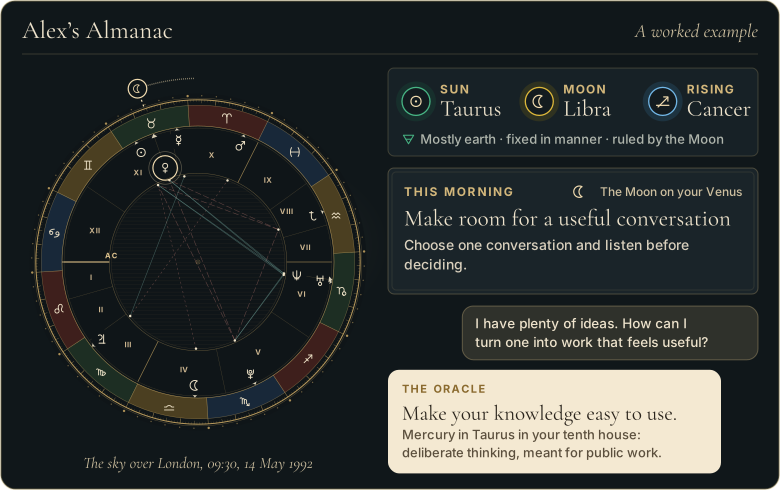
Walk through Alex’s whole example first
 The Road of AgesSee the turning points of your whole life, from your birth date
See your road's shape
The Road of AgesSee the turning points of your whole life, from your birth date
See your road's shape
Prefer to explore first?
 The Road of AgesThe turning points of your whole life, from your own chart
Walk my road
The Road of AgesThe turning points of your whole life, from your own chart
Walk my road
Free, by email
Your daily Almanac letter
One short letter at 7 each morning: the day’s theme read for your own chart, and one thing to do with it.
The story behind Altitude and Azimuth
Horizontal coordinates have long served practical observation, navigation, surveying, and instrument alignment.
A one-minute story
The Wandering Stars
How the moving planets were watched, named and found, and what a transit is.

Why Altitude and Azimuth matters
These coordinates translate a catalogue position into an instruction an observer can use. They change with time and location as Earth rotates.
How to read Altitude and Azimuth
Altitude and Azimuth speaks to live observing directions, always attaching the location and timestamp used for the calculation.
Altitude and Azimuth in practice: an example
An altitude of 30 degrees and azimuth of 180 degrees places an object about one-third of the way up the southern sky under the common north-through-east convention.
Where readings of Altitude and Azimuth go wrong
State the azimuth convention and do not reuse coordinates calculated for a different place or time.
Sources and editorial method
Research references used for this entry include:
- U.S. Naval Observatory: Astronomical Information Center - Official index for time, calendars, seasons, coordinates, and observable sky phenomena.
- NASA Science: Skywatching FAQ - NASA guidance on observing stars, planets, constellations, and the changing night sky.
- Source
- The Great Almanac Dictionary
- Category
- Astronomy & Skywatching
- Last updated
- 2026-09-26
Locate an object from your horizon
A definition tells you what it is; your own birth chart tells you what it means for you. The Oracle casts your real chart and answers for your love, your work, and your year ahead, in conversation. It opens with the 7-day Seeker trial.
Speak with the OracleRelated terms
More in Astronomy & Skywatching
- Atmospheric Extinction
- Dark Nebula
- Geometric Albedo
- Light-Time Correction
- Orbital Inclination
- Protostar
- Skyglow
- Superior Conjunction
From the reference page to your own chart
Every word here
is in your own chart.
- A personal reading about love, work or purpose, written from your chart
- A practical next step to consider
- It opens with 7 days free, with the AI Oracle and daily guidance
$0 today, then $12/month after 7 days. Cancel anytime.
Common questions
What is Altitude and Azimuth?
Altitude and Azimuth are local sky coordinates: altitude measures angle above the horizon, while azimuth gives compass direction around the horizon.
What do people get wrong about Altitude and Azimuth?
State the azimuth convention and do not reuse coordinates calculated for a different place or time.
Free, by email
The Almanac, in your inbox at 7
One short letter at 7 each morning: the day’s theme read for your own chart, and one thing to do with it.