
Mystical systems
Gnosticism
Direct answer
Gnosticism is a broad label for ancient religious movements that emphasized saving knowledge, divine spark themes, complex cosmologies, and often a sharp contrast between spirit and material world.
Gnosticism names ancient movements centered on saving knowledge and cosmic estrangement themes.
$0 today, then $12/month after 7 days. Cancel anytime.
At a glance
- Found in
- Mystical Systems
- Related
- Birth Chart, Zodiac, Transit
Gnosticism names ancient movements centered on saving knowledge and cosmic estrangement themes.
A lineage map for books and systems; it avoids presenting symbolic traditions as literal fact.
What does your own chart say about you?
Choose love, work or purpose. Your reading is written from your chart. Your reading uses your own birth details.
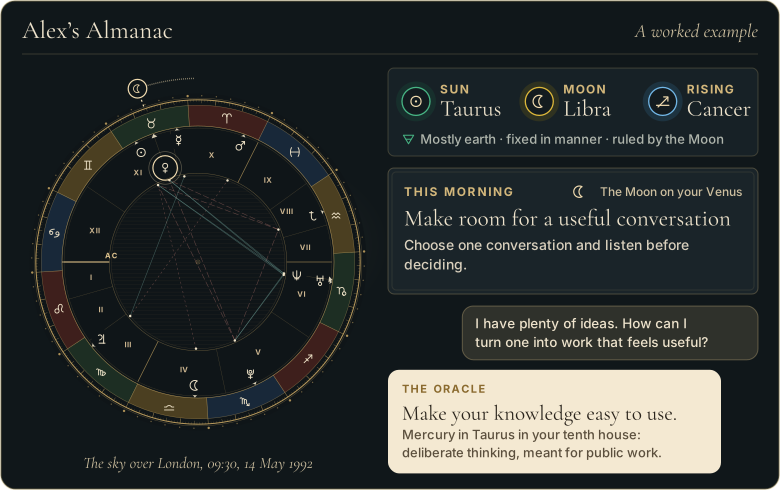
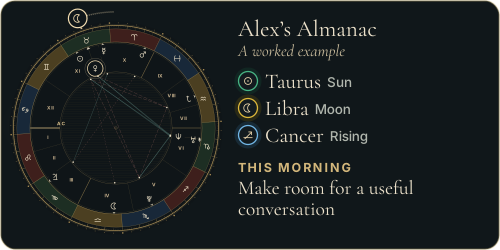
Walk through Alex’s whole example first
 The Road of AgesSee the turning points of your whole life, from your birth date
See your road's shape
The Road of AgesSee the turning points of your whole life, from your birth date
See your road's shape
Prefer to explore first?
 The Road of AgesThe turning points of your whole life, from your own chart
Walk my road
The Road of AgesThe turning points of your whole life, from your own chart
Walk my road
Free, by email
Your daily Almanac letter
One short letter at 7 each morning: the day’s theme read for your own chart, and one thing to do with it.
What sets Gnosticism apart
'Gnostic' comes from the Greek gnosis, knowledge, and in the ancient sources it names a family of groups, not one church. The shared pattern in many of them: the world was made by a lesser craftsman figure (the demiurge) rather than the highest God, and rescue comes through knowledge revealed by a saviour. Scholars now debate whether 'Gnosticism' is one category at all, since the ancient groups mostly did not use the label for themselves.
- Word: Greek gnosis, 'knowledge'; demiurge from dēmiourgos, 'craftsman', a word used in Plato's Timaeus
- Discovery: Nag Hammadi, Egypt, 1945: 13 papyrus codices of about 50 texts, in Coptic
- Hostile witness: Irenaeus of Lyon, Against Heresies, about 180 CE, describes and refutes several schools
- Named teachers: Valentinus, Basilides and the Sethian texts such as the Apocryphon of John
- Scholarly dispute: Michael Williams, Rethinking Gnosticism (1996), argues the category is too broad to hold together
Often mistaken for something else: Gnostic in its narrow sense is an ancient label for particular groups; the modern idea that matter is evil fits only some of them.
The story behind Gnosticism
Gnostic texts and movements flourished in late antiquity and became better known after discoveries such as the Nag Hammadi library.
The spiritual meaning of Gnosticism
Spiritually, Gnosticism asks whether knowledge is becoming healing truth or elitist escape from embodied life.
Gnosticism in the Bible
Christian readers should recognize that historic Christianity rejected many Gnostic claims about creation, Christ, salvation, and secret knowledge.
Why Gnosticism matters
Gnosticism matters because the term is often used too loosely. Historically, it refers to diverse ancient groups and texts, not one simple church or one modern idea that matter is bad.
Where readings of Gnosticism go wrong
It is a mistake to use Gnosticism as a catch-all insult for anything mystical or as proof that Christianity was secretly something else.
A lecture on this, free to read

Sources and editorial method
This entry summarizes the tradition in the Almanac's own words; where no source is listed, it is an editorial summary rather than a primary text, and symbolic readings are named as the tradition's, not as fact.
- Source
- The Great Almanac Dictionary
- Category
- Mystical Systems
- Last updated
- 2026-09-26
Study hidden knowledge historically
A definition tells you what it is; your own birth chart tells you what it means for you. The Oracle casts your real chart and answers for your love, your work, and your year ahead, in conversation. It opens with the 7-day Seeker trial.
Speak with the OracleYour year, written once from your chart alone: the Cosmic Codex reads the whole of it, month by month. Open the Cosmic Codex
Related terms
More in Mystical Systems
From the reference page to your own chart
Every word here
is in your own chart.
- A personal reading about love, work or purpose, written from your chart
- A practical next step to consider
- It opens with 7 days free, with the AI Oracle and daily guidance
$0 today, then $12/month after 7 days. Cancel anytime.
Common questions
What is Gnosticism?
Gnosticism is a broad label for ancient religious movements that emphasized saving knowledge, divine spark themes, complex cosmologies, and often a sharp contrast between spirit and material world.
Where does Gnosticism come from?
Gnostic texts and movements flourished in late antiquity and became better known after discoveries such as the Nag Hammadi library.
What does Gnosticism mean spiritually?
Spiritually, Gnosticism asks whether knowledge is becoming healing truth or elitist escape from embodied life.
What do people get wrong about Gnosticism?
It is a mistake to use Gnosticism as a catch-all insult for anything mystical or as proof that Christianity was secretly something else.
Free, by email
The Almanac, in your inbox at 7
One short letter at 7 each morning: the day’s theme read for your own chart, and one thing to do with it.