
Seasons and sky
Civil Dusk
Direct answer
Civil Dusk is the evening instant when the Sun center descends to 6 degrees below the horizon.
Civil Dusk ends evening civil twilight at a -6-degree solar altitude.
$0 today, then $12/month after 7 days. Cancel anytime.
At a glance
- Found in
- Seasons & Earth Almanac
- Related
- Civil Dawn, Nautical Dawn, Astronomical Season, Equinox
Civil Dusk ends evening civil twilight at a -6-degree solar altitude.
A Sun-Earth orientation for seasonal, atmospheric, tidal, and terrestrial terms.
What does your own chart say about you?
Choose love, work or purpose. Your reading is written from your chart. Your reading uses your own birth details.
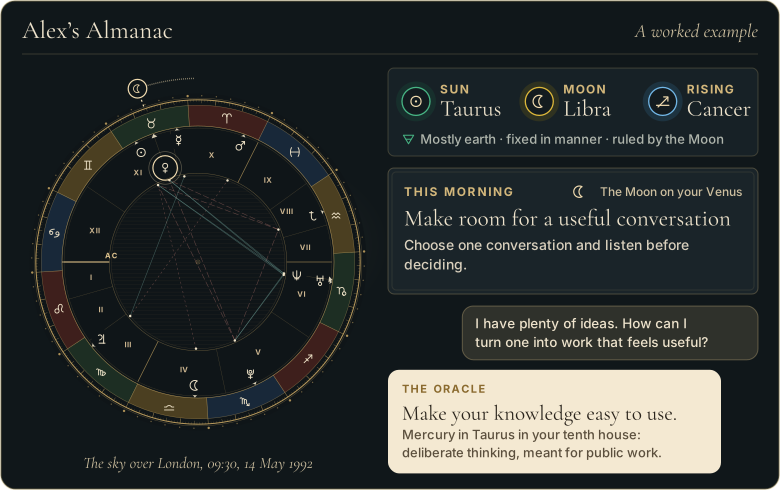
Walk through Alex’s whole example first
 The Road of AgesSee the turning points of your whole life, from your birth date
See your road's shape
The Road of AgesSee the turning points of your whole life, from your birth date
See your road's shape
Prefer to explore first?
 The Road of AgesThe turning points of your whole life, from your own chart
Walk my road
The Road of AgesThe turning points of your whole life, from your own chart
Walk my road
Free, by email
Your daily Almanac letter
One short letter at 7 each morning: the day’s theme read for your own chart, and one thing to do with it.
The story behind Civil Dusk
Legal and navigation practices adopted standardized twilight angles as precise almanac prediction became routine.
Why Civil Dusk matters
Civil Dusk supplies a consistent post-sunset reference for lighting, work, and public schedules.
How to read Civil Dusk
Civil Dusk applies when an operation defines darkness from the end of civil twilight.
Civil Dusk in practice: an example
Street-light or park schedules may reference Civil Dusk rather than sunset itself.
Where readings of Civil Dusk go wrong
Check the governing local definition; regulations may use fixed clock rules or a different twilight standard.
Sources and editorial method
Research references used for this entry include:
- U.S. Naval Observatory: Rise, Set, and Twilight Definitions - Official definitions used for sunrise, sunset, refraction, and twilight calculations.
- NOAA Global Monitoring Laboratory: Solar Calculator Glossary - NOAA definitions for solar geometry, atmospheric refraction, and civil, nautical, and astronomical twilight.
- Source
- The Great Almanac Dictionary
- Category
- Seasons & Earth Almanac
- Last updated
- 2026-09-26
Find the practical-light endpoint
A definition tells you what it is; your own birth chart tells you what it means for you. The Oracle casts your real chart and answers for your love, your work, and your year ahead, in conversation. It opens with the 7-day Seeker trial.
Speak with the OracleRelated terms
More in Seasons & Earth Almanac
- Diurnal Tide
- Glory
- March Equinox
- Nautical Twilight
- Season Length Asymmetry
- Tidal Datum
- Astronomical Dusk
From the reference page to your own chart
Every word here
is in your own chart.
- A personal reading about love, work or purpose, written from your chart
- A practical next step to consider
- It opens with 7 days free, with the AI Oracle and daily guidance
$0 today, then $12/month after 7 days. Cancel anytime.
Common questions
What is Civil Dusk?
Civil Dusk is the evening instant when the Sun center descends to 6 degrees below the horizon.
What do people get wrong about Civil Dusk?
Check the governing local definition; regulations may use fixed clock rules or a different twilight standard.
Free, by email
The Almanac, in your inbox at 7
One short letter at 7 each morning: the day’s theme read for your own chart, and one thing to do with it.