The Twelves in the BibleEvery Occurrence, and the Zodiac Reading
Twelve recurs across the Hebrew Bible and the New Testament with a persistence that is hard to read as accident: twelve sons, twelve tribes, twelve stones, twelve loaves, twelve oxen, twelve spies, twelve apostles, twelve gates. Two first-century Jewish writers, Philo and Josephus, already read some of those twelves as the twelve signs of the zodiac.
Direct answer
Short version
Twelve appears dozens of times in Scripture in structurally important places, and the reading of some of those twelves as the zodiac is not a modern invention: Josephus, writing in the first century, says the twelve stones on the high priest’s breastpiece stand for the twelve months or the twelve signs of the circle the Greeks call the zodiac. Whether every twelve in Scripture is astronomical is a separate question, and the answer is almost certainly no.
The Instruments
Ten readings, worked out from your own birth chart
An instrument is a reading this house works out for you. Give your birth date, time and place once, and each one reads today’s real sky against the chart you were born under. Eight are personal; two are calendars anyone can open. A free account opens one instrument a day. The plans open every instrument, every day.
- Natal Chart Every planet, house and aspect in your chart
- Active Transits Where the planets are now, read against your chart
- Daily Counsel What to pursue today, and what to leave alone
- Personal Timing Your best days to decide, weeks ahead
- Fellowship Your chart and another, read side by side
- Theme of the Day The one thing today is asking of you
- Sacred Numbers Your life path, your cycles, your name in numbers
- Aeolian Harmonics Classical music chosen to match your chart
- Mercury Retrograde Every Mercury retrograde this year, with its dates Open to all
- Void-of-Course Moon When the Moon is between signs, hour by hour Open to all

Quick facts
| The twelve | Where it stands |
|---|---|
| Twelve sons of Jacob | Genesis 35:22 to 26, the ancestors of the tribes |
| Twelve sons of Ishmael | Genesis 25:13 to 16, twelve princes of twelve nations |
| Twelve tribes of Israel | Throughout, from Genesis 49 onward |
| Twelve pillars at Sinai | Exodus 24:4, one for each tribe |
| Twelve stones on the breastpiece | Exodus 28:17 to 21, worn over the ephod by the high priest |
| Twelve loaves of the Presence | Leviticus 24:5 to 6, set in two rows on the pure table |
| Twelve spies | Numbers 13:1 to 16, one from each tribe |
| Twelve stones from the Jordan | Joshua 4:1 to 9 |
| Twelve bronze oxen under the sea | 1 Kings 7:23 to 25, three facing each of the four directions |
| Twelve apostles | Matthew 10:1 to 4; Mark 3:13 to 19; Luke 6:12 to 16 |
| Twelve baskets of fragments | Matthew 14:20, after the feeding of the five thousand |
| Twelve legions of angels | Matthew 26:53 |
| Twelve gates, angels, foundations, pearls | Revelation 21:12 to 21 |
| Twelve fruits of the tree of life | Revelation 22:2, one yield for each month |
| One hundred and forty-four thousand | Revelation 7:4, twelve thousand from each of twelve tribes |
What actually repeats, and where
The first thing to establish is the plain textual fact, because the interpretive argument depends on it and is often made without it. Twelve is not scattered through Scripture the way a common number would be. It sits at the joints: at the founding of a people, at the furnishing of a sanctuary, at the choosing of a company, and at the architecture of the final vision. The table above gives the references so that each one can be opened and counted rather than taken on anyone’s word.
A few of these deserve their exact wording. The twelve stones engraved with the names of the sons of Israel are set in the breastpiece of judgment, which is worn over the ephod, rather than on the ephod itself; the ephod’s own shoulder pieces carry two onyx stones with six names each, which is another twelve arranged differently. The twelve loaves are the bread of the Presence, set out on the pure table each sabbath. The twelve oxen stand under the molten sea in Solomon’s temple, in four groups of three facing the four quarters of the horizon, which is a detail worth holding onto.
In Revelation the twelves multiply rather than repeat: twelve gates with twelve angels and the names of the twelve tribes, twelve foundations with the names of twelve apostles, twelve pearls, a wall measured at a hundred and forty-four cubits, and a city sealed with twelve thousand from each of twelve tribes. The number is being used deliberately and structurally by a writer who expects it to be recognized.
The first-century reading: Philo and Josephus
The claim that these twelves are astronomical is usually presented as a modern rediscovery. It is not. Two Jewish writers of the first century, writing for readers who knew the sanctuary, say it outright.
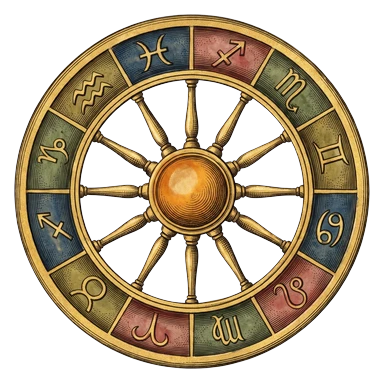
Josephus, describing the high priest’s vestments in Antiquities of the Jews, writes that the twelve stones signify either the twelve months or the twelve signs of that circle which the Greeks call the zodiac. In the same passage he reads the seven lamps of the lampstand as the seven planets, the twelve loaves as the circle of the zodiac and the year, and the four materials of the tabernacle as the four elements. He is not arguing for a hidden meaning against opposition; he is explaining to a Greek-speaking audience what he takes the furniture to have always meant.
Philo of Alexandria, his older contemporary, reads the same furnishings the same way in On the Life of Moses. For Philo the sanctuary is a model of the cosmos, and its numbers are the numbers of the visible heaven. Both men are inside the tradition rather than attacking it, and both are writing while the Second Temple still stands.
This matters for how the question should be framed. Somebody who says the twelve stones were understood by first-century Jews as the zodiac is reporting what two first-century Jews wrote. That is a citation, not a theory.
The plainer reading, which is also in the text
A zodiacal reading does not displace the obvious one, and the obvious one is stated by Scripture itself. The twelve stones are engraved with the names of the sons of Israel, and the text says so: they are the tribes, carried on the high priest’s heart when he goes in before God. The twelve pillars at Sinai are built for the twelve tribes. The twelve spies are one per tribe. The twelve baskets, twelve gates and twelve foundations all sit inside a symbolic vocabulary already established by the tribes.
There is also a calendrical reading that requires no astrology at all: twelve is the number of lunar months in a year, which is why twelve organizes anything meant to stand for a complete cycle. Josephus gives the months as his first option and the zodiac as his second, in that order.
These readings are not rivals so much as layers, and a reader is entitled to hold more than one. Twelve tribes, twelve months and twelve signs were not separate ideas in the ancient world; a people organized in twelve and a year divided in twelve were understood to share a pattern. The interesting question is not which single meaning is correct but why the pattern was thought worth repeating at every structural joint.
Where the popular version overreaches
Lists of biblical twelves circulate online with items that do not survive being looked up, and an argument is weakened rather than helped by them. Three examples come up repeatedly.
Revelation 3:12 is often quoted as twelve pillars in the temple of God. It says nothing of the kind: the promise is that the one who overcomes will be made a pillar, singular, in the temple of God. The twelve pillars are real but they are in Exodus 24:4, at Sinai. Revelation 22:2 is often given as twelve trees whose leaves give life. The text has one tree of life, bearing twelve manner of fruits, yielding its fruit every month, whose leaves are for the healing of the nations. The twelve is in the fruit, not in the trees, and the monthly yield is the detail that actually supports a calendrical reading.
The high priest’s stones are frequently placed on the ephod when they are set in the breastpiece worn over it, and the bronze oxen under the molten sea are sometimes called copper and the sea is sometimes given a name borrowed from a much later Christian vocabulary. None of this is fatal to the larger argument, but precision costs nothing and imprecision is what gives a reader an excuse to dismiss the whole case.
How to check a claimed twelve
- Open the reference before accepting it. A claim with no chapter and verse attached is a claim that has not been checked by whoever repeated it.
- Count what the text counts. Twelve fruits on one tree is not twelve trees, and one pillar is not twelve pillars.
- Ask whether the twelve is stated or inferred. The twelve stones are named as the tribes in the text; a zodiacal meaning is read into them by an interpreter, however early.
- Separate the date of the reading from the date of the text. Josephus is first century, which is early and important; he is still later than most of what he is interpreting.
- Notice when a number is doing structural work. Twelve at the founding of a people and twelve at the architecture of a final city is a deliberate echo, whatever else it also means.
- Hold the layers apart. Tribes, months and signs can all be true of one image without any of them being the single hidden key.
Sources and editorial method
Research and editorial references used for this page include:
- Josephus, Antiquities of the Jews 3.179 to 3.187 - The first-century historian states directly that the seven lamps signify the planets and that the twelve stones signify either the twelve months or the twelve signs of the circle the Greeks call the zodiac.
- Philo of Alexandria, On the Life of Moses II, sections 98 to 126 - A contemporary of Josephus reading the tabernacle furnishings the same way: the lamps as the planets, the twelve stones as the zodiac, the loaves as the year.
- Exodus 28:17 to 21, the twelve stones of the breastpiece - The stones are set in the breastpiece and engraved with the names of the twelve tribes.
- Leviticus 24:5 to 6, the twelve loaves - Twelve cakes set in two rows on the pure table before the Lord.
- 1 Kings 7:23 to 25, the molten sea on twelve oxen - Three oxen facing each of the four directions, carrying the sea.
- Revelation 21:12 to 21 and 22:2 - The twelvefold architecture of the city, and the one tree bearing twelve manner of fruits.
- Exodus 24:4, the twelve pillars - Where the twelve pillars actually stand, against the common misattribution to Revelation 3:12.
Scripture is cited by book, chapter and verse so any translation can be checked. Josephus and Philo are cited by the standard section numbers used in every edition, so the passage can be found even if a link moves. Where a claim rests on a Hebrew or Greek word, the lexicon entry is named. Interpretive traditions are identified as traditions, and the difference between what a text says and what a school reads into it is kept visible throughout.
Related reading
Common questions
How many twelves are there in the Bible?
Nobody has an agreed count, and figures like eighty are repeated without a published list behind them. What can be checked is that twelve appears dozens of times and that it clusters at structurally important points: the founding of the tribes, the furnishing of the sanctuary, the choosing of the apostles, and the architecture of the city in Revelation. The table on this page gives fifteen with references so the pattern can be verified rather than assumed.
Did ancient Jews really read the twelve stones as the zodiac?
Two of them did, in writing, in the first century. Josephus says the stones signify the twelve months or the twelve signs of the circle the Greeks call the zodiac, and Philo reads the sanctuary the same way. That is evidence about how some educated Jews of that period understood the furnishings. It is not evidence that every Israelite always understood them that way.
Does this mean the twelve apostles are the twelve signs?
The text never says so. The Gospels give the apostles names, trades, families and deaths, and do not link them to signs. A reader who finds the correspondence meaningful is making an interpretive move, and it is worth naming it as one rather than presenting it as something the Gospels state.
Is reading the Bible this way compatible with Christian faith?
Christians have disagreed about this for as long as the question has existed. Reading Scripture as layered, with a literal sense and a symbolic sense, is an ancient and thoroughly orthodox practice. Replacing the literal sense entirely is where most churches draw the line. This page reports the readings; what a reader does with them belongs to their own conscience and their own community.