Astrotheology ExplainedThe Claim, the Evidence, and the Dispute
Astrotheology reads Scripture as encoded astronomy: the twelves as the zodiac, the sevens as the planets, and the central figure as the sun moving through the year. Parts of that reading have first-century support. The strongest form of it, that no historical Jesus stands behind the Gospels, is a minority position in academic history.
Direct answer
Short version
Astrotheology is the reading of sacred texts as coded astronomy. Its weaker claim, that Scripture uses astronomical symbolism heavily and deliberately, is well supported and was already being made by Philo and Josephus in the first century. Its stronger claim, that the Gospels are solar allegory and their central figure never lived, is held by a small number of writers and rejected by the large majority of academic historians of the period, religious and secular alike.
The Instruments
Ten readings, worked out from your own birth chart
An instrument is a reading this house works out for you. Give your birth date, time and place once, and each one reads today’s real sky against the chart you were born under. Eight are personal; two are calendars anyone can open. A free account opens one instrument a day. The plans open every instrument, every day.
- Natal Chart Every planet, house and aspect in your chart
- Active Transits Where the planets are now, read against your chart
- Daily Counsel What to pursue today, and what to leave alone
- Personal Timing Your best days to decide, weeks ahead
- Fellowship Your chart and another, read side by side
- Theme of the Day The one thing today is asking of you
- Sacred Numbers Your life path, your cycles, your name in numbers
- Aeolian Harmonics Classical music chosen to match your chart
- Mercury Retrograde Every Mercury retrograde this year, with its dates Open to all
- Void-of-Course Moon When the Moon is between signs, hour by hour Open to all

Quick facts
| Claim | How it stands |
|---|---|
| Scripture uses astronomical symbolism | Well supported; stated by Philo and Josephus in the first century |
| The twelve stones were read as the zodiac | Documented; Josephus says so directly |
| The seven lamps were read as the planets | Documented; Josephus and Philo both say so |
| Scripture has a symbolic sense beside the literal | Ancient and orthodox; standard in patristic and medieval reading |
| Galilee means the zodiac | Not supported by the lexicon; see the separate page |
| The Gospels are only solar allegory | A minority academic position, disputed |
| No historical Jesus stands behind the Gospels | Rejected by the large majority of historians of the period |
What astrotheology teaches
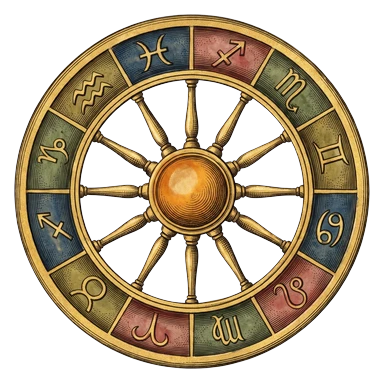
The core move is to treat the numbers, figures and journeys in sacred text as descriptions of the sky. The twelve become the signs of the zodiac; the sevens become the classical planets; the central solar figure moves through the twelve as the sun moves through the year, dying at the winter solstice and rising again. On this reading a sacred text is not a chronicle but a cosmology written in narrative.
Its modern exponents present it as the recovery of something deliberately hidden. Santos Bonacci, an Australian teacher whose talks are the most widely circulated version in English, argues that the twelves in Scripture are the zodiac, that the sevens are the planets, and that reading the Gospels as literal history is a category mistake that empties them of their actual meaning. He is emphatic that this does not make the text untrue: his position is that a myth can carry more truth than a library of histories, and that the text speaks to the reader on many levels at once.
Whatever one concludes, the position deserves to be stated at its strongest rather than caricatured. It is not the claim that the Bible is worthless. It is the claim that it is a different kind of book from the one most readers were handed.
Where it comes from
Astrotheology is not a recent invention and its ancestry runs in two separate strands that are often confused.
The first is ancient and internal. Philo of Alexandria and Josephus both read the sanctuary as a model of the cosmos, and said so while the temple stood. Allegorical reading of Scripture, with a literal sense and one or more symbolic senses layered over it, was normal in the patristic and medieval church and was never a fringe activity. On this strand astrotheology is continuous with something entirely orthodox.
The second is modern and polemical. In the late eighteenth and nineteenth centuries writers including Charles Dupuis, Constantin Volney, Godfrey Higgins and Gerald Massey argued that Christianity was a solar cult in disguise and that its central figure was a personification of the sun. This literature was written against the churches rather than inside them, and much of its comparative evidence has been reassessed unfavourably since. Twentieth and twenty-first century popularisers, including D. M. Murdock and the film Zeitgeist, transmitted this strand to a much larger audience.
Modern astrotheology usually presents both strands as one continuous tradition. They are not. The first is a way of reading a text believed to be true; the second is an argument that the text is not what it claims. A reader is well served by noticing which one a given claim belongs to.
What mainstream scholarship says
On the symbolic reading, there is no real dispute. That Scripture uses number symbolically, that the sanctuary was understood cosmologically by at least some first-century Jews, and that early Christian writers read the text on several levels are all ordinary scholarly positions with primary sources behind them.
On the historical question the picture is different. The view that no historical figure stands behind the Gospel narratives, usually called the Christ myth theory, is held by a small number of scholars and a larger number of writers outside the academy. The prevailing view among historians of the period, including those with no religious commitment of any kind, is that a Galilean teacher was executed under Pontius Pilate and that the Gospels are theologically shaped accounts of him rather than allegories composed from scratch. The usual reasons given are the early non-Christian references, the character of the Pauline letters, and the presence of narrative details a purely constructed story would have had little motive to invent.
That is reported here as the state of a scholarly argument rather than as a verdict this house is qualified to hand down. Readers who want to weigh it should read both sides in their own words. What would be dishonest is to let a page imply that the strong claim carries the same evidential weight as the symbolic one, because it does not.
What the churches say
Every major Christian tradition holds that the incarnation is a historical event and not a figure of speech, and each has creedal language tying it to a datable moment: suffered under Pontius Pilate. A reading that dissolves the historical claim into solar allegory is, by that standard, outside what the churches teach, and there is no use pretending otherwise.
What the churches have not generally opposed is symbolic reading as such. Reading the sanctuary as a model of creation, or the number twelve as an image of completeness, sits comfortably inside historic Christian interpretation. The line, where it is drawn, is drawn at replacement rather than at layering.
This site reads the sky as created and the heavens as witnesses rather than rulers, which is the frame Genesis 1:14 sets out. Within that frame the twelves and the sevens are worth studying closely and honestly. Outside it, a reader is entitled to go where their own conscience and their own community take them, and will not find this house pretending the question is simpler than it is.
How to weigh an astrotheological claim
- Ask what kind of claim it is. A claim about how a first-century writer read a text, a claim about what the text says, and a claim about what happened in history need different evidence.
- Follow the citation to the primary source. Josephus and Philo can be read directly and are short on the passages that matter.
- Check the lexicon yourself when a claim rests on a single word. Word meanings are the easiest thing to overstate and the easiest thing to verify.
- Notice when a resemblance is doing the work. Two things sharing a number is a starting point for an argument, not the argument.
- Distinguish the teacher’s strongest claim from their most quotable one. Talks circulate in clips, and a clip is usually the sharpest thing said rather than the best supported.
- Let a disputed thing stay disputed. A reader is not owed a verdict on a question the evidence has not settled.
Sources and editorial method
Research and editorial references used for this page include:
- Josephus, Antiquities of the Jews 3.179 to 3.187 - The first-century historian states directly that the seven lamps signify the planets and that the twelve stones signify either the twelve months or the twelve signs of the circle the Greeks call the zodiac.
- Philo of Alexandria, On the Life of Moses II, sections 98 to 126 - A contemporary of Josephus reading the tabernacle furnishings the same way: the lamps as the planets, the twelve stones as the zodiac, the loaves as the year.
- Genesis 1:14, lights for signs and seasons - The verse that frames this site’s reading of the heavens as created markers rather than powers.
- Psalm 82:6 and John 10:34, the saying that you are gods - A text central to the astrotheological reading of human divinity, and much debated in its own right.
- John 1:14, the Word made flesh - The verse at the center of the dispute between allegorical and historical readings of the incarnation.
Scripture is cited by book, chapter and verse so any translation can be checked. Josephus and Philo are cited by the standard section numbers used in every edition, so the passage can be found even if a link moves. Where a claim rests on a Hebrew or Greek word, the lexicon entry is named. Interpretive traditions are identified as traditions, and the difference between what a text says and what a school reads into it is kept visible throughout.
Related reading
Common questions
Who is Santos Bonacci?
An Australian teacher of astrotheology whose recorded talks are the most widely circulated English-language presentation of the subject. He argues that the twelves in Scripture are the zodiac, the sevens are the planets, and that the Gospels are myth rather than chronicle, while holding that myth carries more truth than history rather than less. His readings of the twelves and sevens have first-century precedent in Philo and Josephus; his conclusions about the historical Jesus are disputed by most historians of the period.
Is astrotheology the same as astrology?
No. Astrology reads the sky for meaning about people, times and events. Astrotheology reads sacred texts as encoded descriptions of the sky. They overlap in vocabulary and often in audience, but they are answering different questions.
Is any of it actually supported?
Yes, the symbolic part. That the sanctuary was read cosmologically by first-century Jewish writers is documented in their own surviving works, with the twelve stones as the zodiac and the seven lamps as the planets stated outright. The contested part is the leap from there to the claim that the Gospel narratives have no historical person behind them.
Does this site teach astrotheology?
This site reports it. The Great Almanac reads the heavens as created signs under God, which is the frame of Genesis 1:14, and it does not teach that the incarnation is allegory. It also does not think readers are served by pretending the twelves and sevens are not there, or that Philo and Josephus did not write what they wrote.