

Personal Week Number
A Personal Week number is a modern numerology timing device that assigns a reduced number to a seven-day period. There is no universally standardized formula, so a meaningful result must state the week boundary, reduction rules, and calculation method.
$0 today, then $12/month after 7 days. Cancel anytime.
Direct answer
Short version
One transparent Monday-based method calculates the Personal Year, adds the calendar month to obtain the Personal Month, then adds the calendar date of the Monday beginning the week and reduces, keeping 11, 22, and 33 as the Almanac does in every cycle. Other practitioners use different anchors, so two calculators can disagree without either arithmetic result being accidental.

What could this mean for your life?
Explore your recurring patterns, what matters to you, and a way forward. Your reading uses your own birth details.
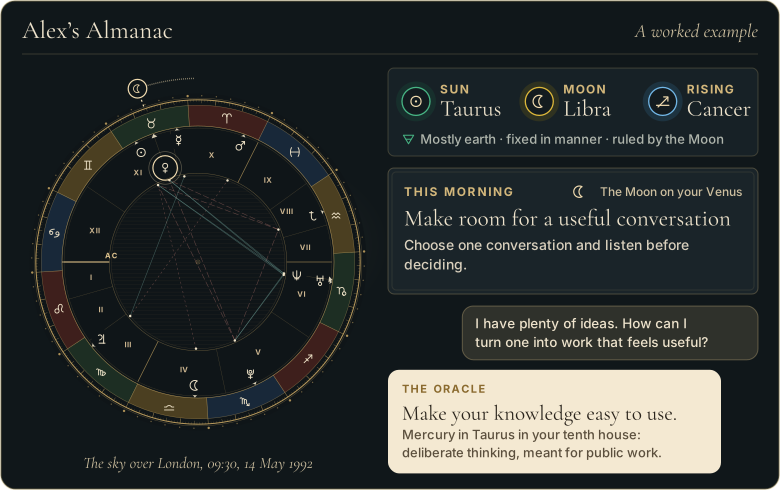
Walk through Alex’s whole example first
 The Road of AgesSee the turning points of your whole life, from your birth date
See your road's shape
The Road of AgesSee the turning points of your whole life, from your birth date
See your road's shape
Prefer to explore first?
 The Road of AgesThe turning points of your whole life, from your own chart
Walk my road
The Road of AgesThe turning points of your whole life, from your own chart
Walk my road
Free, by email
Your daily Almanac letter
One short letter at 7 each morning: the day’s theme read for your own chart, and one thing to do with it.
Quick facts
| Decision | Convention used here |
|---|---|
| Week boundary | Monday through Sunday, following ISO weekday order |
| Personal Year | Reduced birth month + reduced birth day + the calendar year’s digits reduced (the Universal Year), reduced |
| Personal Month | Personal Year + calendar month, reduced |
| Personal Week | Personal Month + calendar date of that week’s Monday, reduced |
| Final range | Roots 1 through 9, with 11, 22, and 33 kept as master numbers at every step, as in all Almanac cycles |
A one-minute story
The Music of Number
From a blacksmith's hammers to your Life Path: the story of number.

Why the formula must be declared
Personal Year and Personal Month calculations are widely recognizable within modern Western numerology, although even those cycles have competing birthday-to-birthday and calendar-year conventions. Personal Week is less standardized. Some systems treat it as the Personal Day number of the week’s first day, some add a numbered calendar week, and some divide a Personal Month into numbered segments.
A result without a method cannot be checked or compared. Monday versus Sunday changes the anchor date; preserving 11 or 22 changes reduction; using an ISO week number produces a different sequence from using the Monday’s day of month. Transparency is more valuable than claiming that one modern convention is timeless.
Step-by-step Monday-based calculation
- Choose the Monday that begins the seven-day period. Record its full civil date and time zone if the calculation is being shared across regions.
- Calculate the Personal Year by adding the reduced birth month, the reduced birth day, and the reduced digits of the Monday’s calendar year, then reduce the total, keeping 11, 22, or 33.
- Add the Monday’s calendar month number to the Personal Year and reduce again. This gives the Personal Month.
- Add the Monday’s day-of-month number to the Personal Month and reduce to obtain the Personal Week.
- Keep the unreduced arithmetic beside the result so another reader can reproduce it.
- If reducing master numbers away or using a birthday-to-birthday Personal Year, label that variation before interpreting it.
Worked example
Take a birth date of 15 March and the week beginning Monday, 20 July 2026. First calculate the Personal Year: March is 3, the birth day 15 reduces to 6, and 2026 reduces to 1. The sum 3 + 6 + 1 equals 10, which reduces to Personal Year 1.
Next calculate the Personal Month for July: Personal Year 1 + month 7 equals 8. Then add the Monday date: Personal Month 8 + 20 equals 28, and 2 + 8 equals 10, which reduces to Personal Week 1. Under this declared method, the period from Monday 20 July through Sunday 26 July 2026 is a Personal Week 1.
A Sunday-based method would anchor the period to 19 July and could yield a different number. That difference is methodological, not evidence that one result has exposed a hidden truth. Choose a consistent convention before comparing weeks.
Numbers 1-9 and the master numbers as weekly planning prompts
| Number | Useful emphasis | Question for the week |
|---|---|---|
| 1 | Begin, decide, define ownership | What deserves a clean first move? |
| 2 | Cooperate, listen, pace, negotiate | Where would sensitivity improve coordination? |
| 3 | Communicate, create, connect | What needs expression rather than more private rehearsal? |
| 4 | Organize, maintain, build | Which structure would make the work easier to sustain? |
| 5 | Experiment, move, revise | What change can be tested without abandoning every commitment? |
| 6 | Care, repair, take responsibility | Which person or obligation needs reliable attention? |
| 7 | Study, review, withdraw selectively | What becomes clearer when noise is reduced? |
| 8 | Manage resources, authority, and consequence | Which material decision needs accurate numbers and accountability? |
| 9 | Complete, release, integrate | What can be finished or relinquished without drama? |
| 11 | Notice, listen, then share it (read with 2) | What insight needs a steady, shared next step? |
| 22 | Plan and build at a larger scale (read with 4) | Which larger plan deserves a practical first structure? |
| 33 | Serve and teach with care (read with 6) | Where can care be offered without losing yourself? |
How to use the number without outsourcing decisions
Treat the number as a weekly theme-selection device. A 4 week does not make organization cosmically mandatory, but choosing organization as a prompt may reveal neglected maintenance. A 7 week does not prohibit social plans; it can invite one period of review or study. Concrete use should remain proportionate: select one question, one behavior, and one end-of-week review.
Keep a record before judging accuracy. Write the number and intended practice on Monday, then note evidence for and against the interpretation on Sunday. Avoid retrofitting every event. If any result can be explained as every possible outcome, the interpretation is too vague to teach anything.
Planning should still follow deadlines, health, money, caregiving, weather, and other facts. A symbolic 5 does not justify reckless travel; an 8 does not promise financial gain; a 9 does not require ending a relationship. Ordinary evidence and consent govern real decisions.
Why calculators return different numbers
Week start
Monday, Sunday, and culture-specific boundaries give different anchor dates.
Year boundary
Calendar-year and birthday-to-birthday Personal Years can differ before the birthday.
Master numbers
Some schools preserve 11 and 22; others reduce every timing cycle to 1-9. The Almanac keeps 11, 22, and 33.
Reduction order
Reducing components first can differ from adding the unreduced values and reducing once.
Week-number methods
Adding ISO week 30 is not equivalent to adding the Monday date 20.
Time zone
A Sunday night in one region may already be Monday in another, changing the named period.
Limits and responsible interpretation

Numerology asserts symbolic relationships between numbers and life; it is not a scientifically validated forecasting system. A Personal Week cannot verify a future event, diagnose health, establish compatibility, or identify divine instruction. Repeated checking can increase anxiety by making normal uncertainty feel like a puzzle that must be solved.
Use the cycle only while it encourages reflection and practical action. Stop when it produces fear, compulsion, superiority, or avoidance of qualified advice. A useful seven-day review asks what was attempted, what happened, what evidence changed the plan, and what should carry into the next week, whether or not the symbolic number felt accurate.
Sources and editorial method
Research and editorial references used for this page include:
- Encyclopaedia Britannica: Numerology - Reference context for numerology as a belief-based interpretive system.
- World Numerology: Personal Numerology Forecast - Documents the Personal Year and Personal Month arithmetic used as the foundation for shorter timing cycles.
- International Organization for Standardization: ISO 8601 - Authoritative date standard supporting an explicit Monday-first week convention.
These references support the factual, historical, textual, or interpretive claims on this page. Interpretive traditions are identified as such, and factual claims are kept separate from symbolic claims.
Related reading
From the method to your own numbers
Your numbers,
worked out for you.
- A personal reading about love, work or purpose, written from your chart
- A practical next step to consider
- It opens with 7 days free, with the AI Oracle and daily guidance
$0 today, then $12/month after 7 days. Cancel anytime.
Common questions
Is there one official Personal Week formula?
No. Modern numerology sources use different anchors and reduction rules. A responsible calculation states its method so the result can be reproduced.
When does the Personal Week begin?
The method described here uses Monday through Sunday, consistent with ISO weekday order. A Sunday-based tradition will produce different boundaries and sometimes a different number.
Should 11, 22 and 33 be reduced?
Timing-cycle practice varies. The Almanac keeps 11, 22 and 33 at every step, in this cycle as in all its cycles; a school that reduces every timing cycle to 1-9 would read those weeks as 2, 4 and 6.
Can a Personal Week predict what will happen?
No. It is a symbolic planning prompt, not an evidence-based forecast. Decisions still require current facts, responsibility, consent, and qualified advice where appropriate.
Free, by email
The Almanac, in your inbox at 7
One short letter at 7 each morning: the day’s theme read for your own chart, and one thing to do with it.
