
Destiny Number (Expression Number)Calculation and Meaning
In the modern Pythagorean name-numerology convention used here, Destiny Number and Expression Number are two names for the total derived from every letter of the full name given at birth. It is interpreted as a symbolic description of outward capacities, expression, and developmental themes.
$0 today, then $12/month after 7 days. Cancel anytime.
Direct answer
Short version
To calculate a Destiny Number, write the complete birth name, convert every letter with the 1-9 chart, add the values, and reduce the total to one digit unless the final total is 11, 22, or 33. In the fictional example LENA MORRIS, the letters total 52 and reduce to 7. This is a convention within numerology, not a scientifically validated measure of talent, fate, or personality. Some schools use the label “Destiny Number” differently, so a reliable calculator must name its letter system, input rule, and reduction rule.

What could this mean for your life?
Explore your recurring patterns, what matters to you, and a way forward. Your reading uses your own birth details.
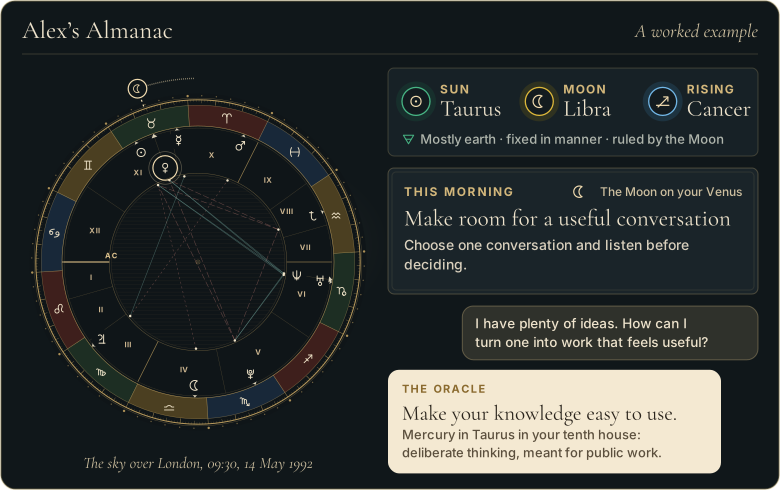
Walk through Alex’s whole example first
 The Road of AgesSee the turning points of your whole life, from your birth date
See your road's shape
The Road of AgesSee the turning points of your whole life, from your birth date
See your road's shape
Prefer to explore first?
 The Road of AgesThe turning points of your whole life, from your own chart
Walk my road
The Road of AgesThe turning points of your whole life, from your own chart
Walk my road
Free, by email
Your daily Almanac letter
One short letter at 7 each morning: the day’s theme read for your own chart, and one thing to do with it.
Quick facts
| Number | Letters in the modern Pythagorean chart | Sequence |
|---|---|---|
| 1 | A, J, S | 1st, 10th, and 19th letters |
| 2 | B, K, T | 2nd, 11th, and 20th letters |
| 3 | C, L, U | 3rd, 12th, and 21st letters |
| 4 | D, M, V | 4th, 13th, and 22nd letters |
| 5 | E, N, W | 5th, 14th, and 23rd letters |
| 6 | F, O, X | 6th, 15th, and 24th letters |
| 7 | G, P, Y | 7th, 16th, and 25th letters |
| 8 | H, Q, Z | 8th, 17th, and 26th letters |
| 9 | I, R | 9th and 18th letters |
A one-minute story
The Music of Number
From a blacksmith's hammers to your Life Path: the story of number.

Destiny Number and Expression Number are usually synonyms
Many English-language numerology guides use Destiny Number and Expression Number for the same full-name calculation. The label “expression” is often clearer because the interpretation concerns how capacities and qualities are expressed, not an unavoidable future. A number does not establish what must happen to someone.
Terminology is not universal. Some authors reserve “destiny” for a birth-date calculation or combine it with another number. Before comparing interpretations, check whether both sources used the same name, alphabet mapping, and reduction method. Matching labels can hide different arithmetic.
This page uses the full name recorded at birth as the core input, the repeating 1-9 modern Pythagorean letter chart, and final master numbers 11, 22, and 33. Those choices are declared so that the result can be reproduced rather than treated as a mysterious output.
How to calculate a Destiny Number step by step
- Write the full birth name, including every recorded given, middle, and family name.
- Remove spaces, hyphens, apostrophes, and punctuation; they carry no value in this convention.
- Normalize accented Latin letters consistently and disclose the spelling used. Do not silently translate or invent letters.
- Assign each remaining letter its value from the 1-9 chart.
- Add every letter value across the complete name.
- Reduce the total by adding its digits until reaching 1-9, or preserve 11, 22, or 33 when one is the final reduction under the stated rule.
- Keep the unreduced total in the result so another reader can verify the arithmetic.
Do not reduce each name separately unless the method explicitly requires it; that can produce a different result from adding every letter first.
Fictional worked example: Lena Morris
Under this declared method, the fictional full birth name LENA MORRIS has a Destiny or Expression Number of 7. The arithmetic is the factual output of the chosen mapping. The claim that 7 symbolizes analysis, introspection, investigation, or inward depth is the interpretive layer supplied by numerology.
Showing both layers matters. A reader should be able to confirm the total without being asked to accept the meaning as mathematical proof. A different spelling, alphabet, or number system can produce a different result.
| Name part | Letter values | Subtotal |
|---|---|---|
| LENA | L 3 + E 5 + N 5 + A 1 | 14 |
| MORRIS | M 4 + O 6 + R 9 + R 9 + I 9 + S 1 | 38 |
| Complete name | 14 + 38 | 52 |
| Reduction | 5 + 2 | 7 |
Destiny Number meanings at a glance
| Number | Traditional expression theme | Constructive use | Common overextension |
|---|---|---|---|
| 1 | Independence and initiative | Originating, deciding, leading, and developing a distinct voice | Isolation, force, impatience, or needing to be first |
| 2 | Cooperation and sensitivity | Mediating, listening, coordinating, and building trust | Appeasement, indecision, or disappearing into other people’s needs |
| 3 | Communication and creativity | Writing, speaking, performing, connecting, and making ideas memorable | Scattered focus, exaggeration, or performance without substance |
| 4 | Structure and reliability | Organizing, practicing, maintaining, and turning plans into durable systems | Rigidity, overwork, control, or fear of experimentation |
| 5 | Freedom and adaptation | Exploring, translating, networking, changing, and learning through experience | Restlessness, excess, avoidance, or weak follow-through |
| 6 | Care and responsibility | Teaching, tending, repairing, beautifying, and protecting what matters | Rescuing, perfectionism, interference, or resentment |
| 7 | Inquiry and discernment | Researching, analyzing, studying, contemplating, and testing assumptions | Withdrawal, suspicion, overanalysis, or intellectual pride |
| 8 | Authority and stewardship | Managing resources, negotiating, executing, and carrying visible responsibility | Domination, status fixation, harshness, or equating worth with results |
| 9 | Completion and broad concern | Integrating experience, creating for a wide audience, serving, and releasing | Martyrdom, weak boundaries, vagueness, or difficulty completing personal needs |
| 11 | Illumination and heightened sensitivity | Communicating insight while grounding it in practical service | Anxiety, specialness, overstimulation, or grand spiritual claims |
| 22 | Large-scale building | Joining vision with planning, infrastructure, patience, and collective usefulness | Crushing pressure, grandiosity, burnout, or fear of starting |
| 33 | Teaching and compassionate responsibility | Making care instructive, bounded, skillful, and sustainable | Self-erasure, savior roles, guilt, or unchosen responsibility |
Master-number meanings vary strongly by school. Read 11 with its root 2, 22 with 4, and 33 with 6 rather than treating a master number as a superior rank.
Destiny Number compared with other core numbers
These labels describe separate calculations. A Destiny Number should not be calculated from a birth date in the convention used on this page, and a Life Path should not be calculated from a name. Keeping inputs separate prevents a calculator from producing impressive-looking but irreproducible results.
| Number | Input | Traditional question |
|---|---|---|
| Destiny / Expression | All letters of the full birth name | How might capacities and outward expression develop? |
| Soul Urge / Heart’s Desire | Vowels in the full birth name | What motives, preferences, or longings are emphasized? |
| Personality Number | Consonants in the full birth name | What qualities may be noticed first by other people? |
| Life Path Number | Complete date of birth | What broad developmental themes are associated with the birth date? |
| Birthday Number | Calendar day of birth | What narrower talent or style is traditionally assigned to the day? |
Which name should you use?
For the core Destiny or Expression Number, this method uses the complete name given at birth. Include recorded middle names and the original family name. Suffixes, honorifics, and professional titles are normally excluded because they are not part of the personal name itself.
A current, married, adopted, professional, or chosen name can be calculated separately as an active-name layer. It does not need to erase the birth-name calculation. Comparing the two can show how the arithmetic changes when a public identity changes, but the meaning remains an interpretive exercise rather than evidence that a renamed person’s fate has changed.
For names written in another script, a calculator must state whether it uses the original writing system, a specific transliteration, or a Latin spelling from official records. Transliteration choices alter letters and therefore totals. There is no responsible way to hide that decision.
Why Destiny Number calculators disagree
- One calculator uses a modern Pythagorean chart while another uses a Chaldean or custom mapping.
- One uses the full recorded birth name while another accepts only the everyday name.
- Middle names, suffixes, particles, apostrophes, and accented letters are normalized differently.
- Master numbers are preserved at different stages of the addition.
- Some calculators reduce each name part before combining; others add every letter first.
- The label “Destiny Number” is applied to a different calculation tradition.
The best result screen displays the normalized input, letter chart, subtotals, total, and reduction rule.
How to use the result without turning it into fate
A Destiny Number can be used as a prompt for reviewing how a person communicates, organizes, creates, cares, investigates, or leads. It cannot establish aptitude, diagnose personality, guarantee vocation, prove compatibility, or override demonstrated skill and conduct.
Sources and editorial method
Research and editorial references used for this page include:
- World Numerology: Expression Number - Practitioner reference for the full-name Expression Number convention.
- Professional Numerology Association: Number Reduction Rules - Practitioner reference documenting reduction choices and master-number variation.
- Astrodienst Astrowiki: Number Symbolism - Background reference defining number symbolism as the assignment of qualitative meanings to numbers.
These references support the factual, historical, textual, or interpretive claims on this page. Interpretive traditions are identified as such, and factual claims are kept separate from symbolic claims.
Related reading
From the method to your own numbers
Your numbers,
worked out for you.
- A personal reading about love, work or purpose, written from your chart
- A practical next step to consider
- It opens with 7 days free, with the AI Oracle and daily guidance
$0 today, then $12/month after 7 days. Cancel anytime.
Common questions
Is Destiny Number the same as Expression Number?
Usually, yes, in modern Pythagorean name numerology. Because terminology varies, confirm that the source calculates it from every letter of the full birth name.
Do I use my birth name or current name?
Use the complete birth name for the core calculation in this method. A current or chosen name can be calculated separately as an active-name comparison.
Do spaces and punctuation count?
No. This convention assigns values to letters. Spaces, hyphens, and apostrophes are removed, while the normalized spelling should be shown.
What if my total is 11, 22, or 33?
This method preserves those final totals as master numbers and also reads their roots: 11/2, 22/4, and 33/6. Other methods may reduce them, so disclose the rule.
Can a Destiny Number predict my career?
No. It can suggest a symbolic theme, but career depends on interests, opportunity, training, health, resources, decisions, and demonstrated ability.
Free, by email
The Almanac, in your inbox at 7
One short letter at 7 each morning: the day’s theme read for your own chart, and one thing to do with it.
