
Resting on the breath
The plainest practice: a few minutes, counting the out-breaths.

How do I begin a simple breath meditation?
What it is
This is the plainest practice there is. A person sits upright, breathes as they normally do, and rests their attention on the breath where it is easiest to feel, at the nostrils or the belly. Many count each out-breath from one to ten and begin again. The mind wanders within seconds. Noticing that it has gone and returning to the breath, without scolding, is not a failure of the practice. It is the practice.
The teaching
As the Buddhist tradition of mindfulness of breathing, from the suttas to Zen teaches it.
The seat
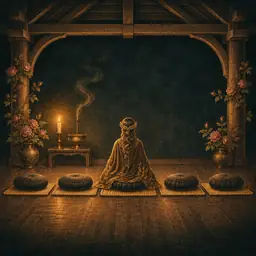
The old instruction begins with a place and a posture. The meditator goes to a quiet spot, the root of a tree or an empty room, sits with the legs crossed, sets the body upright and sets mindfulness in front of them, close at hand and ready. A chair serves as well as a cushion: the feet flat on the floor, the back upright without leaning on anything, the shoulders loose, the hands resting in the lap.
Zen teachers add the details of the hall. The ears are in line with the shoulders and the nose with the navel, the chin drawn slightly in, the tongue resting against the roof of the mouth, the lips and teeth closed, the eyes left open, lowered to the floor a little way ahead. The left hand rests in the right palm, and the tips of the thumbs lightly touch. Dogen asks only that the breath pass quietly through the nose. Nothing else is done to it.
Knowing the breath
The Buddha's discourse on mindfulness of breathing gives sixteen steps, in four sets of four. The first four belong to the body. Breathing in long, the meditator knows: I breathe in long. Breathing out long, they know: I breathe out long. Breathing in short, they know it is short, and breathing out short, they know that too. Then they train to breathe in and out experiencing the whole body, and then to breathe in and out calming the bodily formation, which is the breath itself, so that it grows quieter of its own accord.
Nothing in these steps makes the breath long or short. It is only known as it is. Teachers read the third step in two ways. The commentary takes the whole body to mean the whole of each breath, its beginning, middle and end; many teachers today take it to mean the whole physical body, felt as it breathes. Either way the attention widens without letting go of the breath.
Feeling, mind and the way things are
The second four steps belong to feeling. The meditator trains to breathe in and out experiencing rapture, the bright gladness that can come as the mind settles; then experiencing ease, a quieter pleasure; then experiencing the mental formation, which is feeling and perception as they colour the mind; and then calming it.
The third four belong to the mind itself: breathing in and out experiencing the mind, gladdening the mind, steadying the mind, and setting the mind free. The last four turn to insight: breathing in and out contemplating impermanence, then the fading away of desire, then cessation, and then letting go. The commentary says plainly that the first four steps are the beginner's work, and that the later sets belong to one whose mind is already steady. Nobody is hurried through them.
Counting
For the beginner whose mind will not stay, the commentary of Buddhaghosa gives counting. The breaths are counted, in or out, whichever is plainer, from one to ten, and then from one again. The count never stops short of five and never runs past ten. Below five the mind is cramped, like cattle shut in a small pen; beyond ten it begins to watch the numbers instead of the breath. When the count is lost, it starts again at one, without comment.
At first the counting is slow, like a grain measurer who fills his measure, says one, and empties it, and goes on in the same unhurried way. As the breaths grow plain, it may quicken, like a herdsman counting cattle through a gate. Zen halls teach newcomers the same exercise, counting each out-breath up to ten. The count is a scaffold, and when the attention stays on the breath without it, the counting is let go.
Following, and the point of touch
After counting comes following. The attention goes with the breath, but it does not chase the breath into the body. A mind that follows the air down to the belly and back up to the nose grows restless, the commentary warns. It gives instead the picture of a man sawing a log, whose attention stays where the teeth of the saw meet the wood, not on the teeth as they come and go. So the meditator rests at the point where the breath touches, the rim of the nostrils or the upper lip, and lets each breath pass there.
A second picture is the gatekeeper, who does not follow every traveller into the town and out again, but notes each one as they pass the gate. The breaths come and go. The attention stays at the gate.
When the breath grows faint
As the mind settles, the breath grows finer, and a time may come when it seems to have vanished. The commentary says not to get up and leave. The breath is still there. The meditator looks for it where it always touches, as a ploughman whose oxen have strayed does not search the whole forest, but waits at the pool where they come to drink.
To some, the commentary adds, a sign appears as the mind gathers: a light like a star, a touch like a tuft of cotton, a thread, a wisp of smoke. It comes differently to different people because each perceives differently, and it is nothing to chase. If something like it comes, the attention stays with the breath. If nothing comes, nothing is missing.
The wandering mind
The mind will wander, within seconds at first. The tradition names five hindrances that carry it off: longing for pleasant things, ill will, dullness and drowsiness, restlessness and worry, and doubt. Each is known by its name when it comes, and the attention goes back to the breath. Wandering is not a failure of the practice. Noticing that the mind has gone, and bringing it back without scolding, is the practice, repeated as often as it takes.
Drowsiness is met by opening the eyes a little wider, sitting up straighter, or standing for a few breaths; the Buddha's own advice to a drowsy disciple runs from recalling a teaching he had heard, to rubbing the limbs, splashing the eyes with water and walking up and down. Restlessness is met by counting again. Doubt is met by sitting out the time that was set and judging nothing until afterwards. Zen teachers say to let thoughts come and go without taking hold of them.
How long, and the signs to stop
Begin with five minutes, with a timer set so that the clock is no concern, once a day at a time that can be kept. Ten minutes is plenty for the first weeks; coming back each day matters more than length. The breath is never forced, slowed on purpose or held, because the instruction is to know it, not to manage it.
If dizziness, breathlessness or panic comes, or the breath begins to feel tight and strange, open the eyes, look around the room, feel the feet on the floor and move. Letting the breath go its own way again is the remedy. Some people find the breath a hard place to rest. For them the sounds in the room, or the feel of the hands in the lap, serve just as well, and every step above is the same.
How it is practised
Five minutes is enough to begin, with a timer so the clock is not a worry. Sit on a chair with both feet on the floor and the back straight but not stiff. Breathe through the nose at the ordinary pace: nothing is forced, slowed or held. Count each out-breath up to ten, and start again at one whenever the count is lost. If dizziness or panic comes, open the eyes, look around the room and move.
Where it comes from
Mindfulness of breathing is set out in early Buddhist discourses, and the fifth-century commentator Buddhaghosa recommends counting breaths to steady a beginner. Japanese Zen kept the counting as a first exercise in zazen. The Burmese teachers who revived vipassana in the last century also began with the breath, and the hospital courses that started in 1979 took it from them. Eastern Christian monks, separately, joined the Jesus Prayer to the rhythm of breathing. The discourse itself, the Anapanasati Sutta, gives sixteen steps; the calm it builds is called samatha, and the texts say it may deepen into the absorptions named jhana.
What is known, and what is not
Breath practice is one part of the mindfulness courses tested in trials. A 2014 review of 47 trials found moderate evidence that such courses ease anxiety, low mood and pain, to about the same degree as other active approaches such as exercise. Counting the breath on its own has rarely been tested. Brain imaging studies report differences in meditators, but many are small, and what they mean is not settled. An older laboratory finding still stands: in the 1970s Herbert Benson measured slower breathing and heart rate in meditators and named it the relaxation response.
Its words
- Mindfulness
- Attention kept on what is happening now, without judging it. The English word translates the Pali sati, which also means remembering.
 Zazen
- The seated meditation of Zen: upright, eyes half open, often counting the breath or simply sitting.
- Vipassana
- Insight meditation: the Buddhist practice of watching sensations and thoughts arise and pass, taught today mostly in forms revived in Burma.
- Anapanasati
- Mindfulness of breathing in and out, the Buddha's breath meditation, set out in sixteen steps in the discourse of the same name.
- Samatha
- Calm abiding: the Buddhist practice of resting attention on one object until the mind is steady, the partner of insight.
- Jhana
- A state of deep absorption reached through calm meditation. The early Buddhist texts describe four, each quieter than the last.
- Tonglen
- Giving and taking: the Tibetan practice of breathing in the suffering of others and breathing out relief, to train compassion.
- Relaxation Response
- Herbert Benson's name, from the 1970s, for the bodily calming, slower breath and heart, that simple repetition of a word can bring on.
Ask the Oracle further
How long should a beginner sit in breath meditation each day?What do I do when my mind keeps wandering during meditation?
Before you practise
Start short: five to ten minutes. If sitting in silence stirs panic, old trauma or a feeling of unreality, stop, open your eyes and move; a teacher or therapist is the right company for that.
Its other branches
The body scanContemplative prayerWalking practiceThe evening reviewWhen sitting is hardThe whole artSearch the tree

