Centaurs and minor planets
Thereus
Direct answer
Thereus is first an astronomical object with a measured orbit, official number, discovery record, and myth-derived name. Astrological meanings attached to it are recent and experimental; they should be built from repeated chart observation, not treated as scientifically demonstrated or ancient doctrine.
32532 Thereus is a small Solar System body in the dynamically unstable population called Centaurs, whose orbits lie among the giant planets. It was discovered in 2001 and named for a centaur from Greek myth.
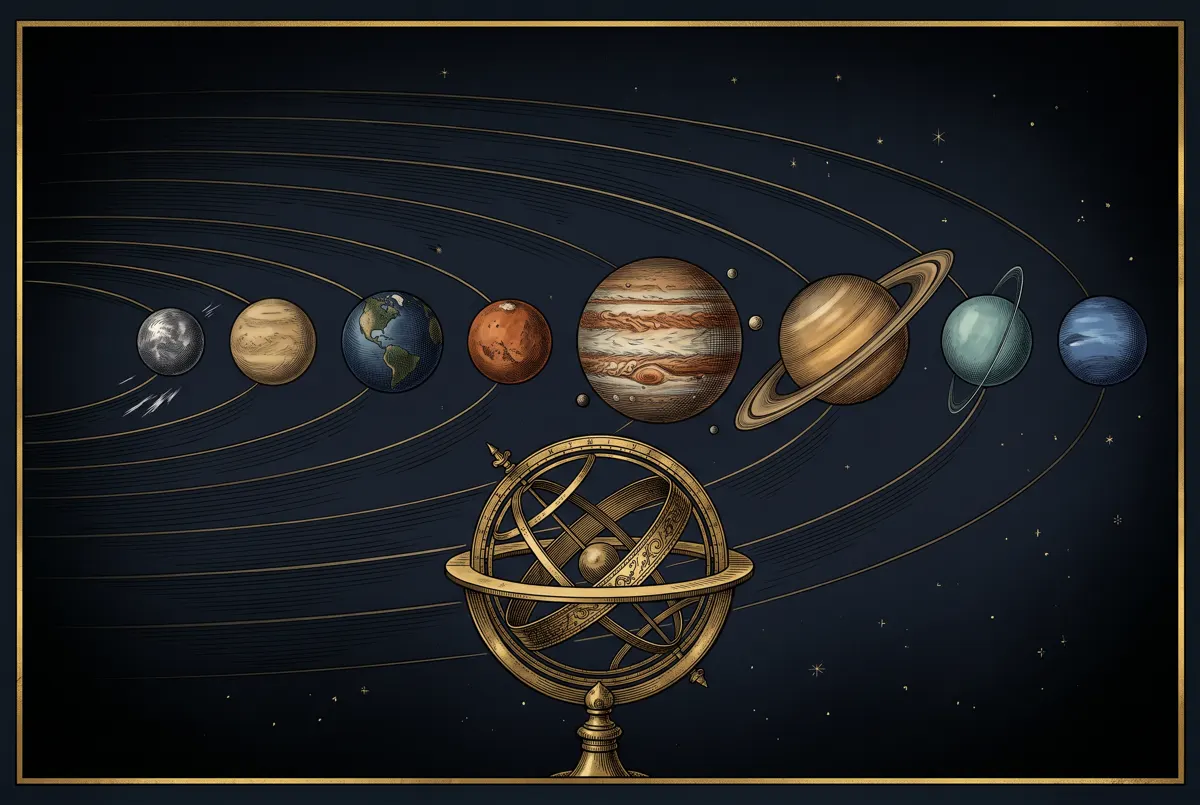
Thereus means a centaur associated by name with pursuit and capture themes.
The orbit map distinguishes physical bodies, calculated points, and symbolic cycles where possible.Quick facts
| Property | Reference point |
|---|---|
| Official designation | 32532 Thereus, with provisional designation 2001 PT13. |
| Population | Centaur, a class of small bodies moving among the giant-planet region. |
| Discovery | Discovered in 2001 by the Near-Earth Asteroid Tracking program. |
| Name source | A mythological centaur named Thereus; myth variants should be checked in classical sources. |
The Instruments
Ten readings, worked out from your own birth chart
An instrument is a reading this house works out for you. Give your birth date, time and place once, and each one reads today’s real sky against the chart you were born under. Eight are personal; two are calendars anyone can open. A free account opens one instrument a day. The plans open every instrument, every day.
- Natal Chart Every planet, house and aspect in your chart
- Active Transits Where the planets are now, read against your chart
- Daily Counsel What to pursue today, and what to leave alone
- Personal Timing Your best days to decide, weeks ahead
- Fellowship Your chart and another, read side by side
- Theme of the Day The one thing today is asking of you
- Sacred Numbers Your life path, your cycles, your name in numbers
- Aeolian Harmonics Classical music chosen to match your chart
- Mercury Retrograde Every Mercury retrograde this year, with its dates Open to all
- Void-of-Course Moon When the Moon is between signs, hour by hour Open to all







Thereus as a Centaur object
Centaurs occupy transitional, planet-crossing or planet-approaching orbits in the outer Solar System. Repeated gravitational encounters with giant planets make their trajectories dynamically unstable over astronomical timescales. They are not centaurs because of physical appearance; the population name inspired an International Astronomical Union convention of using mythological centaur names. Thereus has a cataloged orbit, but osculating elements change with epoch, so copied values for semimajor axis, eccentricity, inclination, or orbital period should always include a date and authoritative database source.
The myth behind the name
The named figure is a relatively obscure centaur rather than one of the extensively narrated Chiron or Nessus. Modern summaries often repeat a short characterization involving bear hunting or carrying bears from the mountains, ultimately associated with ancient literary notices. Because minor mythic figures survive through brief, variant references, a dramatic modern biography can exceed the evidence quickly. The official naming citation and a cited classical edition should anchor the account; an astrological keyword derived from the name is an interpretation, not a recovered ancient teaching about the minor planet.
How astrologers experiment with Thereus
Astrologers who use Thereus may begin with the mythic themes, the broader Centaur motif of boundary crossing, and empirical comparison of conjunctions to natal planets or angles. Because the body is not part of established classical rulership, there is no consensus dignity, house, sign, or aspect doctrine. Use a tight orb, record the exact ecliptic longitude from a reliable ephemeris, and examine many charts, including nonconfirming cases. A striking example can suggest a hypothesis but cannot establish a universal meaning.
Verifying positions and keeping claims proportionate
Search by number 32532 to avoid spelling ambiguity, choose the intended geocentric or heliocentric viewpoint, and record time scale, zodiac, and coordinate type. JPL’s database and Horizons service provide orbital and ephemeris data; horoscope software may omit the body or use cached elements. Astronomy can establish where Thereus was calculated to be, not that it causes a life event. An interpretation should be described as modern symbolic practice, avoid predictions of violence or fate based on an obscure myth, and remain secondary to the clearer structure of the chart.
Sources and editorial method
Research and editorial references used for this page include:
- NASA JPL: Small-Body Database lookup - Authoritative orbital, discovery, and designation data for 32532 Thereus.
- NASA: WISE Finds Mysterious Centaurs May Be Comets - Scientific overview of the diverse Centaur population.
These references support the factual, historical, textual, or interpretive claims on this page. Interpretive traditions are identified as such, and factual claims are kept separate from symbolic claims.
Related reading
Check Thereus in your skymap
Thereus in a book is one thing; Thereus in your own birth chart is your life. The Oracle casts your real chart and tells you what it means for your love, your work, and your year ahead, in conversation, free.
Speak with the OracleWhere Thereus moves through your own year, and what that asks of your love and your work, is written in the Cosmic Codex, month by month from your chart. Open the Cosmic Codex
More in Planets & Celestial Bodies
Common questions
Is Thereus an asteroid?
It is often called an asteroid informally, but its more informative dynamical classification is Centaur. Small-body categories can overlap in catalog usage.
Does Thereus have an established astrological meaning?
No broad consensus exists. Interpretations are recent, school-dependent, and best treated as hypotheses tested across many charts.
How can I find Thereus in an ephemeris?
Search the official number 32532 in a small-body database or ephemeris service and specify the desired date, observer location, and coordinate system.