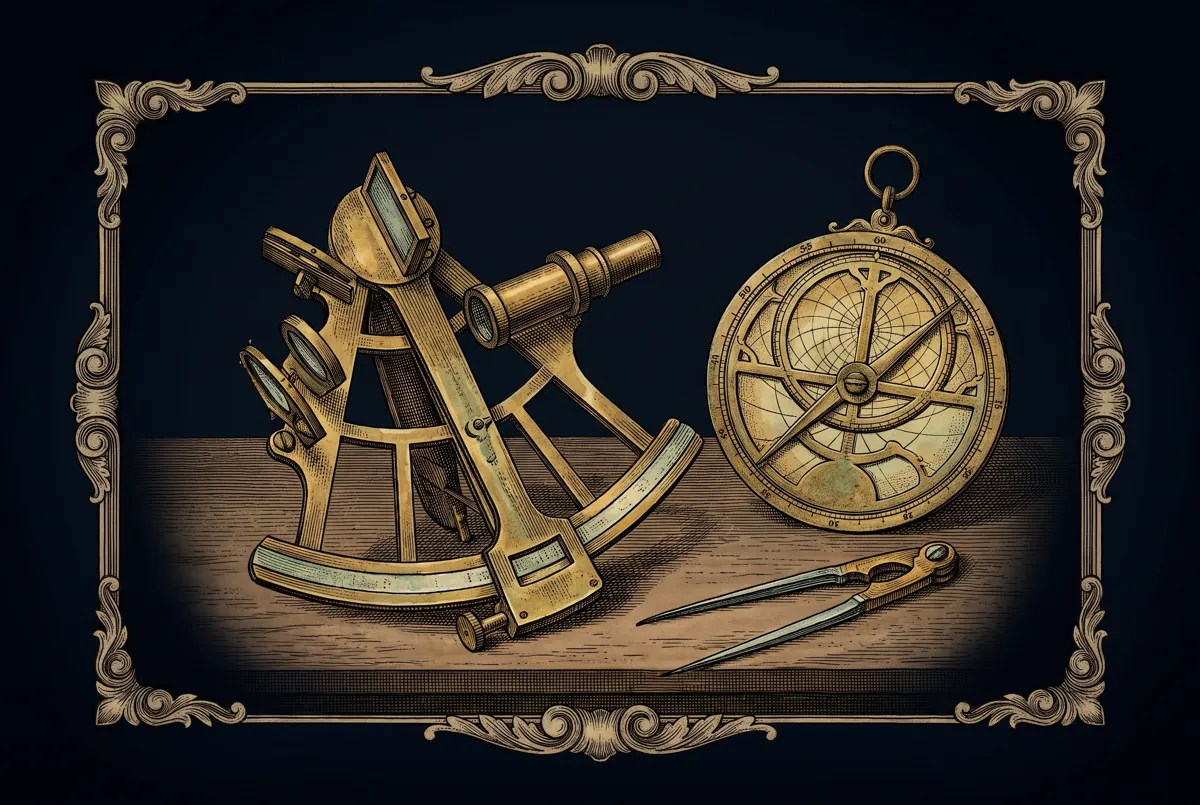
Old instruments
Line of Position
Direct answer
Line of Position is a line on which the observer is estimated to lie according to one navigation observation.
Line of Position is a geographic position constraint used in historical astronomy, timekeeping, or navigation.
$0 today, then $12/month after 7 days. Cancel anytime.
At a glance
- Found in
- Historical Almanacs & Instruments
- Related
- Intercept Method, Marcq Saint-Hilaire Method, Celestial Position Fix, Running Fix
Line of Position is a geographic position constraint used in historical astronomy, timekeeping, or navigation.
An engraved functional orientation; the page explains the real instrument, method, or publication.
What does your own chart say about you?
Choose love, work or purpose. Your reading is written from your chart. Your reading uses your own birth details.
Walk through Alex’s whole example first


 The Road of AgesSee the turning points of your whole life, from your birth date
See your road's shape
The Road of AgesSee the turning points of your whole life, from your birth date
See your road's shape
Prefer to explore first?
 The Road of AgesThe turning points of your whole life, from your own chart
Walk my road
The Road of AgesThe turning points of your whole life, from your own chart
Walk my road
Free, by email
Your daily Almanac letter
One short letter at 7 each morning: the day’s theme read for your own chart, and one thing to do with it.
Why Line of Position matters
Line of Position matters because one observation narrows location to a locus while two or more suitable observations can determine a fix.
A one-minute story
The Book of the Sky
How people learned to read the sky, from Babylon to the day you were born.

Line of Position in practice: an example
A celestial altitude produces a local line approximately perpendicular to the body's azimuth.
Where readings of Line of Position go wrong
A line is not a point, and nearly parallel lines create a weak intersection with large uncertainty.
Sources and editorial method
Research references used for this entry include:
- National Geospatial-Intelligence Agency: The American Practical Navigator - Official modern reference for navigation principles, celestial observations, sight reduction, and navigational tables.
- Source
- The Great Almanac Dictionary
- Category
- Historical Almanacs & Instruments
- Last updated
- 2026-09-26
Explore Line of Position
A definition tells you what it is; your own birth chart tells you what it means for you. The Oracle casts your real chart and answers for your love, your work, and your year ahead, in conversation. It opens with the 7-day Seeker trial.
Speak with the OracleRelated terms
More in Historical Almanacs & Instruments
- Meridian Circle
- Orrery
- Repeating Circle
- Sun Sight
- Astronomical Quadrant
- Computed Altitude
- Equinoctial Ring Dial
From the reference page to your own chart
Every word here
is in your own chart.
- A personal reading about love, work or purpose, written from your chart
- A practical next step to consider
- It opens with 7 days free, with the AI Oracle and daily guidance
$0 today, then $12/month after 7 days. Cancel anytime.
Common questions
What is Line of Position?
Line of Position is a line on which the observer is estimated to lie according to one navigation observation.
What do people get wrong about Line of Position?
A line is not a point, and nearly parallel lines create a weak intersection with large uncertainty.
Why does Line of Position matter?
Line of Position matters because one observation narrows location to a locus while two or more suitable observations can determine a fix.
Free, by email
The Almanac, in your inbox at 7
One short letter at 7 each morning: the day’s theme read for your own chart, and one thing to do with it.