Seasons and sky
Earth-Sun Distance Cycle
Direct answer
Earth-Sun Distance Cycle: The Earth-Sun Distance Cycle is the annual variation in separation produced by Earth's slightly elliptical orbit, from perihelion to aphelion and back.
The Earth-Sun Distance Cycle is the yearly change between Earth closest and farthest solar distances.
$0 today, then $12/month after 7 days. Cancel anytime.
At a glance
- Found in
- Seasons & Earth Almanac
- Related
- Axial Tilt, Season Length Asymmetry, Astronomical Season, Equinox
The Earth-Sun Distance Cycle is the yearly change between Earth closest and farthest solar distances.
A Sun-Earth orientation for seasonal, atmospheric, tidal, and terrestrial terms.
What does your own chart say about you?
Choose love, work or purpose. Your reading is written from your chart. Your reading uses your own birth details.
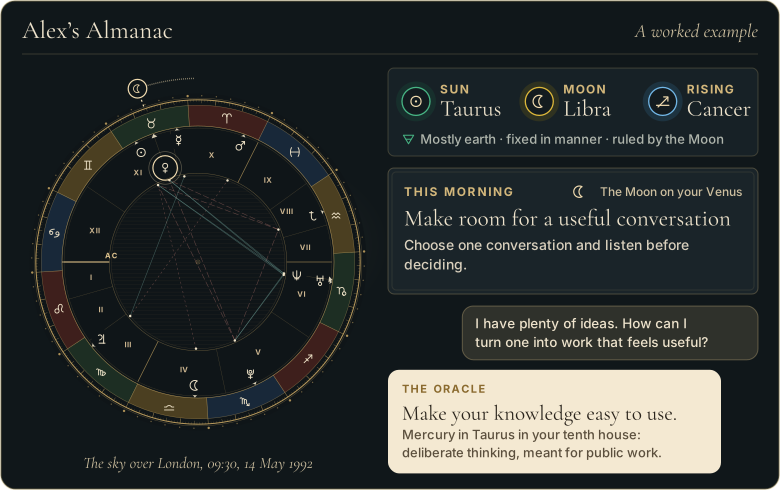
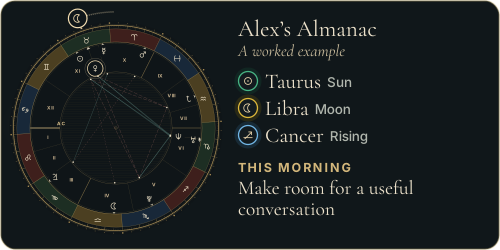
Walk through Alex’s whole example first
 The Road of AgesSee the turning points of your whole life, from your birth date
See your road's shape
The Road of AgesSee the turning points of your whole life, from your birth date
See your road's shape
Prefer to explore first?
 The Road of AgesThe turning points of your whole life, from your own chart
Walk my road
The Road of AgesThe turning points of your whole life, from your own chart
Walk my road
Free, by email
Your daily Almanac letter
One short letter at 7 each morning: the day’s theme read for your own chart, and one thing to do with it.
The story behind Earth-Sun Distance Cycle
Kepler elliptical-orbit model replaced the older assumption that Earth-Sun distance remains fixed through uniform circular motion.
Why Earth-Sun Distance Cycle matters
Earth-Sun Distance Cycle modestly changes incoming solar energy and orbital speed while demonstrating that axial tilt, not distance, drives opposite hemispheric seasons.
Earth-Sun Distance Cycle in practice: an example
Earth is closest to the Sun in early January and farthest in early July even though the two hemispheres experience opposite seasons.
Where readings of Earth-Sun Distance Cycle go wrong
The usual misreading is to attribute a particular cold snap, heat wave, or personal event directly to the slow annual distance change.
Sources and editorial method
Research references used for this entry include:
- U.S. Naval Observatory: The Seasons and the Earth's Orbit - Official explanation of axial tilt, solstices, equinoxes, perihelion, aphelion, and seasonal sunlight.
- NOAA Tides and Currents Glossary - Operational definitions for tides, tidal currents, ranges, datums, bores, and amphidromic systems.
- Source
- The Great Almanac Dictionary
- Category
- Seasons & Earth Almanac
- Last updated
- 2026-09-26
Compare distance with seasonal tilt
A definition tells you what it is; your own birth chart tells you what it means for you. The Oracle casts your real chart and answers for your love, your work, and your year ahead, in conversation. It opens with the 7-day Seeker trial.
Speak with the OracleRelated terms
More in Seasons & Earth Almanac
- Growing Degree Day
- Mixed Tide
- Perigean Spring Tide
- September Equinox
- Sun Pillar
- 22-Degree Halo
- Belt of Venus
- Cooling Degree Day
From the reference page to your own chart
Every word here
is in your own chart.
- A personal reading about love, work or purpose, written from your chart
- A practical next step to consider
- It opens with 7 days free, with the AI Oracle and daily guidance
$0 today, then $12/month after 7 days. Cancel anytime.
Common questions
What is the Earth-Sun Distance Cycle?
The Earth-Sun Distance Cycle is the annual variation in separation produced by Earth's slightly elliptical orbit, from perihelion to aphelion and back.
What do people get wrong about the Earth-Sun Distance Cycle?
The usual misreading is to attribute a particular cold snap, heat wave, or personal event directly to the slow annual distance change.
Free, by email
The Almanac, in your inbox at 7
One short letter at 7 each morning: the day’s theme read for your own chart, and one thing to do with it.