Seasons and sky
Perigean Spring Tide
Direct answer
Perigean Spring Tide: A Perigean Spring Tide occurs when new- or full-moon spring-tide alignment falls near lunar perigee, increasing the astronomical tide-generating effect.
A Perigean Spring Tide combines syzygy with a relatively close Moon.
$0 today, then $12/month after 7 days. Cancel anytime.
At a glance
- Found in
- Seasons & Earth Almanac
- Related
- Amphidromic Point, Equinoctial Tide, Astronomical Season, Equinox
A Perigean Spring Tide combines syzygy with a relatively close Moon.
A Sun-Earth orientation for seasonal, atmospheric, tidal, and terrestrial terms.
What does your own chart say about you?
Choose love, work or purpose. Your reading is written from your chart. Your reading uses your own birth details.
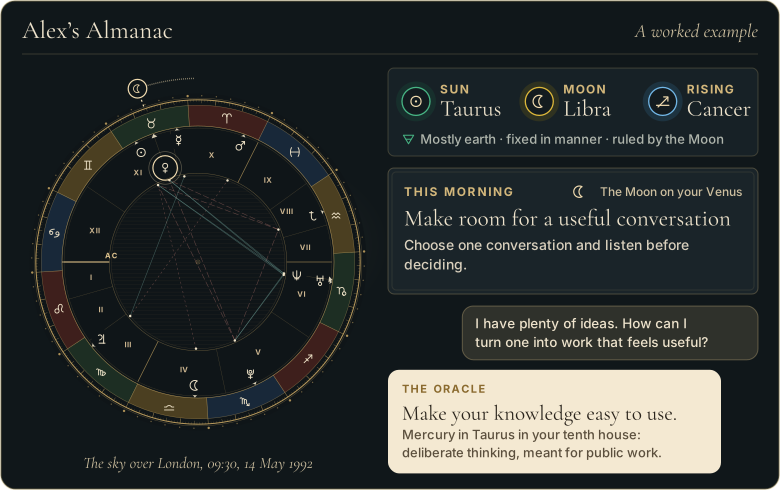
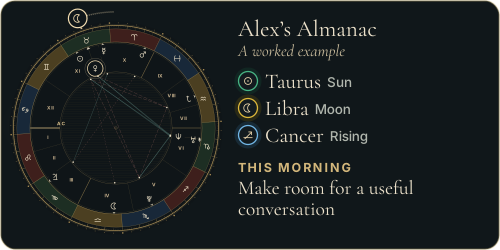
Walk through Alex’s whole example first
 The Road of AgesSee the turning points of your whole life, from your birth date
See your road's shape
The Road of AgesSee the turning points of your whole life, from your birth date
See your road's shape
Prefer to explore first?
 The Road of AgesThe turning points of your whole life, from your own chart
Walk my road
The Road of AgesThe turning points of your whole life, from your own chart
Walk my road
Free, by email
Your daily Almanac letter
One short letter at 7 each morning: the day’s theme read for your own chart, and one thing to do with it.
The story behind Perigean Spring Tide
Improved lunar ephemerides and tide gauges made the combined phase-distance modulation measurable and predictable.
Why Perigean Spring Tide matters
Perigean Spring Tide can raise predicted high tides and lower predicted lows beyond ordinary spring-tide values at susceptible coasts.
Perigean Spring Tide in practice: an example
A full Moon near perigee may coincide with an unusually large predicted tidal range at a local station.
Where readings of Perigean Spring Tide go wrong
The usual misreading is to equate it automatically with flooding; wind, pressure, waves, coastline, and sea-level anomalies determine impacts.
Sources and editorial method
Research references used for this entry include:
- NOAA Tides and Currents Glossary - Operational definitions for tides, tidal currents, ranges, datums, bores, and amphidromic systems.
- NOAA Ocean Service: What Are Spring and Neap Tides? - Official explanation of lunar-solar alignment and spring and neap tidal ranges.
- Source
- The Great Almanac Dictionary
- Category
- Seasons & Earth Almanac
- Last updated
- 2026-09-26
Compare perigee with the local tide table
A definition tells you what it is; your own birth chart tells you what it means for you. The Oracle casts your real chart and answers for your love, your work, and your year ahead, in conversation. It opens with the 7-day Seeker trial.
Speak with the OracleRelated terms
More in Seasons & Earth Almanac
- September Equinox
- Sun Pillar
- 22-Degree Halo
- Belt of Venus
- Cooling Degree Day
- Earth-Sun Distance Cycle
- Growing Degree Day
- Mixed Tide
From the reference page to your own chart
Every word here
is in your own chart.
- A personal reading about love, work or purpose, written from your chart
- A practical next step to consider
- It opens with 7 days free, with the AI Oracle and daily guidance
$0 today, then $12/month after 7 days. Cancel anytime.
Common questions
What is a Perigean Spring Tide?
A Perigean Spring Tide occurs when new- or full-moon spring-tide alignment falls near lunar perigee, increasing the astronomical tide-generating effect.
What do people get wrong about a Perigean Spring Tide?
The usual misreading is to equate it automatically with flooding; wind, pressure, waves, coastline, and sea-level anomalies determine impacts.
Free, by email
The Almanac, in your inbox at 7
One short letter at 7 each morning: the day’s theme read for your own chart, and one thing to do with it.