

The inner life
Dream Sign
Direct answer
Dream Sign: A dream sign is a feature that recurs in a person's dreams and seldom or never in waking life, which can be learned as a cue for realising that one is dreaming.
$0 today, then $19/month after 7 days. Cancel anytime.
At a glance
- Also called
- dreamsign, dreamsigns laberge, recurring dream cues
- Found in
- Consciousness & Spiritual Psychology
- Related
- Lucid Dreaming, Dream Journal, Reality Testing, MILD
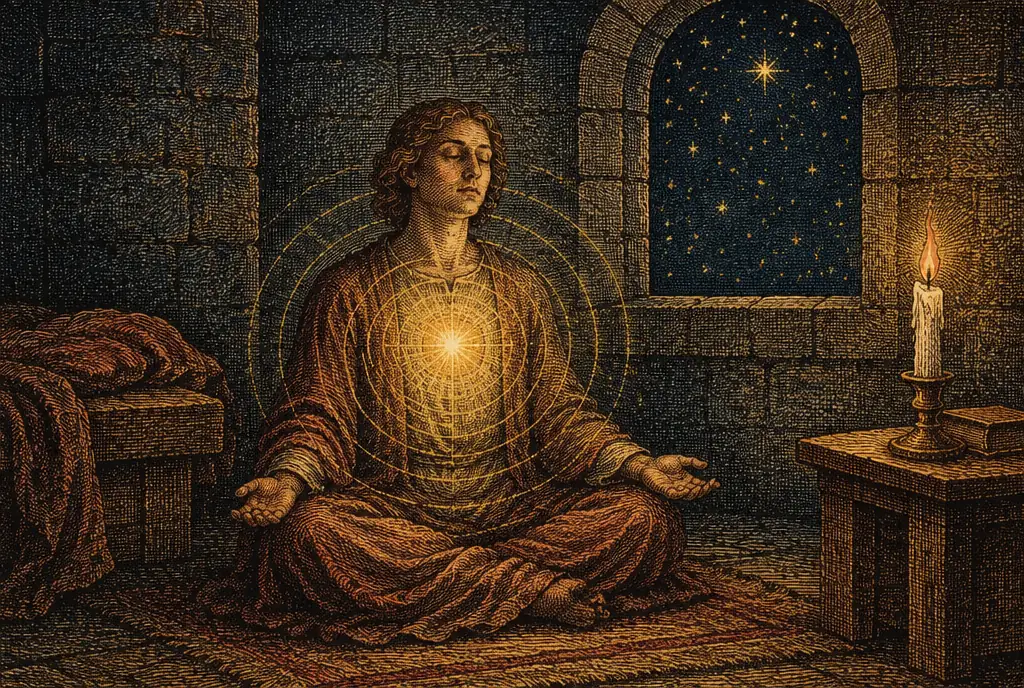
A dream sign is a feature that recurs in a person's dreams and seldom or never in waking life, which can be learned as a cue for realising that one is dreaming.
A plain educational schematic; it does not diagnose a condition or replace professional care.
Understand the chapter you are in.
Your life’s turning points, measured from your birth.
Walk through Alex’s whole example first


Prefer to explore first?
 The Road of AgesThe turning points of your whole life, from your own chart
Walk my road
What is a dream sign?
Dreams are full of things that would be astonishing awake and pass without comment asleep: the dead alive, strangers in the house, a body that floats, a school last seen decades ago. A dream sign is any such feature that keeps returning for a particular dreamer.
Lucid dreamers collect them from their journals. Once a person knows that their dreams often feature, say, a missing shoe or their childhood street, they can rehearse a response: when I see this, I will ask whether I am dreaming. Stephen LaBerge, who wrote the term as one word, dreamsign, grouped them into oddities of inner awareness, of action, of form and of context.
On the tree of the hidden arts: Lucid dreaming.
What sets Dream Sign apart
LaBerge arrived at dream signs by working backwards from success. He gathered reports of how lucidity had begun and found that most started with the dreamer noticing an anomaly. The practical step was to make that noticing likelier by knowing one's own anomalies in advance. His four classes are a checklist for reading a journal: is the oddity in what I thought or felt, in what happened, in how something looked, or in where I was and with whom?
- Coined by: Stephen LaBerge, written dreamsign
- Four classes: inner awareness, action, form, context
- Published: Exploring the World of Lucid Dreaming, 1990
- Where found: in the repeats of one's own dream journal
- Typical examples: the dead alive, a childhood home, devices that will not work
Often mistaken for something else: A dream symbol is read for what it means; a dream sign is used only as a trigger, and its meaning does not matter.
The story behind Dream Sign
Earlier lucid dreamers noted that an absurdity could trigger lucidity; Frederik van Eeden and Hervey de Saint-Denys both describe it. Stephen LaBerge made the idea systematic in the 1980s, coining dreamsign and publishing the four categories with Howard Rheingold in 1990, after sorting reports of lucid dreams by what had prompted the realisation.
Why Dream Sign matters
Dream Sign turns the journal from a record into a tool, and it explains why lucidity so often begins with noticing that something is wrong.
How to read Dream Sign
Dreamers pick two or three from their own journal and tie the question am I dreaming to them, by day in imagination and at night in MILD.
Dream Sign in practice: an example
A reader who finds that in a dozen journal entries they are back in their first flat might adopt that flat as a personal dream sign.
Where readings of Dream Sign go wrong
Dream signs are personal cues for lucidity. They are not symbols with fixed meanings and they foretell nothing.
Sources and editorial method
This entry summarizes the tradition in the Almanac's own words; where no source is listed, it is an editorial summary rather than a primary text, and symbolic readings are named as the tradition's, not as fact.
- Source
- The Great Almanac Dictionary
- Category
- Consciousness & Spiritual Psychology
- Aliases
- dreamsign, dream signs, dream signs lucid dreaming, dreamsigns laberge, recurring dream cues
- Last updated
- 2026-09-26
See Dream Sign in your personal almanac
A definition tells you what it is; your own birth chart tells you what it means for you. The Oracle casts your real chart and answers for your love, your work, and your year ahead, in conversation. It opens with the 7-day Oracle trial.
Speak with the OracleRelated terms
More in Consciousness & Spiritual Psychology
- Heart Coherence
- Love Bombing
- Past Life
- Rumination
- Soulmate
- Tuskegee Syphilis Study
- Anima and Animus
- Cognitive Dissonance
From the reference page to your own chart
Every word here
is in your own chart.
- Your life’s turning points, measured from your birth
- A practical next step to consider
- It opens with 7 days free: the AI Oracle on thirty hidden arts, and your daily horoscope
$0 today, then $19/month after 7 days. Cancel anytime.
Common questions
What is a dream sign?
It is something that shows up repeatedly in your dreams but not in your waking life, such as a person who has died or a place from childhood, and can alert you that you are dreaming.
What are the four types of dream sign?
LaBerge grouped them as inner awareness (odd thoughts or feelings), action (things behaving impossibly), form (people or objects oddly shaped) and context (being somewhere or with someone unlikely).
How do I find my own dream signs?
Keep a dream journal for a few weeks, read it through, and underline anything that appears more than once. The repeats are your signs.


