

The inner life
Cryptomnesia
Direct answer
Cryptomnesia is the return of a forgotten memory that is not recognised as a memory, so that it seems to be a new idea or knowledge from nowhere.
$0 today, then $19/month after 7 days. Cancel anytime.
At a glance
- Also called
- hidden memory, unconscious plagiarism, source amnesia, forgotten memory
- Found in
- Consciousness & Spiritual Psychology
- Related
- Past Life, Reincarnation, Past-Life Regression
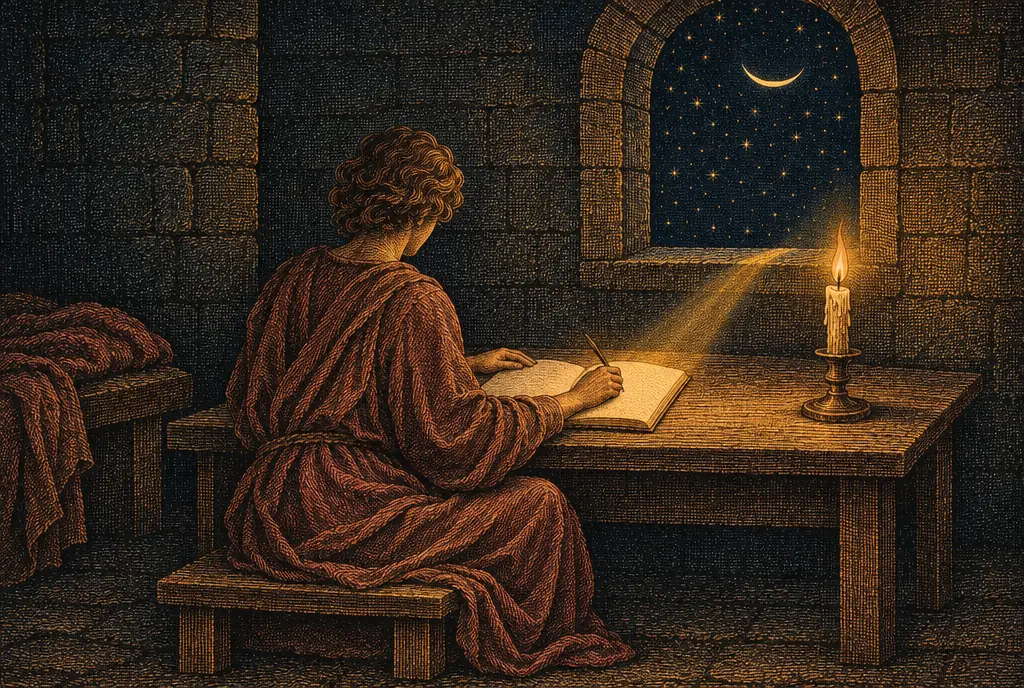
Cryptomnesia is the return of a forgotten memory that is not recognised as a memory, so that it seems to be a new idea or knowledge from nowhere.
A plain educational schematic; it does not diagnose a condition or replace professional care.
Understand the chapter you are in.
Your life’s turning points, measured from your birth.
Walk through Alex’s whole example first


Prefer to explore first?
 The Road of AgesThe turning points of your whole life, from your own chart
Walk my road
What is cryptomnesia?
Cryptomnesia means hidden memory. Something read, heard or seen is forgotten, and later comes back without any sense of having been met before. The person takes it for an original thought, an inspiration, or a message from outside themselves.
Cryptomnesia explains honest cases of unconscious plagiarism, in which a writer or composer reproduces another's work in good faith. It is also the leading explanation for the convincing details in past-life regressions and trance messages: names, places and customs the person once came across and no longer remembers knowing.
On the tree of the hidden arts: Past lives and karma.
What sets Cryptomnesia apart
Cryptomnesia is a failure of labelling, not of storage. The content is kept; what is lost is the tag that says where it came from. Memory researchers call this losing the source, and it is common: most people have told a friend that friend's own joke. The cases that made the word famous are the ones with high stakes, a medium's revelations, a composer's melody, a hypnotised subject's foreign words, where the honest answer to how did you know that is that they once did and forgot.
- Coined by: Théodore Flournoy, From India to the Planet Mars, 1900
- Greek roots: kryptos, hidden, and mneme, memory
- Jung: the essay 'Cryptomnesia', 1905, with an example from Nietzsche
- In law: George Harrison's My Sweet Lord judged an unconscious copy, 1976
- Related term: source amnesia: remembering a thing but not where it came from
Often mistaken for something else: Plagiarism is the knowing use of another's work; cryptomnesia is reproducing it in good faith, with no memory of having met it.
The story behind Cryptomnesia
The Swiss psychologist Théodore Flournoy introduced the term in 1900 in his study of the medium Hélène Smith, tracing her visions of India and of Mars to things she had read and heard. Carl Jung wrote an essay on cryptomnesia in 1905 and showed that a passage in Nietzsche's Zarathustra echoed a book Nietzsche had read as a boy. In a court case of 1976 George Harrison was found to have copied a melody without being aware of it.
Why Cryptomnesia matters
Cryptomnesia shows how accurate-seeming details can turn up in a regression or a trance with no deceit and no past life behind them.
How to read Cryptomnesia
Psychologists and historians test a striking past-life detail by asking first whether the person could have met it in a book, a film or a lesson.
Cryptomnesia in practice: an example
A man under hypnosis gives the name of a medieval village; years earlier he read a novel set there and has no memory of the book.
Where readings of Cryptomnesia go wrong
Cryptomnesia is ordinary forgetting and no sign of illness; it also cannot be ruled out just because a person is sure they never knew a thing.
Sources and editorial method
This entry summarizes the tradition in the Almanac's own words; where no source is listed, it is an editorial summary rather than a primary text, and symbolic readings are named as the tradition's, not as fact.
- Source
- The Great Almanac Dictionary
- Category
- Consciousness & Spiritual Psychology
- Aliases
- cryptomnesia meaning, hidden memory, unconscious plagiarism, source amnesia, forgotten memory
- Last updated
- 2026-09-26
See Cryptomnesia in your personal almanac
A definition tells you what it is; your own birth chart tells you what it means for you. The Oracle casts your real chart and answers for your love, your work, and your year ahead, in conversation. It opens with the 7-day Oracle trial.
Speak with the OracleRelated terms
More in Consciousness & Spiritual Psychology
- Fawn Response
- Inner Child
- Mindfulness-Based Stress Reduction (MBSR)
- Prosperity Gospel
- Shadow Integration
- Subtle Body
- Watergate Scandal
- Biofield
From the reference page to your own chart
Every word here
is in your own chart.
- Your life’s turning points, measured from your birth
- A practical next step to consider
- It opens with 7 days free: the AI Oracle on thirty hidden arts, and your daily horoscope
$0 today, then $19/month after 7 days. Cancel anytime.
Common questions
What is cryptomnesia?
It is a memory that comes back without being recognised as one. The person believes the idea, tune or fact is new to them, when in truth they met it earlier and forgot.
How does cryptomnesia explain past-life memories?
Details given in a regression often match something the person once read or heard. Forgotten as a source, the material returns feeling like a memory of another life.
Who coined the word cryptomnesia?
Théodore Flournoy, a Swiss psychologist, in 1900. He used it to explain where the medium Hélène Smith drew the content of her trance visions.


