
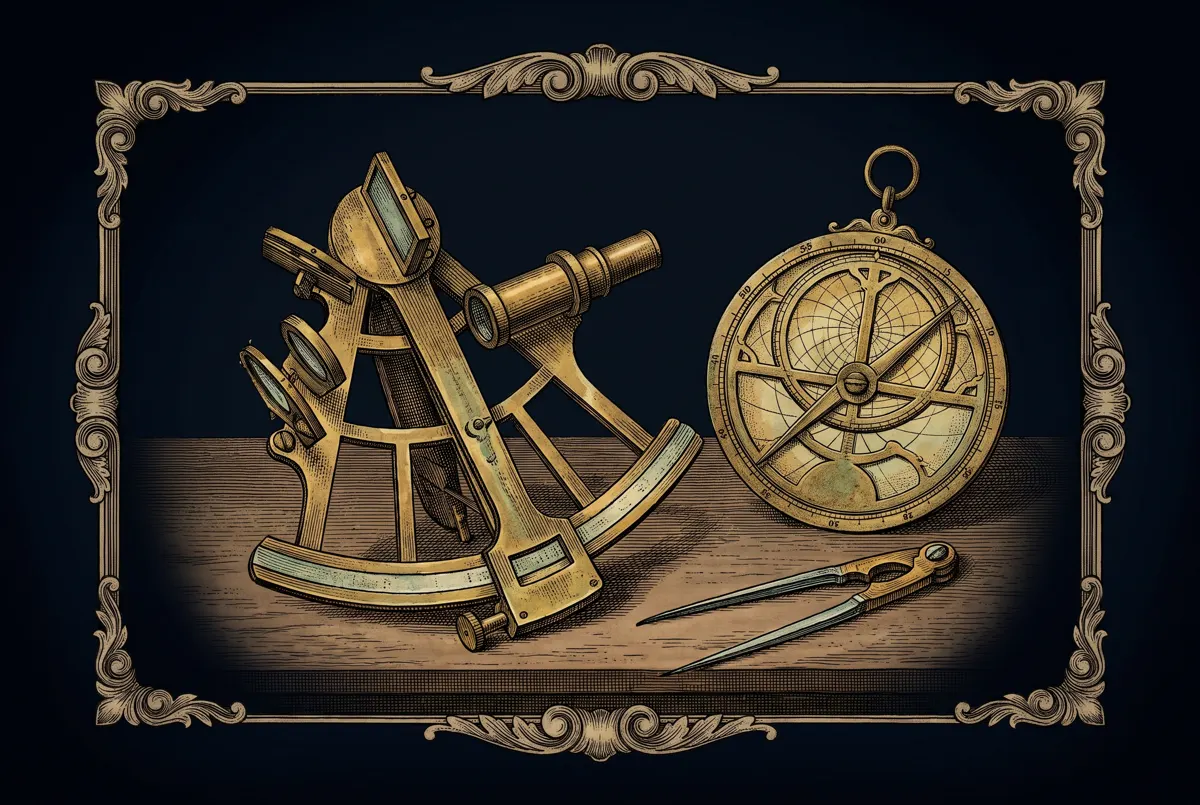
Old instruments
Celestial Globe
Direct answer
Celestial Globe: A Celestial Globe is a spherical map of stars, constellation figures, and celestial coordinates represented on the surface of a globe.
A Celestial Globe maps stars and sky coordinates on a sphere.
$0 today, then $12/month after 7 days. Cancel anytime.
At a glance
- Found in
- Historical Almanacs & Instruments
- Related
- Almanac, Astronomical Almanac, Nautical Almanac, Astrolabe
A Celestial Globe maps stars and sky coordinates on a sphere.
An engraved functional orientation; the page explains the real instrument, method, or publication.
What does your own chart say about you?
Choose love, work or purpose. Your reading is written from your chart. Your reading uses your own birth details.
Walk through Alex’s whole example first


 The Road of AgesSee the turning points of your whole life, from your birth date
See your road's shape
Prefer to explore first?
 The Road of AgesThe turning points of your whole life, from your own chart
Walk my road
Free, by email
Your daily Almanac letter
One short letter at 7 each morning: the day’s theme read for your own chart, and one thing to do with it.
The story behind Celestial Globe
Celestial globes have served astronomy, education, collecting, and artistic display; surviving examples also document the star catalogues and imagery of their makers.
A one-minute story
The Book of the Sky
How people learned to read the sky, from Babylon to the day you were born.

Why Celestial Globe matters
Celestial Globe preserves the whole-sky geometry that flat charts must project and can show how coordinates, constellation regions, and the ecliptic relate.
How to read Celestial Globe
Read a Celestial Globe by checking its viewing convention, epoch, coordinate grid, magnitude notation, and intended latitude or mounting.
Celestial Globe in practice: an example
A historical globe may plot stars by right ascension and declination and draw the ecliptic through traditional constellation figures.
Where readings of Celestial Globe go wrong
Precession makes historical coordinates date-dependent, and a globe viewed from outside can reverse the orientation familiar to an observer looking outward at the sky.
Sources and editorial method
Research references used for this entry include:
- Royal Museums Greenwich: Newton's New and Improved Celestial Globe - Museum documentation of a celestial globe, its coordinates, ecliptic, constellations, and magnitude scale.
- International Astronomical Union: The Constellations - Official constellation names, abbreviations, boundaries, and distinction between regions and figures.
- Source
- The Great Almanac Dictionary
- Category
- Historical Almanacs & Instruments
- Last updated
- 2026-09-26
Read a globe of the stars
A definition tells you what it is; your own birth chart tells you what it means for you. The Oracle casts your real chart and answers for your love, your work, and your year ahead, in conversation. It opens with the 7-day Seeker trial.
Speak with the OracleRelated terms
More in Historical Almanacs & Instruments
- Dead Reckoning
- Gunter's Quadrant
- Lunar Distance Table
- Planisphere
- Semidiameter Correction
- Volvelle
- Assumed Position
From the reference page to your own chart
Every word here
is in your own chart.
- A personal reading about love, work or purpose, written from your chart
- A practical next step to consider
- It opens with 7 days free, with the AI Oracle and daily guidance
$0 today, then $12/month after 7 days. Cancel anytime.
Common questions
What is a Celestial Globe?
A Celestial Globe is a spherical map of stars, constellation figures, and celestial coordinates represented on the surface of a globe.
What do people get wrong about a Celestial Globe?
Precession makes historical coordinates date-dependent, and a globe viewed from outside can reverse the orientation familiar to an observer looking outward at the sky.
Free, by email
The Almanac, in your inbox at 7
One short letter at 7 each morning: the day’s theme read for your own chart, and one thing to do with it.


