
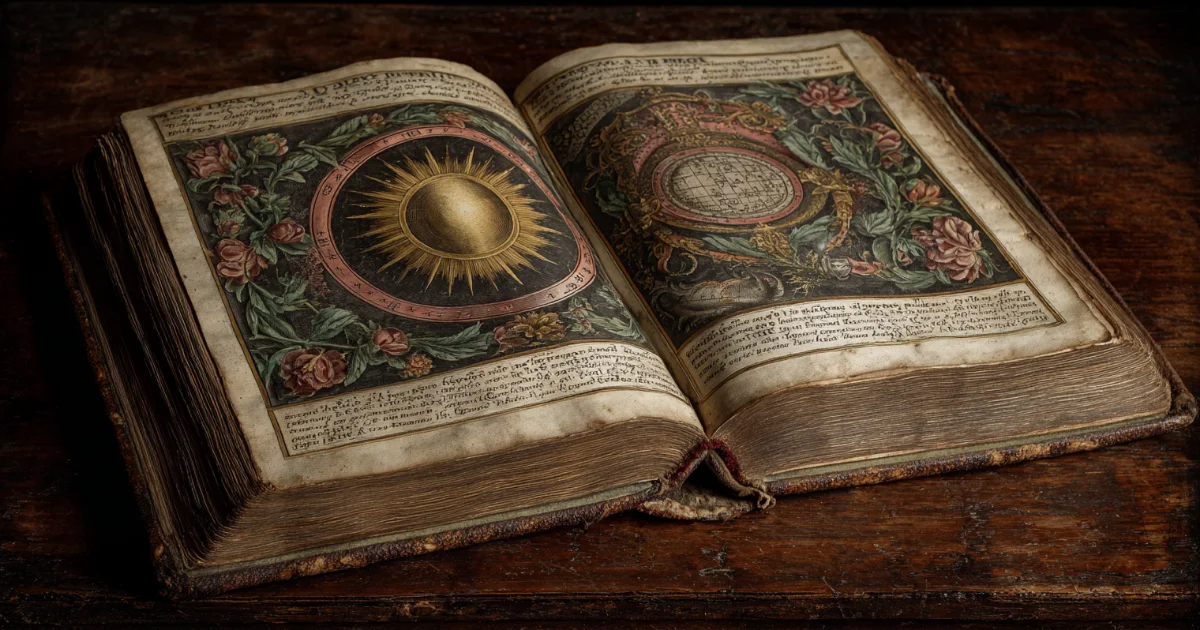
Grimoire manuscript history
Ars Paulina
Direct answer
The text has two principal parts: one organizes named spirits or angels by the twenty-four hours of day and night, and another assigns figures to the 360 degrees of the zodiac. Its attribution to the apostle Paul is pseudonymous, not evidence of apostolic authorship.
The Ars Paulina is the third part of the seventeenth-century English grimoire compilation commonly called the Lemegeton or Lesser Key of Solomon.
$0 today, then $12/month after 7 days. Cancel anytime.
Quick facts
| Question | Direct answer |
|---|---|
| Where does it appear? | As the third book in manuscript collections of the Lemegeton. |
| When was this form compiled? | The surviving English text points to a seventeenth-century compilation. |
| What structures it? | Planetary hours in one part and zodiacal degrees in another. |
| Did Saint Paul write it? | There is no historical evidence for apostolic authorship; the title supplies legendary authority. |

What does your own chart say about you?
Choose love, work or purpose. Your reading is written from your chart. Your reading uses your own birth details.
Walk through Alex’s whole example first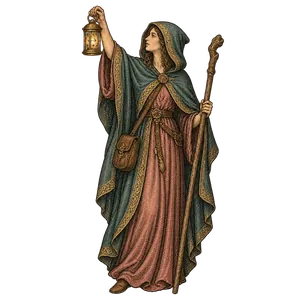
 The Road of AgesSee the turning points of your whole life, from your birth date
See your road's shape
The Road of AgesSee the turning points of your whole life, from your birth date
See your road's shape
Prefer to explore first?
 The Road of AgesThe turning points of your whole life, from your own chart
Walk my road
The Road of AgesThe turning points of your whole life, from your own chart
Walk my road
Free, by email
Your daily Almanac letter
One short letter at 7 each morning: the day’s theme read for your own chart, and one thing to do with it.
Its place in the Lesser Key of Solomon
The Lemegeton is a composite English manuscript work rather than a single ancient book by Solomon. In common arrangements it contains the Ars Goetia, Theurgia-Goetia, Ars Paulina, Ars Almadel, and Ars Notoria or related appendices. Ars Paulina is therefore distinct from the better-known catalogue of seventy-two spirits in the Goetia. Joseph H. Peterson’s manuscript-based edition traces its main text to British Library Sloane MS 3825 and compares variant witnesses. References inside the material, including a stated year and early modern technologies, help date this form much later than the biblical figures named in its legendary framing.
The two-part celestial scheme
The first part divides day and night into twenty-four planetary hours and supplies groups of named beings associated with those hours. The second connects names and seals with the 360 degrees of the zodiac, placing the work at an intersection of angel lore and early modern astrology. These are textual classifications, not modern astronomical catalogues. The names vary across manuscripts because cramped handwriting, copying errors, and editorial choices can change a letter. A scholarly summary should describe the tables and their organizing logic without extracting them into a set of instructions or promising contact with supernatural beings.
Earlier materials behind the compilation
The Ars Paulina did not emerge in isolation. Peterson notes that portions of the first part draw on material connected with Johannes Trithemius’s Steganographia, itself a work with a complex history of cryptography and angelic names. The second part appears to use early modern astrological and physiognomic material. “Pauline Art” was also used for a different Latin text related to the Ars Notoria, so title alone cannot establish identity. Researchers compare incipits, tables, wording, and manuscript provenance to avoid merging those separate works. This is why edition and shelfmark matter whenever a quotation is attributed to the Ars Paulina.
Later editions and modern reception
Nineteenth- and twentieth-century occult revivals brought portions of the Lemegeton into print, often with normalized spelling, redrawn figures, or material borrowed from another witness. Some inexpensive editions contain only the Goetia even when marketed as the complete Lesser Key, while online copies may silently reproduce an old edition. For historical study, compare the edition’s introduction and notes with a manuscript catalogue or diplomatic transcription. Claims that a diagram is “the original Ars Paulina seal” should be checked against a specific folio, because the work contains many figures and later artists frequently redraw them.
How to study Ars Paulina as history
The safest and most accurate way to approach Ars Paulina is as a textual, artistic, or social-history subject. Manuscripts and later printed editions often disagree, while modern websites freely combine material from unrelated periods. Check the date, language, manuscript family, editor, and provenance before repeating a claim. A description in a grimoire records what a text says; it does not establish that the named being or promised effect exists. This article therefore explains vocabulary, transmission, imagery, and reception without providing invocations, seals for use, coercive procedures, or instructions aimed at another person. Anyone experiencing fear, threats, stalking, coercion, or distress should address the observable situation and seek appropriate practical or professional support rather than escalating an occult explanation.
Sources and editorial method
Research and editorial references used for this page include:
- Joseph H. Peterson: Ars Paulina - Manuscript-based transcription with source and variant notes.
- British Library Archives: Sloane manuscripts catalogue - Catalogue access for the manuscript witnesses used in modern editions.
These references support the factual, historical, textual, or interpretive claims on this page. Interpretive traditions are identified as such, and factual claims are kept separate from symbolic claims.
Related reading
Study angelic magic without practicing it
A definition tells you what it is; your own birth chart tells you what it means for you. The Oracle casts your real chart and answers for your love, your work, and your year ahead, in conversation. It opens with the 7-day Seeker trial.
Speak with the OracleYour year, written once from your chart alone: the Cosmic Codex reads the whole of it, month by month. Open the Cosmic Codex
More in Spells & Occult Terms
- Chaos Magic
- Dowsing
- Grand Grimoire
- Knot Magic
- Obsession Spell
- Prosperity Spell
- Sortilege
- Thoughtform
From the reference page to your own chart
Every word here
is in your own chart.
- A personal reading about love, work or purpose, written from your chart
- A practical next step to consider
- It opens with 7 days free, with the AI Oracle and daily guidance
$0 today, then $12/month after 7 days. Cancel anytime.
Common questions
Is Ars Paulina the same as Ars Goetia?
No. They are separate parts of the Lemegeton with different catalogues and organizing schemes.
Why is it called Pauline?
The title invokes apostolic and legendary authority, but the surviving English compilation is early modern.
Do all Lesser Key editions include it?
No. Many publications print only the Goetia, and complete editions can still differ by manuscript base.
Free, by email
The Almanac, in your inbox at 7
One short letter at 7 each morning: the day’s theme read for your own chart, and one thing to do with it.
