
Star lore
Alkaid
Direct answer
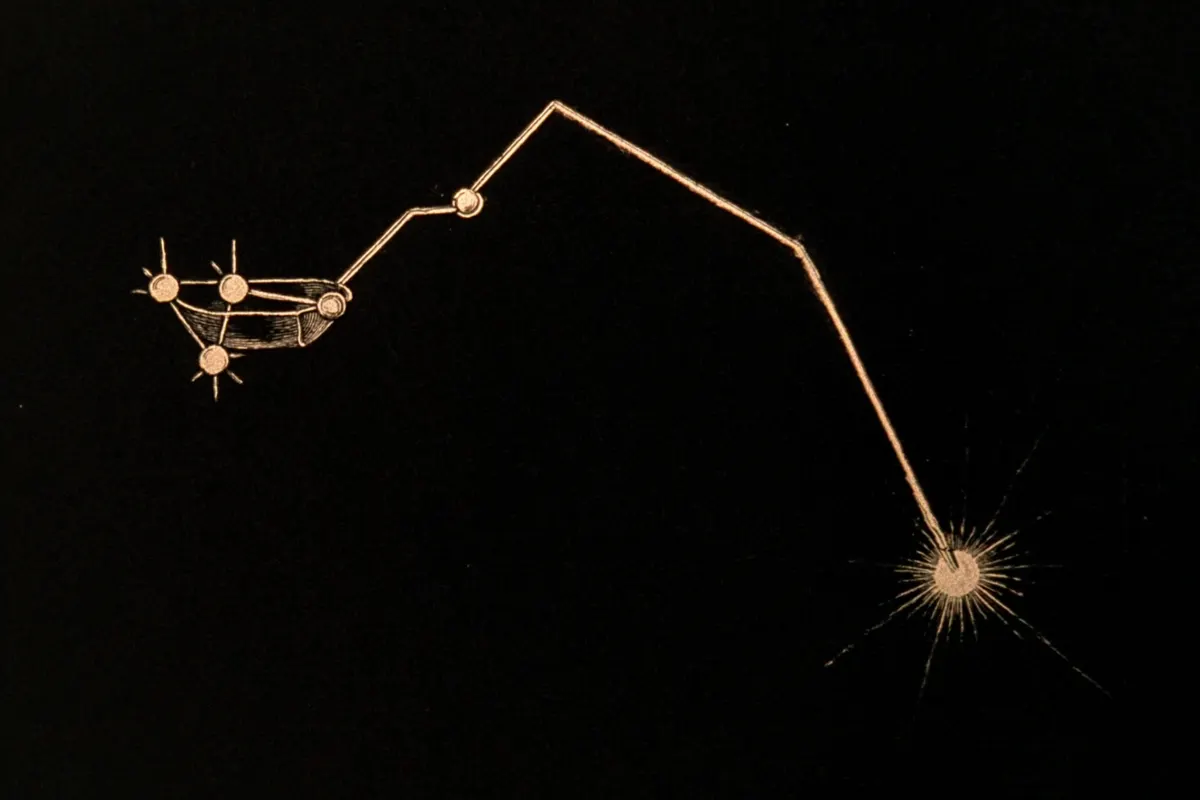
Alkaid is Eta Ursae Majoris, a hot blue-white star at the free end of the Big Dipper's handle.
Alkaid is the bright tip of the Dipper handle and the Great Bear's tail.
$0 today, then $12/month after 7 days. Cancel anytime.
At a glance
- Found in
- Constellations & Star Lore
- Related
- Alioth, Mizar, Denebola, Zubenelgenubi
Alkaid is the bright tip of the Dipper handle and the Great Bear's tail.
A symbolic locator, not a substitute for an observational chart at a specific place and time.
What does your own chart say about you?
Choose love, work or purpose. Your reading is written from your chart. Your reading uses your own birth details.
Walk through Alex’s whole example first
 The Road of AgesSee the turning points of your whole life, from your birth date
See your road's shape
The Road of AgesSee the turning points of your whole life, from your birth date
See your road's shape
Prefer to explore first?
 The Road of AgesThe turning points of your whole life, from your own chart
Walk my road
The Road of AgesThe turning points of your whole life, from your own chart
Walk my road
Free, by email
Your daily Almanac letter
One short letter at 7 each morning: the day’s theme read for your own chart, and one thing to do with it.
How to find Alkaid tonight
Alkaid is the last star in the Big Dipper's handle, the one farthest from the bowl. Face north on any clear evening, find the seven bright stars of the Dipper, and follow the curve of the handle outward: the star at the very tip is Alkaid. From most of Europe, Canada, and the northern United States the Dipper never sets, so Alkaid is findable on any night of the year.
Alkaid is also the starting point of one of the sky's oldest directions: follow the arc of the handle onward and away from the bowl and you "arc to Arcturus," the brilliant orange star of Bootes, and can then "spike to Spica" beyond it. Just below the handle's tip, a small telescope or good binoculars under dark skies will show the Whirlpool Galaxy, M51.
A one-minute story
The Road of the Sun
Where the twelve signs came from, and why they carry the names they do.

The star itself: the Dipper’s hot blue outlier
Alkaid is Eta Ursae Majoris, a young, hot blue-white star of spectral class B3, around thirty-four hundred times the Sun's luminosity and roughly one hundred light years away. It shines at magnitude 1.9, and its surface runs close to sixteen thousand kelvin, far hotter than the Sun and the hottest of the Dipper's seven bright stars.
It is also an outsider in a literal sense. The five middle stars of the Dipper travel together through space as the Ursa Major Moving Group, born from one cloud and still drifting the same way. Alkaid and Dubhe, the two end stars, do not belong to that family: they are passing strangers moving in different directions. Over tens of thousands of years the Dipper's familiar shape will slowly come apart, with its two ends pulling away first.
The name and its lore
The name Alkaid comes from the Arabic qa'id banat na'sh, "the leader of the daughters of the bier." In old Arabic sky lore the bowl of the Dipper was a funeral bier and the three handle stars were mourners walking behind it; Alkaid leads that procession. The star's older alternative name, Benetnash, preserves the same phrase. The International Astronomical Union formally adopted Alkaid as the star's proper name in 2016.
In the Western fixed-star tradition, that funerary image followed the star into astrology, where older catalogues associate Alkaid with mourning and endings. The Great Almanac treats such attributions as inherited symbolism to reflect on, not as a physical influence or a prediction about anyone's life.
The story behind Alkaid
Alkaid’s Arabic-derived name refers to the leader of the daughters of the bier in a traditional Arabic figure.
Why Alkaid matters
Alkaid gives a clean starting point for locating Canes Venatici, Boötes, and several spring galaxies.
How to read Alkaid
Begin at the handle tip, arc inward toward Arcturus, or drop below Alkaid toward the Whirlpool Galaxy.
Alkaid in practice: an example
Alkaid differs in motion from the central Ursa Major Moving Group despite sharing the Dipper pattern.
Where readings of Alkaid go wrong
It is a mistake to assume all seven Dipper stars form one co-moving physical group.
Sources and editorial method
Research references used for this entry include:
- IAU Division C Working Group on Star Names - Official IAU working group responsible for standardizing star names used in international astronomy.
- CDS SIMBAD Astronomical Database - Professional astronomical database for stellar identifiers, positions, classifications, and bibliography.
- Source
- The Great Almanac Dictionary
- Category
- Constellations & Star Lore
- Last updated
- 2026-09-26
Launch from the tip of the Dipper
A definition tells you what it is; your own birth chart tells you what it means for you. The Oracle casts your real chart and answers for your love, your work, and your year ahead, in conversation. It opens with the 7-day Seeker trial.
Speak with the OracleRelated terms
More in Constellations & Star Lore
From the reference page to your own chart
Every word here
is in your own chart.
- A personal reading about love, work or purpose, written from your chart
- A practical next step to consider
- It opens with 7 days free, with the AI Oracle and daily guidance
$0 today, then $12/month after 7 days. Cancel anytime.
Common questions
What is Alkaid?
Alkaid is Eta Ursae Majoris, a hot blue-white star at the free end of the Big Dipper's handle.
What do people get wrong about Alkaid?
It is a mistake to assume all seven Dipper stars form one co-moving physical group.
Free, by email
The Almanac, in your inbox at 7
One short letter at 7 each morning: the day’s theme read for your own chart, and one thing to do with it.