
History, folklore, and safeguarding
Witchcraft Curse
Direct answer
Objects, words, illness, conflict, or bad luck do not by themselves prove a curse. Historical records show that people feared and attempted harmful magic, while also showing how curse accusations could target vulnerable neighbors and escalate into persecution.
A witchcraft curse is an alleged harmful act carried out through magical means; the category includes documented historical beliefs and accusations but does not establish supernatural causation.
$0 today, then $12/month after 7 days. Cancel anytime.
Quick facts
| Question | Direct answer |
|---|---|
| Historical forms | Ancient curse tablets, spoken maledictions, image magic, deposited objects, and early modern maleficium accusations. |
| What artifacts prove | That people made or used them in a belief system, not that supernatural harm occurred. |
| Major social danger | False accusation, scapegoating, fraud, coercion, and violence. |
| First response to suspected harm | Document observable facts, assess health and safety, and seek qualified practical help. |
What does your own chart say about you?
Choose love, work or purpose. Your reading is written from your chart. Your reading uses your own birth details.
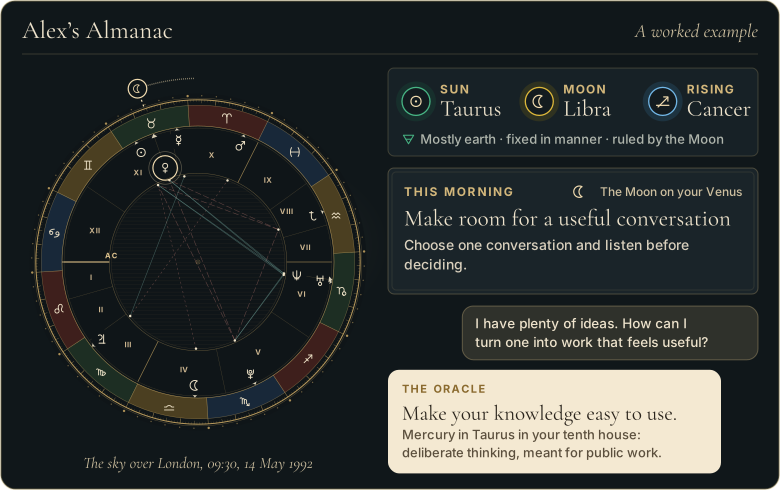
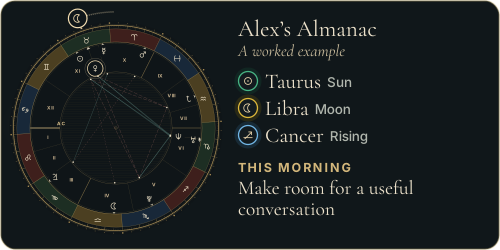
Walk through Alex’s whole example first
 The Road of AgesSee the turning points of your whole life, from your birth date
See your road's shape
The Road of AgesSee the turning points of your whole life, from your birth date
See your road's shape
Prefer to explore first?
 The Road of AgesThe turning points of your whole life, from your own chart
Walk my road
The Road of AgesThe turning points of your whole life, from your own chart
Walk my road
Free, by email
Your daily Almanac letter
One short letter at 7 each morning: the day’s theme read for your own chart, and one thing to do with it.
Curses in ancient and medieval evidence
Greek and Roman curse tablets preserve requests written on lead and deposited in graves, wells, sanctuaries, or other charged places. They address lawsuits, theft, competition, sex, and revenge. Medieval and early modern sources describe maleficium (harm attributed to magic) alongside charms, counter-magic, and legal prosecution. These records are evidence about belief, conflict, religion, and social vulnerability. They do not allow historians to verify supernatural causation. Nor do they form one continuous “witchcraft” religion: a Roman judicial defixio, a medieval clerical text, and a modern social-media curse belong to different settings.
Why accusations require exceptional care
Witchcraft accusations have often followed illness, crop failure, infant death, relationship conflict, or unexplained misfortune. Suspicion could concentrate on outsiders, healers, elderly women, rivals, or socially vulnerable people and produce torture, banishment, or killing. Similar dynamics continue where accused people face violence today. Never identify a supposed witch through a dream, divination, disability, animal encounter, coincidence, or rumor. A real act such as poisoning, stalking, threats, or vandalism should be investigated through evidence and law, not expanded into claims about a person’s hidden supernatural identity.
Unfamiliar objects and alleged curse signs
Knots, jars, powders, dolls, written names, dead animals, coins, or damaged household items can have many explanations. If an object may contain sharps, chemicals, biological material, or evidence of trespass, do not handle it barehanded. Photograph it in place, keep children and animals away, and contact property management or local authorities when appropriate. Avoid posting an accusation that exposes someone’s address or identity. A museum specialist may identify an old object, but no visual checklist can prove an invisible curse or determine who intended it.
Responding to fear and curse-removal fraud
Fear can make every setback feel connected. List events with dates, ordinary explanations, and independent evidence. Seek medical care for symptoms and qualified advice for legal or financial problems. Tell a trusted person if anxiety is disrupting sleep or functioning. Be wary of anyone who announces a curse without evidence, demands secrecy, threatens catastrophe, or requires repeated escalating payments to remove it. Stop sending money and contact payment providers or fraud services. Pastoral support may be comforting, but it should reduce isolation and strengthen practical care rather than confirm blame against a named person.
How to study Witchcraft Curse as history
The safest and most accurate way to approach Witchcraft Curse is as a textual, artistic, or social-history subject. Manuscripts and later printed editions often disagree, while modern websites freely combine material from unrelated periods. Check the date, language, manuscript family, editor, and provenance before repeating a claim. A description in a grimoire records what a text says; it does not establish that the named being or promised effect exists. This article therefore explains vocabulary, transmission, imagery, and reception without providing invocations, seals for use, coercive procedures, or instructions aimed at another person. Anyone experiencing fear, threats, stalking, coercion, or distress should address the observable situation and seek appropriate practical or professional support rather than escalating an occult explanation.
Sources and editorial method
Research and editorial references used for this page include:
- British Museum: Curse tablet collection search - Museum records for material objects classified as curse tablets.
- Encyclopaedia Britannica: Witchcraft - Historical overview of witchcraft beliefs, accusations, and persecution.
These references support the factual, historical, textual, or interpretive claims on this page. Interpretive traditions are identified as such, and factual claims are kept separate from symbolic claims.
Related reading
Refuse fear and accusation
A definition tells you what it is; your own birth chart tells you what it means for you. The Oracle casts your real chart and answers for your love, your work, and your year ahead, in conversation. It opens with the 7-day Seeker trial.
Speak with the OracleThe Cosmic Codex offers a reflective map of your year, written from your chart, never a prediction. Open the Cosmic Codex
More in Curses & Spiritual Warfare
- Bloodline Curse
- Curses
- Execration
- House Oppression
- Name of Jesus Protection
- Relationship Curse
- Spirit of Antichrist
- Spirit Spouse
From the reference page to your own chart
Every word here
is in your own chart.
- A personal reading about love, work or purpose, written from your chart
- A practical next step to consider
- It opens with 7 days free, with the AI Oracle and daily guidance
$0 today, then $12/month after 7 days. Cancel anytime.
Common questions
Do curse tablets prove curses worked?
No. They show that people commissioned or deposited texts with harmful intentions.
What should I do with a suspicious object?
Avoid unsafe handling, document it, and treat hazards or trespass through appropriate practical channels.
How can I spot a curse-removal scam?
Urgency, secrecy, threats, guaranteed results, and escalating fees are major warning signs.
Free, by email
The Almanac, in your inbox at 7
One short letter at 7 each morning: the day’s theme read for your own chart, and one thing to do with it.
