
Words, curses, and history
Malediction
Direct answer
Malediction comes through Latin roots meaning “speaking evil.” In careful use it is stronger than ordinary criticism: it conveys a wish, pronouncement, or invocation of harm. Whether a historical community believed the words had supernatural force is a separate question from what the words do rhetorically.
A malediction is a curse or an utterance that calls down harm, misfortune, or condemnation. The word can name the speech act itself, the content of the curse, or more loosely any forceful denunciation.
$0 today, then $12/month after 7 days. Cancel anytime.
Quick facts
| Related term | Useful distinction |
|---|---|
| Curse | The broad everyday category; malediction is often its formal or literary synonym. |
| Imprecation | A spoken wish or prayer that harm befall someone; very close in meaning. |
| Anathema | Can mean a formal religious condemnation or exclusion, not merely a hostile wish. |
| Benediction | A blessing or speaking of good; the conventional opposite of malediction. |

What does your own chart say about you?
Choose love, work or purpose. Your reading is written from your chart. Your reading uses your own birth details.
Walk through Alex’s whole example first
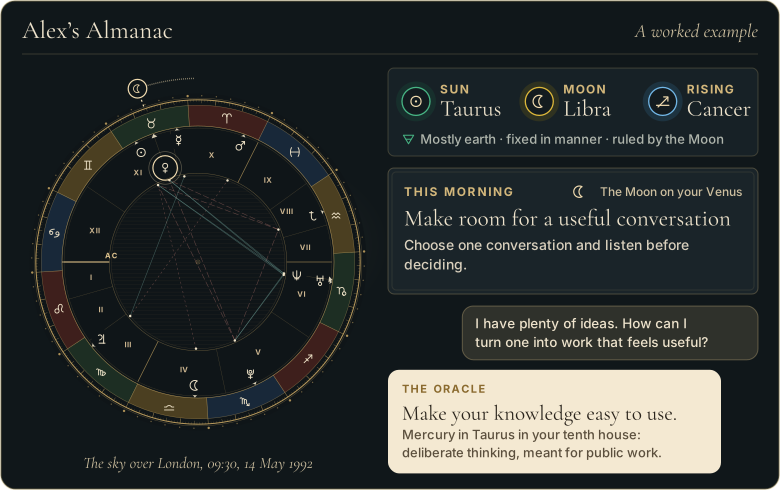
 The Road of AgesSee the turning points of your whole life, from your birth date
See your road's shape
The Road of AgesSee the turning points of your whole life, from your birth date
See your road's shape
Prefer to explore first?
 The Road of AgesThe turning points of your whole life, from your own chart
Walk my road
The Road of AgesThe turning points of your whole life, from your own chart
Walk my road
Free, by email
Your daily Almanac letter
One short letter at 7 each morning: the day’s theme read for your own chart, and one thing to do with it.
What malediction means
In its central sense, malediction is hostile speech framed as a curse. It may invoke divine judgment, predict calamity, consign an enemy to ruin, or formally denounce a person or group. Literary writers can also use the word figuratively for sustained abuse or condemnation. Context decides whether the speaker is portrayed as wielding supernatural power, petitioning a deity, enforcing a social boundary, or simply expressing rage in elevated language.
The word names a kind of utterance, not proof that its threatened effects occurred. Historians may document a malediction on a tablet, in a sermon, or in a poem while remaining neutral about metaphysical efficacy. That distinction is especially important when a later reader connects an illness, accident, or family conflict to hostile words. The existence of a curse text is evidence of belief and intention, not evidence that the curse caused a later event.
Etymology and the contrast with benediction
English malediction derives from Latin maledicere and maledictio, built from elements meaning badly or evil and to speak. The same verbal contrast appears in benediction, literally associated with speaking well and conventionally meaning a blessing. The pair preserves an old idea that formal words can confer benefit, mark condemnation, shape reputation, or call upon an authority beyond the individual speaker.
Etymology clarifies the core image but does not dictate every later usage. “Speaking evil” can mean slander in one setting, cursing in another, and a formula of ecclesiastical condemnation in a third. Translators must look at genre and audience rather than replacing every hostile ancient term with malediction. In modern English, the word often sounds archaic, ceremonial, theological, or deliberately dramatic.
Maledictions in religion, law, and literature
Ancient curse tablets record petitions against rivals in lawsuits, commerce, athletics, and love. Covenant and legal texts can attach curses to oath-breaking. Religious polemic may use malediction to define outsiders or warn against transgression. Epic, drama, and folklore turn the curse into a plot mechanism: a spoken sentence announces injustice, binds generations, or reveals the destructive reach of anger. These settings share hostile language but differ greatly in authority and expected mechanism.
A useful reading asks who speaks, who is addressed, who witnesses the speech, what power is invoked, and what consequence is named. Material form also matters. An inscription buried in a grave, a public proclamation, and a private outburst do not perform the same social work. Studying those differences reveals fear, conflict, and concepts of justice without reducing every malediction to a generic “spell.”
Reading curse language without amplifying harm

Maledictions can preserve violent, misogynistic, sectarian, or dehumanizing language. Quotation should be limited to what analysis requires, with attention to the people targeted and the power relations involved. A historical description should not become a ready-made formula for harassment. Nor should a symbolic reference be used to accuse a living person of supernatural attack; ordinary medical, legal, interpersonal, and technical explanations deserve priority.
If someone makes a direct threat, document the actual words and seek appropriate practical support. If fear centers on an old text or imagined curse, grounding and professional help are safer than paying a supposed remover. The scholarly questions remain concrete: what does the word mean here, what genre contains it, how did the audience understand speech, and what evidence exists for consequences beyond the claim itself?
Sources and editorial method
Research and editorial references used for this page include:
- Merriam-Webster: Malediction - Dictionary definition, word history, and usage examples.
- Smithsonian Libraries: Curse Tablets and Binding Spells from the Ancient World - Catalog record for a scholarly collection of translated ancient curse texts.
These references support the factual, historical, textual, or interpretive claims on this page. Interpretive traditions are identified as such, and factual claims are kept separate from symbolic claims.
Related reading
Turn harmful speech toward blessing
A definition tells you what it is; your own birth chart tells you what it means for you. The Oracle casts your real chart and answers for your love, your work, and your year ahead, in conversation. It opens with the 7-day Seeker trial.
Speak with the OracleThe Cosmic Codex offers a reflective map of your year, written from your chart, never a prediction. Open the Cosmic Codex
More in Curses & Spiritual Warfare
- Soul Tie Curse
- Spirit of Manipulation
- Territorial Spirit
- Blessing and Curse
- Curse of the Law
- Deuteronomy Curses
- Hex
From the reference page to your own chart
Every word here
is in your own chart.
- A personal reading about love, work or purpose, written from your chart
- A practical next step to consider
- It opens with 7 days free, with the AI Oracle and daily guidance
$0 today, then $12/month after 7 days. Cancel anytime.
Common questions
Is every insult a malediction?
No. An insult demeans; a malediction typically wishes, predicts, or invokes harm. A passage can contain both.
What is the opposite of malediction?
Benediction, meaning blessing, is the conventional opposite. The pair contrasts speaking harm with speaking good.
Does calling a text a malediction mean the curse worked?
No. The label identifies the form or intent of the utterance. Historical evidence for a curse text does not demonstrate supernatural causation.
Free, by email
The Almanac, in your inbox at 7
One short letter at 7 each morning: the day’s theme read for your own chart, and one thing to do with it.
