Seasons and sky
Tide
Direct answer
Tide: A Tide is a long-period rise and fall of ocean water driven chiefly by the gravitational interaction of Earth, Moon, and Sun and modified strongly by local geography.
A Tide is the recurring rise and fall of ocean level shaped mainly by lunar and solar gravity.
$0 today, then $12/month after 7 days. Cancel anytime.
At a glance
- Found in
- Seasons & Earth Almanac
- Related
- Astronomical Season, Meteorological Season, Equinox, Solstice
A Tide is the recurring rise and fall of ocean level shaped mainly by lunar and solar gravity.
A Sun-Earth orientation for seasonal, atmospheric, tidal, and terrestrial terms.
What does your own chart say about you?
Choose love, work or purpose. Your reading is written from your chart. Your reading uses your own birth details.
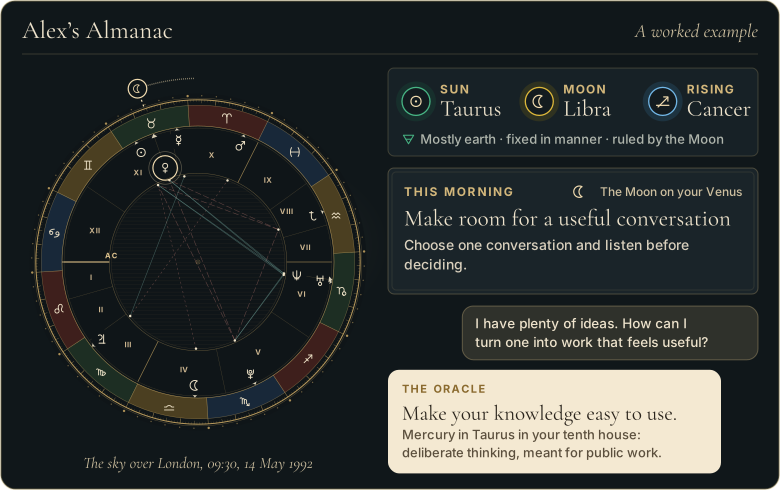
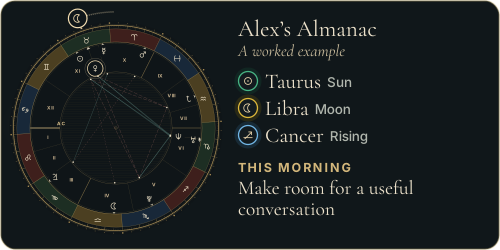
Walk through Alex’s whole example first
 The Road of AgesSee the turning points of your whole life, from your birth date
See your road's shape
The Road of AgesSee the turning points of your whole life, from your birth date
See your road's shape
Prefer to explore first?
 The Road of AgesThe turning points of your whole life, from your own chart
Walk my road
The Road of AgesThe turning points of your whole life, from your own chart
Walk my road
Free, by email
Your daily Almanac letter
One short letter at 7 each morning: the day’s theme read for your own chart, and one thing to do with it.
The story behind Tide
Coastal communities have tracked tides for navigation, fishing, harbor work, and safety; modern services combine harmonic prediction with observations.
Why Tide matters
Tides connect celestial geometry with real coastal conditions, but local timing and height require station-specific prediction.
Tide in practice: an example
Two nearby bays can experience different tide times and ranges because coastline and seafloor shape the tidal wave.
Where readings of Tide go wrong
A common error is to use a generic lunar rule as a substitute for official tide and hazard information.
Sources and editorial method
Research references used for this entry include:
- NOAA Ocean Service: What Are Spring and Neap Tides? - Official explanation of lunar-solar alignment and spring and neap tidal ranges.
- Source
- The Great Almanac Dictionary
- Category
- Seasons & Earth Almanac
- Last updated
- 2026-09-26
Check an official local tide station
A definition tells you what it is; your own birth chart tells you what it means for you. The Oracle casts your real chart and answers for your love, your work, and your year ahead, in conversation. It opens with the 7-day Seeker trial.
Speak with the OracleRelated terms
More in Seasons & Earth Almanac
- Axial Tilt
- Climatological Normal
- Earth Shadow
- Green Flash
- Midnight Sun
- Obliquity of the Ecliptic
- Semidiurnal Tide
- Subsolar Point
From the reference page to your own chart
Every word here
is in your own chart.
- A personal reading about love, work or purpose, written from your chart
- A practical next step to consider
- It opens with 7 days free, with the AI Oracle and daily guidance
$0 today, then $12/month after 7 days. Cancel anytime.
Common questions
What is a Tide?
A Tide is a long-period rise and fall of ocean water driven chiefly by the gravitational interaction of Earth, Moon, and Sun and modified strongly by local geography.
What do people get wrong about a Tide?
A common error is to use a generic lunar rule as a substitute for official tide and hazard information.
Free, by email
The Almanac, in your inbox at 7
One short letter at 7 each morning: the day’s theme read for your own chart, and one thing to do with it.