Seasons and sky
Subsolar Point
Direct answer
Subsolar Point: The Subsolar Point is the place on Earth where the Sun is directly overhead at a given instant.
The Subsolar Point is the location receiving vertical noon sunlight.
$0 today, then $12/month after 7 days. Cancel anytime.
At a glance
- Found in
- Seasons & Earth Almanac
- Related
- December Solstice, Solar Declination, Astronomical Season, Equinox
The Subsolar Point is the location receiving vertical noon sunlight.
A Sun-Earth orientation for seasonal, atmospheric, tidal, and terrestrial terms.
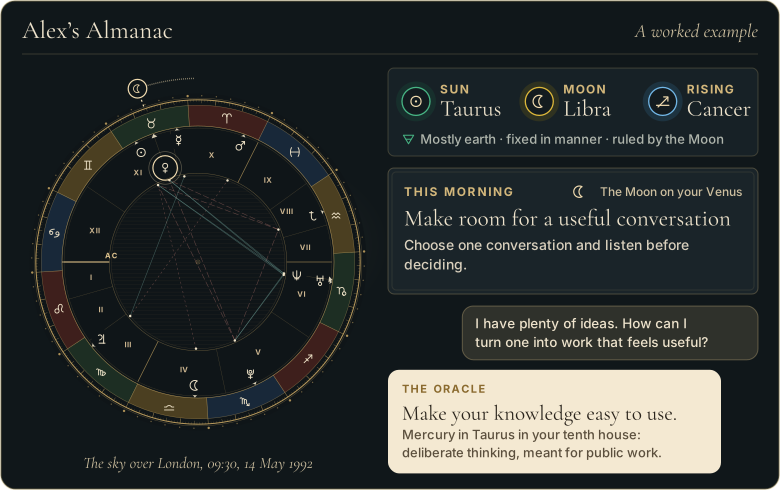
What does your own chart say about you?
Choose love, work or purpose. Your reading is written from your chart. Your reading uses your own birth details.
Walk through Alex’s whole example first
 The Road of AgesSee the turning points of your whole life, from your birth date
See your road's shape
The Road of AgesSee the turning points of your whole life, from your birth date
See your road's shape
Prefer to explore first?
 The Road of AgesThe turning points of your whole life, from your own chart
Walk my road
The Road of AgesThe turning points of your whole life, from your own chart
Walk my road
Free, by email
Your daily Almanac letter
One short letter at 7 each morning: the day’s theme read for your own chart, and one thing to do with it.
The story behind Subsolar Point
Geographers and navigators linked overhead-Sun observations with latitude long before global numerical maps were available.
Why Subsolar Point matters
Subsolar Point’s latitude follows solar declination and its longitude follows time, mapping the center of the daylight hemisphere.
How to read Subsolar Point
Subsolar Point speaks to solar geometry, satellite imagery, seasons, shadows, and the moving day-night pattern.
Subsolar Point in practice: an example
At an equinox the Subsolar Point lies on the equator and moves westward around Earth through the day.
Where readings of Subsolar Point go wrong
The usual misreading is to assume the Sun can be overhead outside the tropics.
Sources and editorial method
Research references used for this entry include:
- NASA Science: Seeing Equinoxes and Solstices from Space - NASA explanation of axial tilt, the terminator, seasonal illumination, equinoxes, and solstices.
- NOAA Global Monitoring Laboratory: Solar Calculator Glossary - NOAA definitions for solar geometry, atmospheric refraction, and civil, nautical, and astronomical twilight.
- Source
- The Great Almanac Dictionary
- Category
- Seasons & Earth Almanac
- Last updated
- 2026-09-26
Find where the Sun is overhead
A definition tells you what it is; your own birth chart tells you what it means for you. The Oracle casts your real chart and answers for your love, your work, and your year ahead, in conversation. It opens with the 7-day Seeker trial.
Speak with the OracleRelated terms
More in Seasons & Earth Almanac
- Tide
- Axial Tilt
- Climatological Normal
- Earth Shadow
- Green Flash
- Midnight Sun
- Obliquity of the Ecliptic
- Semidiurnal Tide
From the reference page to your own chart
Every word here
is in your own chart.
- A personal reading about love, work or purpose, written from your chart
- A practical next step to consider
- It opens with 7 days free, with the AI Oracle and daily guidance
$0 today, then $12/month after 7 days. Cancel anytime.
Common questions
What is the Subsolar Point?
The Subsolar Point is the place on Earth where the Sun is directly overhead at a given instant.
What do people get wrong about the Subsolar Point?
The usual misreading is to assume the Sun can be overhead outside the tropics.
Free, by email
The Almanac, in your inbox at 7
One short letter at 7 each morning: the day’s theme read for your own chart, and one thing to do with it.