Astrology
Synastry
Direct answer
Synastry is relationship astrology that compares two birth charts to study attraction, friction, compatibility, timing, projection, and mutual activation.
Synastry compares two charts to interpret relationship dynamics.
$0 today, then $12/month after 7 days. Cancel anytime.
At a glance
- In astrology
- Synastry reads contacts between planets and points across two charts, especially the Moon, Venus, Mars, Saturn, angles, nodes, and house overlays.
- Found in
- Astrology
- Related
- Birth Chart, Composite Chart, Venus, Mars
Synastry compares two charts to interpret relationship dynamics.
A structural orientation; exact placements depend on the chart or technique being discussed.
Understand your own relationship patterns.
Explore what you need in love and a next step for your situation. Your reading uses your own birth details.
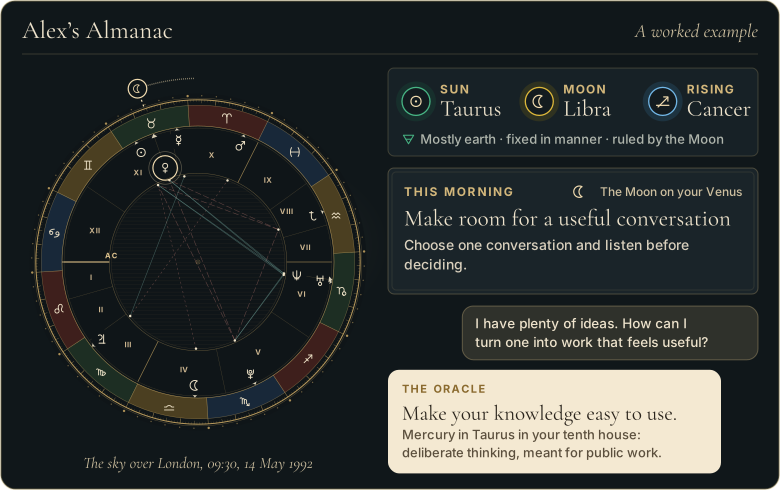
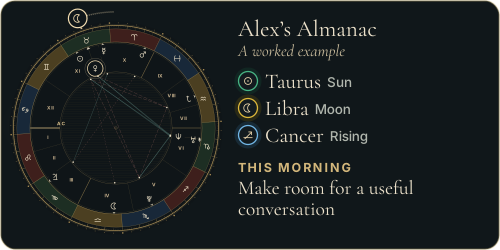
Walk through Alex’s whole example first
 The Road of AgesSee the turning points of your whole life, from your birth date
See your road's shape
The Road of AgesSee the turning points of your whole life, from your birth date
See your road's shape
Prefer to explore first?
 The Road of AgesThe turning points of your whole life, from your own chart
Walk my road
The Road of AgesThe turning points of your whole life, from your own chart
Walk my road
Free, by email
Your daily Almanac letter
One short letter at 7 each morning: the day’s theme read for your own chart, and one thing to do with it.
What sets Synastry apart
In synastry two complete charts stay separate, and the reader looks at what lies between them: aspects from one person's planets to the other's, and where one person's planets land in the other's houses. Ten bodies in each chart give a hundred possible planet pairs, so the Sun sign is only one of them. The results are read both ways, since a contact does not feel the same from each side.
- Pairs: 10 bodies against 10 gives 100 possible planet pairs
- Two kinds of contact: inter-chart aspects, and house overlays of one chart on the other
- Direction: each chart is read onto the other, so every overlay has two readings
- Name: from the Greek syn, together, and astron, star
- Modern text: Ronald Davison's Synastry (1977) set out the method widely used today
Often mistaken for something else: Synastry keeps both charts and compares them. A composite chart folds them into a single new chart made of midpoints.
A one-minute story
The Book of the Sky
How people learned to read the sky, from Babylon to the day you were born.

The story behind Synastry
Chart comparison is a longstanding astrological practice, with modern synastry adding psychological relationship language.
The spiritual meaning of Synastry
Spiritually, Synastry asks what relationship reveals, heals, mirrors, or matures.
Why Synastry matters
Synastry matters because real compatibility is not Sun-sign matching. It shows what each person activates in the other: affection, irritation, safety, desire, responsibility, growth, and blind spots.
How to read Synastry
Synastry speaks to romantic, friendship, family, business, mentorship, and client questions where two charts interact.
Synastry in practice: an example
One person's Mars on another person's Moon may bring chemistry, irritation, protection, or emotional urgency depending on the whole chart.
Where readings of Synastry go wrong
The usual misreading is to use Synastry to decide someone's worth or force a relationship conclusion.
Sources and editorial method
This entry summarizes the tradition in the Almanac's own words; where no source is listed, it is an editorial summary rather than a primary text, and symbolic readings are named as the tradition's, not as fact.
- Source
- The Great Almanac Dictionary
- Category
- Astrology
- Aliases
- relationship astrology
- Last updated
- 2026-09-26
Compare your relationship charts
Synastry in a book is one thing; Synastry in your own birth chart is your life. The Oracle casts your real chart and tells you what it means for your love, your work, and your year ahead, in conversation. It opens with the 7-day Seeker trial.
Speak with the OracleHow Synastry lives in your own chart across your year, in love, in work, in timing, is written in the Cosmic Codex: the whole year, once. Open the Cosmic Codex
Related terms
More in Astrology
- Age of Pisces
- Bonification
- Descendant
- Exaltation
- Hemisphere Emphasis
- Lot of Siblings
- Nocturnal Chart
- Refranation
From the reference page to your own chart
Every word here
is in your own chart.
- A personal reading about love, work or purpose, written from your chart
- A practical next step to consider
- It opens with 7 days free, with the AI Oracle and daily guidance
$0 today, then $12/month after 7 days. Cancel anytime.
Common questions
What is synastry?
Synastry is relationship astrology that compares two birth charts to study attraction, friction, compatibility, timing, projection, and mutual activation.
Where does synastry come from?
Chart comparison is a longstanding astrological practice, with modern synastry adding psychological relationship language.
What does synastry mean in astrology?
Synastry reads contacts between planets and points across two charts, especially the Moon, Venus, Mars, Saturn, angles, nodes, and house overlays.
What does synastry look like in a birth chart?
One person's Mars on another person's Moon may bring chemistry, irritation, protection, or emotional urgency depending on the whole chart.
What does synastry mean spiritually?
Spiritually, Synastry asks what relationship reveals, heals, mirrors, or matures.
Free, by email
The Almanac, in your inbox at 7
One short letter at 7 each morning: the day’s theme read for your own chart, and one thing to do with it.