Sky science
Rayleigh Criterion
Direct answer
Rayleigh Criterion: The Rayleigh Criterion conventionally resolves two point sources when one diffraction maximum falls on the other’s first minimum.
It is one standard threshold for separating diffraction patterns.
$0 today, then $12/month after 7 days. Cancel anytime.
At a glance
- Found in
- Astronomy & Skywatching
- Related
- Resolving Power, Diffraction Limit, Telescope Aperture, Telescope Focal Length
It is one standard threshold for separating diffraction patterns.
A scientific orientation to scale, light, or motion; the article supplies the precise definition.
What does your own chart say about you?
Choose love, work or purpose. Your reading is written from your chart. Your reading uses your own birth details.
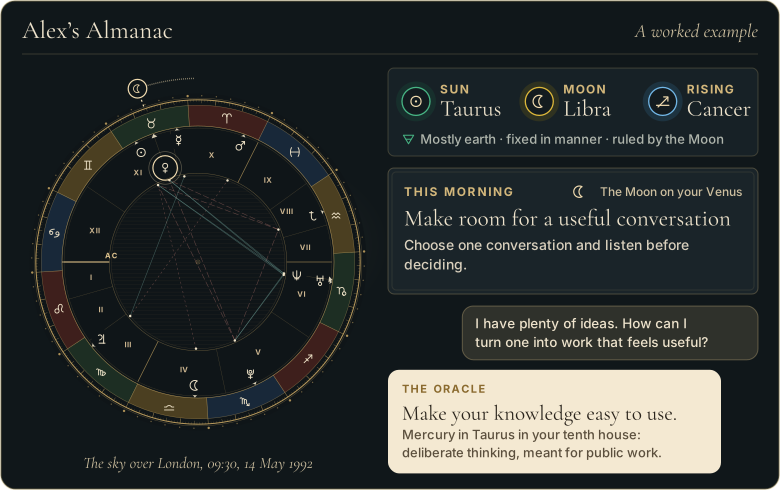
Walk through Alex’s whole example first
 The Road of AgesSee the turning points of your whole life, from your birth date
See your road's shape
The Road of AgesSee the turning points of your whole life, from your birth date
See your road's shape
Prefer to explore first?
 The Road of AgesThe turning points of your whole life, from your own chart
Walk my road
The Road of AgesThe turning points of your whole life, from your own chart
Walk my road
Free, by email
Your daily Almanac letter
One short letter at 7 each morning: the day’s theme read for your own chart, and one thing to do with it.
The story behind Rayleigh Criterion
Lord Rayleigh formalized resolution criteria within nineteenth-century wave optics.
A one-minute story
The Wandering Stars
How the moving planets were watched, named and found, and what a transit is.

Why Rayleigh Criterion matters
Rayleigh Criterion turns a gradual visibility problem into a useful numerical comparison.
Rayleigh Criterion in practice: an example
For a circular aperture the angle scales approximately as 1.22 wavelength divided by diameter.
Where readings of Rayleigh Criterion go wrong
Real detectors and image processing can use other definitions.
Sources and editorial method
Research references used for this entry include:
- European Southern Observatory: Technology for Telescopes - Observatory reference for aperture, angular resolution, atmospheric seeing, mirrors, and telescope technology.
- NASA Science: Universe Glossary - NASA definitions for common stellar, galactic, orbital, and high-energy astronomy terms.
- Source
- The Great Almanac Dictionary
- Category
- Astronomy & Skywatching
- Last updated
- 2026-09-26
Apply a resolution criterion
A definition tells you what it is; your own birth chart tells you what it means for you. The Oracle casts your real chart and answers for your love, your work, and your year ahead, in conversation. It opens with the 7-day Seeker trial.
Speak with the OracleRelated terms
More in Astronomy & Skywatching
From the reference page to your own chart
Every word here
is in your own chart.
- A personal reading about love, work or purpose, written from your chart
- A practical next step to consider
- It opens with 7 days free, with the AI Oracle and daily guidance
$0 today, then $12/month after 7 days. Cancel anytime.
Common questions
What is the Rayleigh Criterion?
The Rayleigh Criterion conventionally resolves two point sources when one diffraction maximum falls on the other’s first minimum.
What do people get wrong about the Rayleigh Criterion?
Real detectors and image processing can use other definitions.
Free, by email
The Almanac, in your inbox at 7
One short letter at 7 each morning: the day’s theme read for your own chart, and one thing to do with it.