
Demonology and grimoire history
Paimon
Direct answer
The early modern catalog provides Paimon with a rank, appearance, retinue, and set of attributed offices, but not the detailed personality or life story common in recent fiction. Historical claims should be traced to a manuscript or edition and separated from modern devotional, occult, and horror interpretations.
Paimon is a king in the Ars Goetia, usually listed ninth, whose entry emphasizes knowledge, arts, hidden matters, authority, and an elaborate arrival with music and attendants. The source depicts a crowned figure riding a dromedary.
$0 today, then $12/month after 7 days. Cancel anytime.
Quick facts
| Question | Historical answer |
|---|---|
| Where is Paimon described? | In the Ars Goetia, the first section of the Lemegeton or Lesser Key of Solomon. |
| What rank is assigned? | King, with a large body of subordinate spirits; legion counts vary across witnesses and editions. |
| What is the usual image? | A crowned person riding a dromedary, preceded by instruments and a noisy host. |
| What offices are named? | Teaching arts and sciences, explaining secret things, granting dignities, and binding or assigning familiars. |

What does your own chart say about you?
Choose love, work or purpose. Your reading is written from your chart. Your reading uses your own birth details.
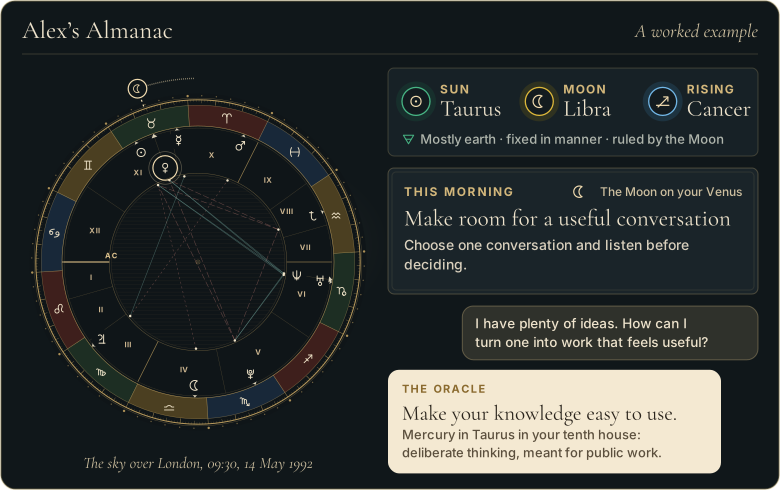
Walk through Alex’s whole example first
 The Road of AgesSee the turning points of your whole life, from your birth date
See your road's shape
The Road of AgesSee the turning points of your whole life, from your birth date
See your road's shape
Prefer to explore first?
 The Road of AgesThe turning points of your whole life, from your own chart
Walk my road
The Road of AgesThe turning points of your whole life, from your own chart
Walk my road
Free, by email
Your daily Almanac letter
One short letter at 7 each morning: the day’s theme read for your own chart, and one thing to do with it.
What the Goetic entry records
Paimon’s notice is longer than many entries in the Ars Goetia. It calls him a great king, says he is obedient to Lucifer, and describes his approach with a host and musical sound. The crowned rider on a dromedary is the central visual motif. The text assigns broad intellectual and political offices: teaching arts, sciences, and secret matters; explaining the nature of mind or knowledge; granting dignity; and giving authority over other spirits. Exact wording and legion totals differ across copies, so quotations require an identified edition.
Name variants, gender, and iconography
Spellings such as Paimon, Paymon, and Paimonia occur through manuscript transmission. The entry’s gendered language and description have also generated debate because early editions describe a masculine king while mentioning a feminine-looking face or form in some readings. That ambiguity should not be turned into a confident modern identity claim. Crown, camel-like mount, procession, and loud instruments signal kingship and ceremonial arrival within the catalog’s imagery; the text does not supply a complete symbolic key explaining each feature.
From Solomonic manuscripts to modern demonology
The Lemegeton is an early modern European compilation traditionally placed under Solomon’s name, not a text historians attribute to the biblical king. Paimon also has parallels or namesakes in related spirit catalogs, but resemblance must be demonstrated rather than assumed. The widely read 1904 Mathers-Crowley edition shaped English spelling and phrasing. Later ceremonial orders, demonological encyclopedias, games, films, and online communities have added correspondences, relationships, preferences, and narratives that may be meaningful within those settings but are not present in the brief manuscript record.
How to study Paimon without confusing source and fiction
Compare a searchable edition with manuscript catalog records, noting rank, wording, seal design, and neighboring entries. Label every later claim by date and author. A film portrayal is evidence for twenty-first-century reception, not early demonology; an unsourced “ancient fact” repeated across pages remains unsourced. Historical study does not require reciting conjurations or attempting contact, and this reference does not provide operational instructions. If demonic material triggers persistent fear or a sense of being commanded, step away and seek grounded support rather than treating a literary catalog as a diagnosis.
Sources and editorial method
Research and editorial references used for this page include:
- Project Gutenberg: The Lesser Key of Solomon - Searchable public-domain edition containing Paimon’s catalog entry.
- British Library: Sloane MS 3825 catalog record - Institutional record for a major manuscript witness to the Lemegeton tradition.
These references support the factual, historical, textual, or interpretive claims on this page. Interpretive traditions are identified as such, and factual claims are kept separate from symbolic claims.
Related reading
Separate fame from source
A definition tells you what it is; your own birth chart tells you what it means for you. The Oracle casts your real chart and answers for your love, your work, and your year ahead, in conversation. It opens with the 7-day Seeker trial.
Speak with the OracleThe Cosmic Codex offers a reflective map of your year, written from your chart, never a prediction. Open the Cosmic Codex
More in Demons & Fallen Beings
From the reference page to your own chart
Every word here
is in your own chart.
- A personal reading about love, work or purpose, written from your chart
- A practical next step to consider
- It opens with 7 days free, with the AI Oracle and daily guidance
$0 today, then $12/month after 7 days. Cancel anytime.
Common questions
Is Paimon in the Bible?
No. Paimon never appears in the Bible, in either Testament or the Apocrypha. The name comes from the early modern grimoires: Johann Weyer printed a catalogue of demons that includes Paimon in 1577, and the Ars Goetia, the first book of the Lesser Key of Solomon, makes him the ninth of its seventy-two spirits, a king. Films and games that pair him with Scripture are borrowing the name, not quoting a text.
Is Paimon an ancient god?
The secure reference point is an early modern grimoire tradition. Proposed links to older deities require separate linguistic and historical evidence and should not be stated as fact.
Is the Paimon in horror films historically accurate?
No film should be treated as a documentary source. Recent works borrow the name and selected motifs while creating their own plot, motives, and visual language.
Does the Ars Goetia describe Paimon’s personality?
Only indirectly through rank, appearance, behavior on arrival, and attributed offices. Detailed temperaments, likes, alliances, and biographies are mostly later developments.
Free, by email
The Almanac, in your inbox at 7
One short letter at 7 each morning: the day’s theme read for your own chart, and one thing to do with it.
