Demonology
Agrat Bat Mahlat
Direct answer
Agrat Bat Mahlat is a Jewish demonological figure, often described in later lore as a queen of demons who roams at night with a vast retinue.
Agrat Bat Mahlat is a night-demon queen in Jewish and Kabbalistic demonology.
$0 today, then $12/month after 7 days. Cancel anytime.
At a glance
- Found in
- Demons & Fallen Beings
- Related
- Demon, Fallen Angel, Spiritual Warfare, Discernment
What does your own chart say about you?
Choose love, work or purpose. Your reading is written from your chart. Your reading uses your own birth details.
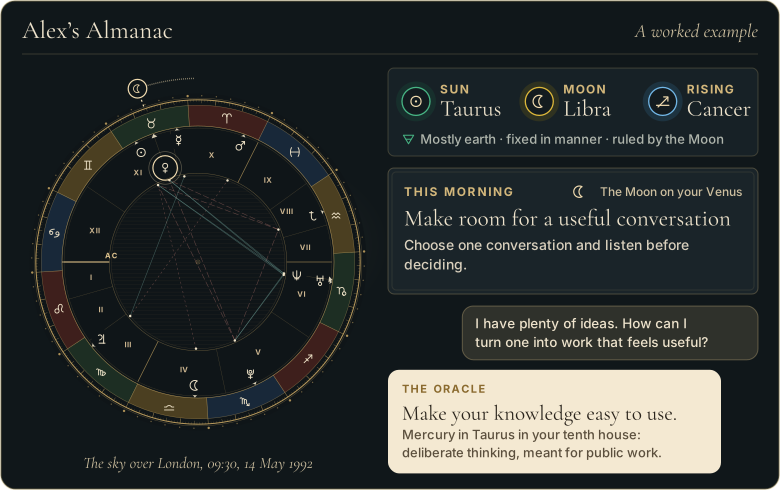
Walk through Alex’s whole example first
 The Road of AgesSee the turning points of your whole life, from your birth date
See your road's shape
The Road of AgesSee the turning points of your whole life, from your birth date
See your road's shape
Prefer to explore first?
 The Road of AgesThe turning points of your whole life, from your own chart
Walk my road
The Road of AgesThe turning points of your whole life, from your own chart
Walk my road
Free, by email
Your daily Almanac letter
One short letter at 7 each morning: the day’s theme read for your own chart, and one thing to do with it.
Where she appears in the sources
Agrat bat Mahlat, "Agrat daughter of Mahlat," enters the record in the Babylonian Talmud. Pesachim 112b preserves the tradition that one should not go out alone on Wednesday nights or Sabbath nights, "because Agrat bat Mahlat and eighteen myriads of destroying angels go forth, and each has permission to destroy on its own." The same passage tells how her license was curtailed: confronted by the sage Abaye (in the received story following an encounter with Rabbi Hanina ben Dosa), her free roaming was restricted to those two nights alone.
Later Kabbalistic literature developed her considerably, grouping her with Lilith, Naamah, and Eisheth Zenunim as the four queens or mothers of demons. That fourfold scheme is medieval and early modern elaboration, not Talmudic text, and the two layers are worth keeping distinct.
What the tradition was doing with her
Night-demon traditions like this one did cultural work. The named danger of particular nights gave form to real fears: travel after dark was genuinely dangerous, and a bounded prohibition (these two nights, not all nights) is characteristic of how the rabbis domesticated folk terror rather than amplifying it. The story arc of her restriction is itself the point: in the tradition's own telling, the fear has limits, and holiness sets them.
Scholars of rabbinic literature generally read these passages within the wider ancient Near Eastern world of protective customs, amulets, and incantation bowls, many of which survive and name similar figures.
Folklore, not a rule for your nights
The Great Almanac documents figures like Agrat bat Mahlat as textual history because the sources are real and the questions arrive constantly. It does not teach that Wednesday nights are dangerous, that named demons govern the calendar, or that anyone needs a protocol against them.
The Christian tradition's counsel here is the same one the Almanac applies to every fear-shaped claim: the unseen is not managed by schedule-keeping or fascination, dread is not discernment, and a person's nights belong to prayer and ordinary prudence, not to folklore's rota. Read the history with interest and sleep without it.
The story behind Agrat Bat Mahlat
Jewish Encyclopedia notes Agrat Bat Mahlat as a familiar queen of demons and connects her with night-roaming retinues in rabbinic tradition.
The spiritual meaning of Agrat Bat Mahlat
Spiritually, Agrat Bat Mahlat asks how inherited fear stories can be studied without obeying them.
Agrat Bat Mahlat in the Bible
Agrat Bat Mahlat is not a canonical biblical demon. Her developed role comes from later Jewish folklore and mystical commentary.
Why Agrat Bat Mahlat matters
Agrat Bat Mahlat matters because she shows how rabbinic warning lore, folk fear, and Kabbalistic demonology built vivid female demonic figures.
Where readings of Agrat Bat Mahlat go wrong
It is a mistake to turn folklore about nights and demons into anxiety triggers.
Sources and editorial method
This entry summarizes the tradition in the Almanac's own words; where no source is listed, it is an editorial summary rather than a primary text, and symbolic readings are named as the tradition's, not as fact.
Recorded here as history and lore. No rite is taught on this page.
- Source
- The Great Almanac Dictionary
- Category
- Demons & Fallen Beings
- Last updated
- 2026-09-26
Demystify night folklore
A definition tells you what it is; your own birth chart tells you what it means for you. The Oracle casts your real chart and answers for your love, your work, and your year ahead, in conversation. It opens with the 7-day Seeker trial.
Speak with the OracleThe Cosmic Codex offers a reflective map of your year, written from your chart, never a prediction. Open the Cosmic Codex
Related terms
More in Demons & Fallen Beings
From the reference page to your own chart
Every word here
is in your own chart.
- A personal reading about love, work or purpose, written from your chart
- A practical next step to consider
- It opens with 7 days free, with the AI Oracle and daily guidance
$0 today, then $12/month after 7 days. Cancel anytime.
Common questions
Who is Agrat Bat Mahlat?
Agrat Bat Mahlat is a Jewish demonological figure, often described in later lore as a queen of demons who roams at night with a vast retinue.
Where does Agrat Bat Mahlat come from?
Jewish Encyclopedia notes Agrat Bat Mahlat as a familiar queen of demons and connects her with night-roaming retinues in rabbinic tradition.
What does Agrat Bat Mahlat mean spiritually?
Spiritually, Agrat Bat Mahlat asks how inherited fear stories can be studied without obeying them.
What is the Christian view of Agrat Bat Mahlat?
Agrat Bat Mahlat is not a canonical biblical demon. Her developed role comes from later Jewish folklore and mystical commentary.
Free, by email
The Almanac, in your inbox at 7
One short letter at 7 each morning: the day’s theme read for your own chart, and one thing to do with it.