Fixed stars and angles
Fixed Star Parans
Direct answer
Parans must be calculated for a specific latitude, longitude, date, and time framework. A star can be far from a planet in ecliptic longitude yet form a paran because their horizon or meridian events coincide; ordinary longitude aspect orbs cannot establish the relationship.
A fixed-star paran links a star and a planet because both occupy angular positions at the same time: each is rising, culminating, setting, or reaching the lower meridian. It is a relationship in diurnal motion, not a zodiacal conjunction.
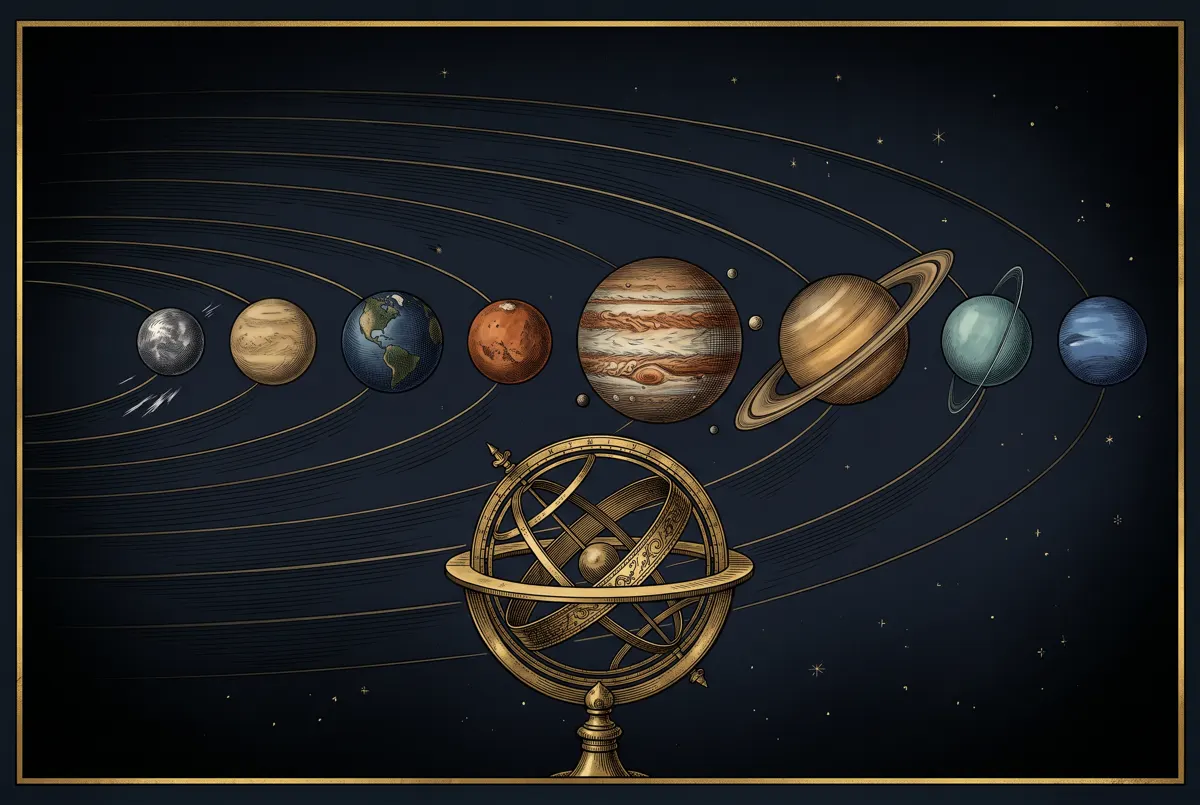
Fixed Star Parans are location-based contacts between fixed stars and chart factors.
The orbit map distinguishes physical bodies, calculated points, and symbolic cycles where possible.Quick facts
| Element | What it controls |
|---|---|
| Four angular events | Rising, upper culmination, setting, and lower culmination. |
| Location | Latitude changes whether and when a star reaches an angle; longitude anchors the local timing. |
| Birth time | Needed for natal parans tied to the sky at a particular moment or day. |
| Not the same as | A conjunction or aspect measured only along the ecliptic zodiac. |
The Instruments
Ten readings, worked out from your own birth chart
An instrument is a reading this house works out for you. Give your birth date, time and place once, and each one reads today’s real sky against the chart you were born under. Eight are personal; two are calendars anyone can open. A free account opens one instrument a day. The plans open every instrument, every day.
- Natal Chart Every planet, house and aspect in your chart
- Active Transits Where the planets are now, read against your chart
- Daily Counsel What to pursue today, and what to leave alone
- Personal Timing Your best days to decide, weeks ahead
- Fellowship Your chart and another, read side by side
- Theme of the Day The one thing today is asking of you
- Sacred Numbers Your life path, your cycles, your name in numbers
- Aeolian Harmonics Classical music chosen to match your chart
- Mercury Retrograde Every Mercury retrograde this year, with its dates Open to all
- Void-of-Course Moon When the Moon is between signs, hour by hour Open to all






What a paran actually measures
Paran is short for paranatellonta, a term connected with bodies that rise together or otherwise share angular timing. In contemporary fixed-star practice, the definition is broader than simultaneous rising. One body may rise while another culminates, set while another reaches the lower meridian, or form any other pairing among the four principal angles. The relationship is established through local diurnal motion across the horizon and meridian.
This differs fundamentally from checking whether a planet and star share the same tropical longitude. Stars can lie far north or south of the ecliptic, so longitude alone compresses their three-dimensional position into a coordinate that may not capture visible angular behavior. A paran preserves declination, latitude, and local sky geometry. That is why a star with no close zodiacal conjunction can still have a precisely timed relationship with a planet.
How parans are calculated
A calculation begins with accurate right ascension and declination for the star and planet, corrected to the relevant epoch, plus the terrestrial latitude and longitude. Spherical astronomy then determines the local sidereal times at which each body crosses the eastern horizon, upper meridian, western horizon, or lower meridian. The calculator compares those event times and declares a paran when their separation falls within the chosen time or arc tolerance.
Stars can be circumpolar at high latitudes, never setting below the horizon, while others never rise. Software must handle those cases instead of inventing events. Atmospheric refraction, whether a star’s center or apparent limb is used, precession, proper motion, and the treatment of the birth date can all cause small discrepancies. A reproducible result lists the location, event pair, star position source, coordinate epoch, and allowable separation.
Birth-moment and latitude paran methods
Not every astrologer uses the word paran identically. Some examine simultaneous angular contacts at the exact birth moment. Others calculate the series of star and planet angular crossings during the birth day at the natal latitude, creating a set of “paran phases” even when the paired event did not occur at the clock minute of birth. Both can be internally coherent, but their results answer different questions and should never be merged without explanation.
This distinction also affects birth-time sensitivity. Exact-moment parans can change quickly with the angles and require a reliable recorded time. Day-based latitude parans remain rooted in the date and location but use their own rules for the relevant day boundary. Relocation raises another question: some practitioners retain birthplace parans as natal signatures, while others inspect new angular relationships at the relocated latitude. State which chart and convention are being interpreted.
Reading a paran without flattening the star
Interpretation joins the star’s documented historical symbolism, the planet’s astrological function, and the particular angular phase. Rising can emphasize emergence or visibility; culmination public peak or elevation; setting encounter and decline; lower culmination roots, privacy, or foundations. These are symbolic associations, not physical forces. The same star-planet pair may be described differently if one source relies on ancient star lore and another on a modern interpretive school.
A strong reading names the exact pair (such as star rising while Venus culminates) rather than claiming that someone simply “has” the star. It checks whether a later myth has been misassigned to the star, avoids uniformly labeling stars benefic or dangerous, and compares the symbolism with biography. Parans are an astrological technique rather than a scientifically validated predictor, even though their underlying horizon and meridian calculations are astronomical.
Sources and editorial method
Research and editorial references used for this page include:
- Astrodienst Astrowiki: Paran - Technical overview of paranatellonta and fixed-star paran practice.
- NASA JPL: Horizons system manual - Reference for obtaining time-dependent astronomical coordinates and understanding output settings.
These references support the factual, historical, textual, or interpretive claims on this page. Interpretive traditions are identified as such, and factual claims are kept separate from symbolic claims.
Related reading
Read fixed stars precisely
Fixed Star Parans in a book is one thing; Fixed Star Parans in your own birth chart is your life. The Oracle casts your real chart and tells you what it means for your love, your work, and your year ahead, in conversation, free.
Speak with the OracleWhere Fixed Star Parans moves through your own year, and what that asks of your love and your work, is written in the Cosmic Codex, month by month from your chart. Open the Cosmic Codex
More in Planets & Celestial Bodies
Common questions
Is a paran the same as a fixed-star conjunction?
No. A conjunction compares zodiacal longitude, while a paran compares the local timing of horizon and meridian events.
Why does changing birthplace change the paran list?
Latitude changes the arcs and times at which stars rise, culminate, and set. Some stars also become circumpolar or invisible at extreme latitudes.
Can parans be calculated without an exact birth time?
Some day-based methods can calculate angular pairings for the birth date and latitude, but exact-moment natal parans require a reliable time. The chosen method must be named.