

Biblical symbol
Bull
Direct answer
Bull is a biblical symbol of strength, fertility, sacrifice, wealth, danger, and sometimes idolatry.
Bull symbolizes powerful embodied strength that can serve worship or become an idol.
$0 today, then $12/month after 7 days. Cancel anytime.
At a glance
- Found in
- Biblical Symbolism
- Related
- Tree of Life, Tree of Knowledge, Serpent, Temple
Bull symbolizes powerful embodied strength that can serve worship or become an idol.
A symbolic reading aid; dates, predictions, and supernatural certainty are deliberately excluded.
What does your own chart say about you?
Choose love, work or purpose. Your reading is written from your chart. Your reading uses your own birth details.
Walk through Alex’s whole example first
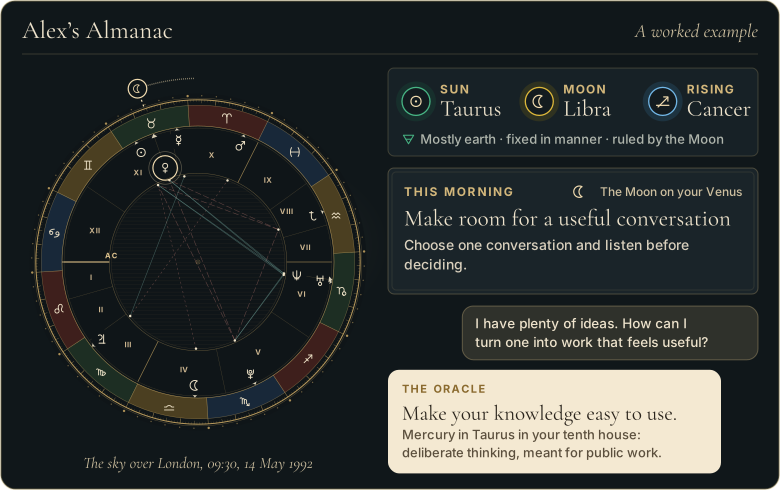
 The Road of AgesSee the turning points of your whole life, from your birth date
See your road's shape
The Road of AgesSee the turning points of your whole life, from your birth date
See your road's shape
Prefer to explore first?
 The Road of AgesThe turning points of your whole life, from your own chart
Walk my road
The Road of AgesThe turning points of your whole life, from your own chart
Walk my road
Free, by email
Your daily Almanac letter
One short letter at 7 each morning: the day’s theme read for your own chart, and one thing to do with it.
Hill's Age of the Bull
J. H. Hill ties the bull to the Age of Taurus, when the spring equinox lay in that sign. He lists Apis, Baal, the winged bull, the silver bull heads of Mycenae and the golden calf as its images, and reads the T-shaped temples as the first cross, the sign of Taurus.
He puts the bull of God that "taketh away sin" as the image later taken over by the lamb. His Age of Taurus ends about 4,300 years before his time. These are his arguments.
The bull among the four creatures
Taurus is also the ox or calf of the four living creatures, one of the four fixed signs. Hill pairs it with Aquarius as the Cherubim, the half of the year when days grow longer. See Four Living Creatures and Age of Aquarius.
The story behind Bull
Ancient Near Eastern religions often used bull imagery for divine strength and fertility, which forms the background to biblical polemic.
The spiritual meaning of Bull
Spiritually, Bull asks whether strength and appetite are being consecrated or enthroned.
Bull in the Bible
Bulls appear in sacrificial law, prophetic imagery, royal strength, and idol critique such as the golden calf story.
Why Bull matters
Bull matters because the same animal can stand near the altar, the field, royal power, or the golden calf.
Where readings of Bull go wrong
The usual misreading is to treat bull imagery as one-note masculinity symbolism.
Sources and editorial method
This entry summarizes the tradition in the Almanac's own words; where no source is listed, it is an editorial summary rather than a primary text, and symbolic readings are named as the tradition's, not as fact.
- Source
- The Great Almanac Dictionary
- Category
- Biblical Symbolism
- Last updated
- 2026-09-26
See it in your own chart
A definition tells you what it is; your own birth chart tells you what it means for you. The Oracle casts your real chart and answers for your love, your work, and your year ahead, in conversation. It opens with the 7-day Seeker trial.
Speak with the OracleThe Cosmic Codex offers a reflective map of your year, written from your chart, never a prediction. Open the Cosmic Codex
Related terms
More in Biblical Symbolism
- Dove in the Bible
- Golden Lampstand
- Laver of Bronze
- Names Written in Heaven
- Rainbow
- Seven Seals
- Twelve Tribes
- Ark
From the reference page to your own chart
Every word here
is in your own chart.
- A personal reading about love, work or purpose, written from your chart
- A practical next step to consider
- It opens with 7 days free, with the AI Oracle and daily guidance
$0 today, then $12/month after 7 days. Cancel anytime.
Common questions
What is bull?
Bull is a biblical symbol of strength, fertility, sacrifice, wealth, danger, and sometimes idolatry.
Where does bull come from?
Ancient Near Eastern religions often used bull imagery for divine strength and fertility, which forms the background to biblical polemic.
What does bull mean spiritually?
Spiritually, Bull asks whether strength and appetite are being consecrated or enthroned.
What do people get wrong about bull?
The usual misreading is to treat bull imagery as one-note masculinity symbolism.
Free, by email
The Almanac, in your inbox at 7
One short letter at 7 each morning: the day’s theme read for your own chart, and one thing to do with it.


