

Numerology and Spiritual Growth
Numerology can supply memorable themes for reflection, but arithmetic does not prove a spiritual message. Growth must be evaluated through observable qualities such as honesty, patience, courage, responsibility, compassion, repair, and freedom from compulsive checking.
$0 today, then $12/month after 7 days. Cancel anytime.
Direct answer
Short version
The safest way to connect numerology with spiritual growth is to treat a number as a question, not an authority. Choose one grounded practice, record what happens, consider contrary evidence, and let conscience, community, Scripture or another declared tradition, and real-world responsibility outrank the pattern.

What could this mean for your life?
Explore your recurring patterns, what matters to you, and a way forward. Your reading uses your own birth details.
Walk through Alex’s whole example first
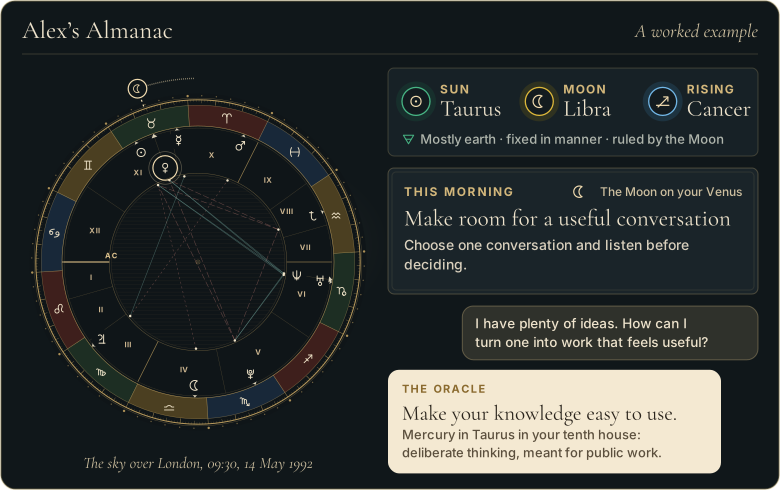
 The Road of AgesSee the turning points of your whole life, from your birth date
See your road's shape
The Road of AgesSee the turning points of your whole life, from your birth date
See your road's shape
Prefer to explore first?
 The Road of AgesThe turning points of your whole life, from your own chart
Walk my road
The Road of AgesThe turning points of your whole life, from your own chart
Walk my road
Free, by email
Your daily Almanac letter
One short letter at 7 each morning: the day’s theme read for your own chart, and one thing to do with it.
Quick facts
| Practice | Grounded standard |
|---|---|
| Number interpretation | A symbolic association, not proof of causation or revelation |
| Spiritual growth | A change in character, conduct, relationship, attention, or responsibility |
| Discernment | Testing source, context, fruit, alternatives, and consequences |
| Journaling | Record the interpretation before events so misses and contradictions remain visible |
| Stopping rule | Pause when number searching increases fear, compulsion, superiority, or avoidance |
A one-minute story
The Music of Number
From a blacksmith's hammers to your Life Path: the story of number.

What numerology contributes, and what it does not
Numerology assigns symbolic significance to numbers derived from dates, names, repeated sequences, or cycles. Its systems are cultural and conventional: Pythagorean name values differ from Chaldean mappings, master-number rules vary, and personal timing methods do not all begin on the same date. The arithmetic may be reproducible once rules are chosen, but the claimed meanings are interpretations rather than measurements of an invisible force.
That distinction does not make reflection meaningless. A number can function like a prompt in a journal or sermon illustration. A 4 theme may lead someone to examine structure; a 6 theme may raise responsibility and care; a 9 theme may invite review and completion. The value comes from the quality of attention and action, not from proving that the number caused the week’s events.
Define spiritual growth in observable terms
“Growth” becomes vague when it means feeling special, receiving constant signs, or collecting increasingly elaborate interpretations. A stronger definition concerns formation: becoming more truthful under pressure, more able to repair harm, less controlled by fear, more patient with uncertainty, and more responsible for practical obligations.
A spiritual interpretation should therefore produce a testable next step. If the theme is 2 and cooperation, the practice might be listening without preparing a rebuttal in one specific conversation. If the theme is 8 and stewardship, the practice might be reviewing actual expenses rather than visualizing abundance. If the theme is 7 and contemplation, it might mean twenty quiet minutes followed by a decision, not endless withdrawal.
Feelings matter, but fruit takes time. One striking coincidence can create excitement without changing character. Repeated small acts (keeping promises, naming limits, apologizing, serving, studying, resting, or seeking help) offer better evidence that reflection has become growth.
A disciplined reflection method
- Name the calculation or observed sequence exactly. Do not switch methods after seeing which interpretation feels most flattering.
- Write the number’s proposed theme in one sentence before reviewing the day or week.
- List at least one ordinary explanation for why the number appeared, such as attention, routine, a common timestamp, or selective memory.
- Choose one action small enough to complete and clear enough to evaluate.
- At the end of the period, record supporting evidence, contrary evidence, and events that had no meaningful connection.
- Ask whether the practice increased honesty, peace, responsibility, courage, and care, or increased fear, pride, control, and dependency.
- Close the inquiry after the review. Do not keep searching for more sequences to force certainty.
Pattern recognition and confirmation bias
Human attention is built to detect patterns. Once a sequence such as 444 becomes important, it is easier to notice on clocks, receipts, addresses, and counters while thousands of other numbers pass without being remembered. Confirmation bias then favors matches and explains away misses. These ordinary processes do not prove that every experience is empty; they show why a strong feeling of significance is not enough to establish an external message.
Prospective journaling is useful because it preserves predictions and interpretations before memory reshapes them. If a number is said to indicate communication, define what would count, how often ordinary communication happens, and what would count against the idea. A claim that fits every possible result cannot guide discernment.
A Christian discernment boundary

The Bible uses numbers in narrative, law, poetry, genealogy, prophecy, and literary structure. That fact does not create a general biblical method for treating repeated clock numbers as private angelic instructions. Scripture passages should be read in their literary and historical context rather than searched for chapter-and-verse combinations that resemble a receipt or timestamp.
A Christian can use a number as a reminder to pray or examine conduct without claiming divine authorization. The content of the response should remain consistent with love of God and neighbor, truthfulness, humility, freedom from divination, and wise counsel. A pattern should never outrank the plain responsibilities already known.
Traditions outside Christianity require the same honesty about method. State the worldview, do not borrow sacred claims without context, and distinguish personal symbolism from a teaching that a community actually recognizes.
When the practice stops helping
Compulsive checking
Repeatedly refreshing clocks, totals, or feeds to obtain reassurance strengthens anxiety rather than discernment.
Decision avoidance
Waiting for a number can postpone a conversation, appointment, safety response, or evidence-based choice.
Spiritual superiority
Believing that frequent patterns prove special rank can isolate a person from correction and community.
Financial exploitation
A reader should not need escalating purchases to decode an allegedly urgent message.
Medical substitution
Numbers cannot diagnose illness or replace qualified assessment, treatment, or crisis care.
Relationship control
A sequence cannot establish another person’s feelings, consent, fidelity, or obligation to return.
A seven-day growth experiment
Select one number theme and translate it into one behavior. Record the baseline: how often is the behavior already present, and what makes it difficult? Practice it once each day without hunting for confirming numbers. On day seven, review the behavior rather than the coincidences.
Keep the theme only if it made conduct more grounded. Revise it if the symbol was too vague. End it if it increased anxiety or avoidance. This approach allows symbolic curiosity while protecting freedom: the person remains responsible for choosing, testing, and changing course.
Sources and editorial method
Research and editorial references used for this page include:
- Encyclopaedia Britannica: Numerology - Historical reference framing numerology as belief in symbolic relationships between numbers and events.
- American Psychological Association: The Writing Cure - Research overview on expressive writing, including its possible benefits and important limits.
- Bible Gateway: Romans 12 - Canonical Christian context for discernment, humility, transformed conduct, and communal responsibility.
- International OCD Foundation: What Is OCD? - Clinical context for recognizing intrusive fears and compulsive reassurance behavior without spiritualizing them.
These references support the factual, historical, textual, or interpretive claims on this page. Interpretive traditions are identified as such, and factual claims are kept separate from symbolic claims.
Related reading
From the method to your own numbers
Your numbers,
worked out for you.
- A personal reading about love, work or purpose, written from your chart
- A practical next step to consider
- It opens with 7 days free, with the AI Oracle and daily guidance
$0 today, then $12/month after 7 days. Cancel anytime.
Common questions
Can numerology cause spiritual growth?
A symbolic prompt may support reflection, but growth comes through attention, practice, relationship, grace, learning, and accountable action. The number itself does not establish causation.
Are repeated numbers messages from angels?
That belief exists in modern popular spirituality, but it is not established by the appearance of the sequence and is not a general biblical teaching. Consider ordinary explanations and avoid claiming certainty.
How can I test a numerology interpretation?
Write it before the period, define what would count for and against it, record misses as carefully as matches, and evaluate whether the resulting action improved real conduct.
When should I stop checking numbers?
Stop when checking produces distress, interferes with sleep or responsibilities, drives spending, or feels necessary to prevent harm. Grounding and qualified mental-health support can help when the cycle is difficult to interrupt.
Free, by email
The Almanac, in your inbox at 7
One short letter at 7 each morning: the day’s theme read for your own chart, and one thing to do with it.
