
Silence
The oldest discipline, and the gentlest.
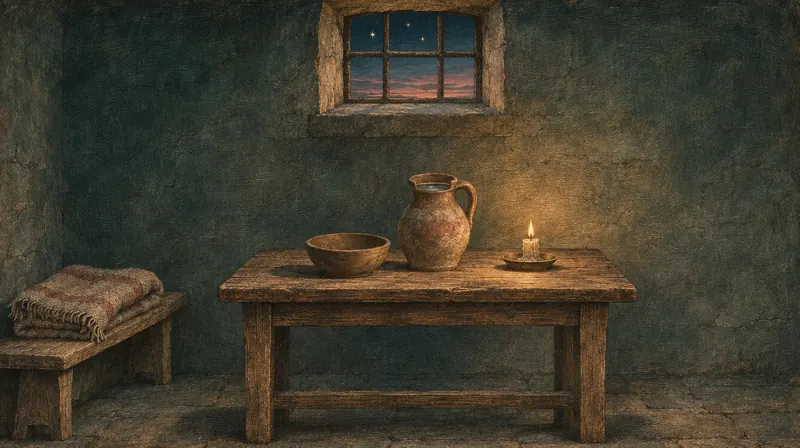
What does a discipline of silence teach, like fasting from speech, and how do I try a day of it?
What it is
Silence is the oldest discipline and the gentlest. It asks nothing of the body except that the tongue rest. Monasteries keep the Great Silence from the last prayer of the evening until after the first of the morning. Hindu teachers take vows of mauna, not speaking; Gandhi kept one day of silence every week. Quakers worship in it. The aim is the same in each: to hear what the talk was covering, in oneself and all around.
The teaching
As the desert elders, Benedict's Rule, the Quakers and the Indian vow of mauna teaches it.
The rest of the tongue
Silence asks nothing of the body except that the tongue rest. It is the oldest discipline and the gentlest, and every tradition that keeps it gives the same reason: talk covers what is there, in oneself and all around, and silence lets it be heard. The Hebrew Scriptures put it plainly: 'In the multitude of words there wanteth not sin', and 'Be still, and know that I am God.'
Flee, be silent, pray
The desert elders made silence a school. When Arsenius, once a tutor at the imperial court, asked how to be saved, a voice told him: flee, be silent, pray. Abba Agathon, it is said, carried a stone in his mouth for three years until he had learned to keep quiet.
Yet the elders taught that silence is of the heart before the tongue. Abba Poemen said that a person may seem silent while the heart condemns others, and so talk without ceasing; another may speak from morning until night and still keep silence, because nothing said is idle.
The restraint of speech
Benedict gives a chapter of his Rule to the restraint of speech. He begins with the psalm, 'I said, I will take heed to my ways, that I sin not with my tongue', and teaches that even good words are kept few, out of respect for silence, while idle and foolish talk is shut out altogether. Among his steps of humility, the monk keeps quiet until he is asked, does not laugh easily or loudly, and when he speaks, speaks gently, seriously and briefly, with few and reasonable words.
Speech in Benedict's house is not forbidden but weighed. What needs to be said is said, simply and at the right time, and the rest is left in silence.
The Great Silence
From the last prayer of the evening until after the first prayer of the morning, monasteries keep the Great Silence. Benedict asks that no one speak at all after Compline, unless a guest's need or the abbot's command requires it. The night is kept quiet so that the day begins in prayer. Communities that lived in silence through most of the day, the Trappists for a long time among them, said what was necessary in a language of signs.
Noble silence
The Buddha found his monks gathered and talking and told them that when they meet there are two things to do: speak of the teaching, or keep noble silence. Meditation retreats today keep noble silence for days together: no speaking, no gestures, no meeting of the eyes, often no reading or writing, so that the attention that usually goes outward can stay with the practice. Only the teacher is spoken to, and only when there is need.
Mauna, the silence of the sage
In India the silent sage is the muni, and his silence is mauna. Teachers take vows of mauna for a day, for weeks or for years; the strictest forbid even gestures and writing, the gentlest allow a note for what must be said. Gandhi kept one day of silence every week, and worked and wrote through it. Ramana Maharshi taught that silence is itself the highest teaching, and gave it to many who sat with him without a word being spoken.
The vow is kept for the inner quiet it makes room for, not for the outward show of it.
Waiting in silence
The Quakers worship in silence. They gather without a priest, a set prayer or a programme, sit together and wait upon God, settling into a deeper stillness, which they call centring down. If anyone feels moved by the Spirit to speak, they stand and say what is given, briefly, and the silence closes over it again. Many meetings pass with no word spoken at all, and that is not counted as empty. The meeting ends when two elders shake hands, and then everyone does.
A day of silence
A morning, or a day, is enough to begin. Tell the household beforehand, so that the silence is not taken for anger. Put the telephone away, and go about ordinary quiet tasks without speaking and without filling the gap with screens, music or reading. If something must be said, write a short note.
Notice the urge to speak when it comes, what it wanted, and what happens when it passes; notice the sounds that talk usually covers. Break the silence at once for anyone's safety or need. At the end write a few lines: what was noticed, and what the first words were, chosen with care.
Silence is chosen and kept by oneself, and nobody else is made to keep it. Chosen quiet is a different thing from isolation, and if the silence turns heavy or lonely, it is broken, and a friend is called.
How it is practised
A morning, or a day, is enough to begin. The reader tells the household beforehand, puts the telephone away, and goes about ordinary quiet tasks without speaking and without filling the gap with screens. A note is written if something must be said, and the silence is broken at once for anyone's safety or need. At the end a few lines are written down: what was noticed, and what the first words were. Nobody else is made to keep it.
Where it comes from
Later tradition says the pupils of Pythagoras kept silent for five years before they might speak in his presence. Among the Desert Fathers, Arsenius was told to flee, be silent and pray. Benedict's Rule, about 530, has a chapter on restraint of speech and forbids talk after the evening office. Medieval anchorites, many of them women, were enclosed for life in a cell against a church wall. The Carthusians, founded in 1084, have lived mostly in silence ever since, and the Trappists long spoke by signs.
What is known, and what is not
The monastic rules are documented, and the five years of the Pythagoreans rest on writers of many centuries later. A small study by Luciano Bernardi, published in 2006, found that two-minute silences between pieces of music slowed the heart and breath more than the calmest music did. Chosen quiet is different from isolation: long solitude that is forced on a person is known to harm.
Its words
- Great Silence
- The monastic rule of not speaking from the last prayer of the evening until after the first prayer of the morning.
- Desert Fathers
- The Christian monks of the Egyptian, Syrian and Palestinian deserts from the late third century, teachers of fasting, silence and watchfulness.
- Anchorite
- A medieval recluse, man or woman, shut by a bishop's rite into one cell against a church wall and vowed to stay there until death.
Ask the Oracle further
What does the ascetic discipline of silence do that fasting does not?Did the pupils of Pythagoras really keep an ascetic silence of five years?
Before you practise
Never go without water, and do not fast beyond a day without a doctor’s word; not at all if you are pregnant, under eighteen, diabetic, on medicine, underweight or have had an eating disorder. Never give up sleep for a practice, never enter cold water alone, and never stare at the sun. If food or your body has become a fear, please tell a doctor.
Its other branches
Fasting in the religionsWhere the body sets the limitCold and the vigilTraining the willThe whole artSearch the tree

