

Constellations
Vela
Direct answer
Vela lies between Carina, Puppis, Centaurus, and Pyxis in the southern Milky Way. It is easiest to explore on February and March evenings from the Southern Hemisphere, where its stars and deep-sky objects stand high above the horizon.
Vela, Latin for “the sails,” is a southern constellation that once formed part of the enormous Argo Navis. It contains bright navigation stars, the False Cross, a nearby supernova remnant and pulsar, rich clusters, and extensive nebulae.
$0 today, then $12/month after 7 days. Cancel anytime.
Quick facts
| Category | Details |
|---|---|
| Official name and abbreviation | Vela, Vel |
| Name meaning | The sails |
| Sky region | Southern celestial hemisphere, along the Milky Way |
| Historical parent figure | Argo Navis, the ship of Jason and the Argonauts in Greek tradition |
| Major observing targets | Vela supernova remnant and pulsar, Gum Nebula, IC 2391, Gamma Velorum |

What does your own chart say about you?
Choose love, work or purpose. Your reading is written from your chart. Your reading uses your own birth details.
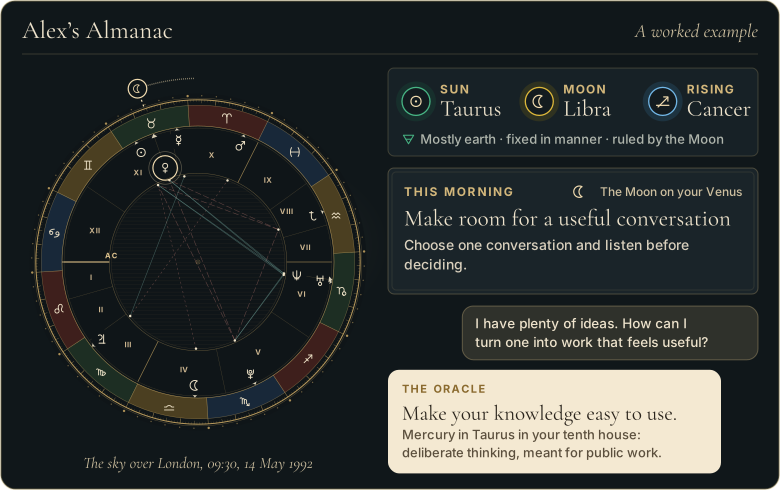
Walk through Alex’s whole example first
 The Road of AgesSee the turning points of your whole life, from your birth date
See your road's shape
The Road of AgesSee the turning points of your whole life, from your birth date
See your road's shape
Prefer to explore first?
 The Road of AgesThe turning points of your whole life, from your own chart
Walk my road
The Road of AgesThe turning points of your whole life, from your own chart
Walk my road
Free, by email
Your daily Almanac letter
One short letter at 7 each morning: the day’s theme read for your own chart, and one thing to do with it.
What and where Vela is
Vela is one of the 88 official constellations whose modern boundaries cover the whole sky. Its name is the Latin plural for sails, preserving one portion of Argo Navis, the ship constellation known in Greco-Roman star tradition. Unlike an asterism, Vela is not merely a connect-the-dots picture: every coordinate inside its International Astronomical Union boundary belongs to Vela.
It occupies a dense part of the southern Milky Way. Carina lies mostly to the south and west, Puppis to the east, Centaurus to the north, and the small compass constellation Pyxis nearby. The region contains young stars and clusters, glowing gas, dark dust, and the debris of a relatively nearby stellar explosion.
A one-minute story
The Road of the Sun
Where the twelve signs came from, and why they carry the names they do.

From Argo Navis to Vela
Argo Navis represented the mythic ship Argo and appeared among the 48 constellations catalogued by Ptolemy. Its enormous size made it unwieldy for later mapping. During the eighteenth century, Nicolas-Louis de Lacaille reorganized the ship into Carina, the keel; Puppis, the stern; and Vela, the sails. Pyxis, the compass, was introduced separately rather than inheriting the old ship’s Bayer-letter sequence.
The division left an unusual naming trace. Bayer letters are shared historically across the former Argo Navis, so Vela does not need its own Alpha or Beta star. This is why bright stars such as Gamma Velorum and Delta Velorum retain letters that make more sense when the old ship is considered as a whole.
How to find Vela
- Observe during Southern Hemisphere summer or early autumn; February and March evenings place the region conveniently.
- From southern latitudes, use the Southern Cross and the bright stars of Centaurus as an initial orientation, then move eastward along the Milky Way toward Carina and Vela.
- Identify the quadrilateral called the False Cross, formed by Delta and Kappa Velorum with Epsilon and Iota Carinae. Only two of its four stars are in Vela.
- Use a detailed chart rather than the False Cross alone. It is larger and dimmer than Crux and lacks the nearby Alpha and Beta Centauri “pointer” pair.
- At mid-northern latitudes, seek a clear southern horizon. Much of Vela stays low, and the far north cannot see the complete constellation.
Notable stars
Gamma Velorum
A bright multiple-star system dominated by a hot Wolf-Rayet star and an O-type companion. It is an important laboratory for massive-star winds and evolution.
Delta Velorum, Alsephina
A bright multiple system and one corner of the False Cross. Its changing light has been studied as an eclipsing stellar system.
Lambda Velorum, Suhail
An orange supergiant that is among the constellation’s most conspicuous individual stars.
Kappa Velorum, Markeb
A blue-white star marking another False Cross corner. It should not be confused with Markab in Pegasus.
Supernova debris, nebulae, and clusters
The Vela supernova remnant is the expanding debris of a star that exploded thousands of years ago. Because it is nearby and spans many degrees, it looks nothing like a compact round telescope object. Long-exposure photographs reveal delicate filaments; X-ray surveys show a vast hot structure. The Vela pulsar is the rapidly rotating neutron-star remnant of the explosion and emits pulses across several wavelengths.
The Gum Nebula is an even larger region of faint emission across Vela and Puppis, best appreciated in wide-field imaging rather than ordinary visual observing. IC 2391, the Omicron Velorum Cluster, is a broad, bright open cluster suited to binoculars. NGC 3132, often called the Southern Ring Nebula, is a compact planetary nebula for telescopes. Different targets therefore require very different fields of view and expectations.
Vela and the False Cross
The False Cross matters because navigators and casual observers can mistake it for Crux. Crux is smaller and more compact. Its long axis from Gacrux through Acrux helps estimate the south celestial pole, while the False Cross does not provide the same standard construction. Confirm Crux with the nearby Alpha and Beta Centauri pointers before using it for orientation.
The sky figure also crosses modern boundaries: Delta and Kappa Velorum belong to Vela, while Avior and Aspidiske belong to Carina. This is a useful example of why asterisms and official constellations are not the same thing.
Sources and editorial method
Research and editorial references used for this page include:
- International Astronomical Union: The Constellations - Official context for Vela’s name, abbreviation, and bounded constellation status.
- NASA HEASARC: The Vela Supernova Remnant - NASA/GSFC X-ray view and scientific description of the enormous remnant region.
- NASA JPL: The Star, Not the Instrument, Was on the Blink - Background on Delta Velorum’s eclipses and multiple-star nature.
These references support the factual, historical, textual, or interpretive claims on this page. Interpretive traditions are identified as such, and factual claims are kept separate from symbolic claims.
Related reading
Set Argo's Sails across the south
A definition tells you what it is; your own birth chart tells you what it means for you. The Oracle casts your real chart and answers for your love, your work, and your year ahead, in conversation. It opens with the 7-day Seeker trial.
Speak with the OracleMore in Constellations & Star Lore
From the reference page to your own chart
Every word here
is in your own chart.
- A personal reading about love, work or purpose, written from your chart
- A practical next step to consider
- It opens with 7 days free, with the AI Oracle and daily guidance
$0 today, then $12/month after 7 days. Cancel anytime.
Common questions
Can Vela be seen from the Northern Hemisphere?
Parts can be seen from lower and mid-northern latitudes, but it remains low in the south. Southern observers receive a much higher and more complete view.
Why does Vela have no Alpha Velorum?
The Bayer letters were historically assigned across the larger Argo Navis. Alpha and Beta ended up in Carina when the ship was divided.
Can I see the Vela supernova remnant with binoculars?
Its brightest filaments generally require a telescope, dark sky, and often an oxygen-III filter. Much of the enormous remnant is primarily an imaging or multiwavelength target.
Free, by email
The Almanac, in your inbox at 7
One short letter at 7 each morning: the day’s theme read for your own chart, and one thing to do with it.
