
Asterisms and navigation
Southern Cross
Direct answer
Find compact Crux beside the bright pointer stars Alpha and Beta Centauri. Draw a line from Gacrux through Acrux and extend it about four and a half times the Cross’s length; the endpoint approximates the south celestial pole.
The Southern Cross is the famous cross-shaped star pattern within the official constellation Crux. Its long axis can help estimate the south celestial pole, but correct identification and a clear understanding of the method are essential.
$0 today, then $12/month after 7 days. Cancel anytime.
Quick facts
| Feature | Details |
|---|---|
| Official constellation | Crux, abbreviation Cru |
| Main long-axis stars | Gacrux at the top and Acrux at the bottom |
| Crossbar stars | Mimosa and Imai, with a fifth star often included in the visual pattern |
| Pointer stars | Alpha Centauri and Beta Centauri |
| Navigation use | Estimate the south celestial pole, then project down to the horizon for approximate geographic south |

What does your own chart say about you?
Choose love, work or purpose. Your reading is written from your chart. Your reading uses your own birth details.
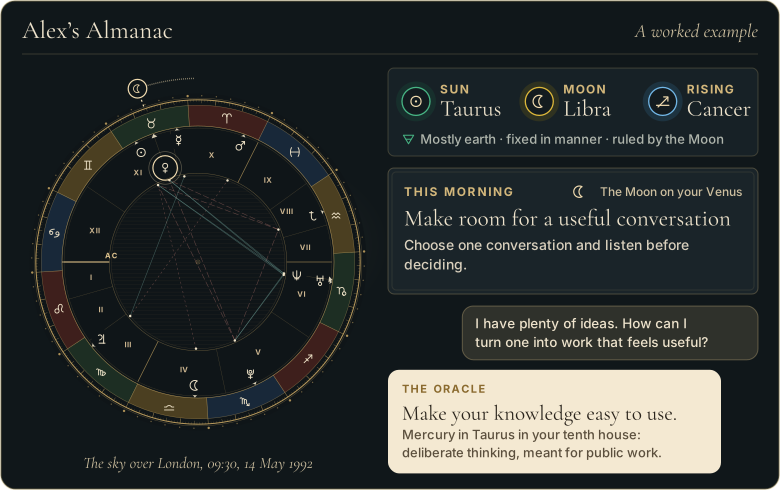
Walk through Alex’s whole example first
 The Road of AgesSee the turning points of your whole life, from your birth date
See your road's shape
The Road of AgesSee the turning points of your whole life, from your birth date
See your road's shape
Prefer to explore first?
 The Road of AgesThe turning points of your whole life, from your own chart
Walk my road
The Road of AgesThe turning points of your whole life, from your own chart
Walk my road
Free, by email
Your daily Almanac letter
One short letter at 7 each morning: the day’s theme read for your own chart, and one thing to do with it.
Southern Cross and Crux
“Southern Cross” commonly means the visible cross pattern, while Crux is the official International Astronomical Union constellation and coordinate region containing it. Crux is the smallest of the 88 constellations by area, yet its bright stars and place in the southern Milky Way make it one of the most recognizable.
The stars only look grouped from Earth. Acrux, Mimosa, Gacrux, Imai, and the fainter fifth point are at different distances and do not form a rigid cross in space. The shape is a line-of-sight pattern. Dark lanes of the Coalsack Nebula lie beside it, and the bright Jewel Box open cluster is close to Mimosa in the same rich Milky Way field.
A one-minute story
The Road of the Sun
Where the twelve signs came from, and why they carry the names they do.

How to identify the real Cross
- Look for a small, compact cross rather than the much larger False Cross. From many southern locations it is visible for much or all of the year, but its orientation rotates around the south celestial pole.
- Confirm the bright long axis: reddish Gacrux is at one end and the multiple-star system Acrux at the other.
- Find Mimosa and Imai across the shorter axis. The geometry is somewhat kite-like, not a perfectly symmetric church cross.
- Locate Alpha and Beta Centauri nearby. These two first-magnitude stars are widely called the Pointers and direct attention toward Crux.
- Check a current sky chart because planets, haze, and orientation can make memorized “upright” pictures misleading.
How to estimate true south
Use the length of the Cross’s long axis from Gacrux through Acrux as one unit. Continue that line beyond Acrux for approximately four and a half cross lengths. The endpoint is close to the south celestial pole, the point around which the southern sky appears to rotate. From that point, drop an imaginary vertical line to a level horizon. The place where it meets the horizon is approximately geographic south.
This is an estimate, not a substitute for a compass or surveyed bearing. Uneven terrain makes the horizon projection difficult, and a mistaken cross produces a wrong result. Magnetic south and geographic south are also different: a magnetic compass responds to Earth’s magnetic field and requires local declination correction for precise navigation.
Using the Pointers as a cross-check
A second construction uses Alpha and Beta Centauri. Imagine the line joining them, find its midpoint, and extend a perpendicular toward the region where it intersects the extended long axis of Crux. The intersection approximates the south celestial pole. Using both constructions helps reject a mistaken identification.
There is no bright southern pole star comparable to Polaris. Sigma Octantis lies relatively near the pole but is faint, so broad geometric methods remain useful for naked-eye orientation. The celestial pole itself is a direction in the sky, not a star.
Do not confuse it with the False Cross
| Feature | Southern Cross | False Cross |
|---|---|---|
| Status | Pattern within official Crux | Asterism spanning Vela and Carina |
| Apparent size | Smaller and more compact | Larger and more open |
| Pointers | Alpha and Beta Centauri nearby | No equivalent adjacent pointer pair |
| Long-axis navigation | Standard 4.5-length pole estimate | Should not be substituted for Crux |
The False Cross consists of Delta and Kappa Velorum with Epsilon and Iota Carinae. Because it also rotates with the sky, “the cross is upright” is not a safe test.
Many cultures, many Southern Cross traditions
Crux appears on the flags of Australia, New Zealand, Papua New Guinea, Samoa, and Brazil, but its significance is not limited to national flags or European navigation. Aboriginal Australian communities, Māori, Pacific peoples, and southern African and South American cultures have distinct names, figures, seasonal knowledge, and stories associated with these stars and the nearby dark Milky Way.
Those traditions should be attributed individually. For example, a museum account tied to one community should not be rewritten as “the Aboriginal meaning,” because hundreds of communities hold different knowledge. Cultural sky knowledge can encode navigation, seasonal change, food cycles, law, genealogy, and ceremony; it is not merely a decorative alternate myth for a Western constellation.
Sources and editorial method
Research and editorial references used for this page include:
- International Astronomical Union: The Constellations - Official context for Crux as a modern bounded constellation.
- Government of Western Australia: Western Australian Astronomy Almanac - Illustrated guidance for extending Crux’s long axis approximately 4.5 lengths to estimate the south celestial pole.
- Western Australian Museum: Conversations at the Museum - Museum context for careful discussion of Aboriginal Australian astronomy and living cultural knowledge.
These references support the factual, historical, textual, or interpretive claims on this page. Interpretive traditions are identified as such, and factual claims are kept separate from symbolic claims.
Related reading
Orient with the southern sky
A definition tells you what it is; your own birth chart tells you what it means for you. The Oracle casts your real chart and answers for your love, your work, and your year ahead, in conversation. It opens with the 7-day Seeker trial.
Speak with the OracleMore in Constellations & Star Lore
From the reference page to your own chart
Every word here
is in your own chart.
- A personal reading about love, work or purpose, written from your chart
- A practical next step to consider
- It opens with 7 days free, with the AI Oracle and daily guidance
$0 today, then $12/month after 7 days. Cancel anytime.
Common questions
Does the Southern Cross always point south?
Its long axis provides a construction toward the south celestial pole when the correct direction from Gacrux through Acrux is used. The entire figure rotates, so it does not remain visually upright.
Can it be seen from the Northern Hemisphere?
It is visible from tropical and some lower northern latitudes, very low in the south during the appropriate season. Farther north it never rises.
Is the Southern Cross an asterism or constellation?
The visible cross is an asterism-like pattern, while Crux is the official constellation and bounded sky region containing it. In ordinary usage the names are often treated as equivalent.
Free, by email
The Almanac, in your inbox at 7
One short letter at 7 each morning: the day’s theme read for your own chart, and one thing to do with it.
