
Demonology and grimoire history
Vapula
Direct answer
The early source gives Vapula an image, rank, legion count, and teaching offices but no developed character narrative. Claims about a specific gender, temperament, favored offerings, technological specialty, or relationship with other spirits belong to later interpretation unless sourced.
Vapula is the sixtieth spirit in the usual Ars Goetia sequence. The catalog calls the figure a great duke, depicts a griffin-winged lion, and attributes skill in handicrafts, professions, philosophy, and sciences.
$0 today, then $12/month after 7 days. Cancel anytime.
Quick facts
| Feature | Common Goetic description |
|---|---|
| Catalog number | Sixty in the widely used ordering. |
| Rank | Great, mighty, and strong duke, commonly assigned thirty-six legions. |
| Image | A lion with griffin wings. |
| Offices | Makes people skilled in handicrafts and professions and teaches philosophy and other sciences. |
What does your own chart say about you?
Choose love, work or purpose. Your reading is written from your chart. Your reading uses your own birth details.
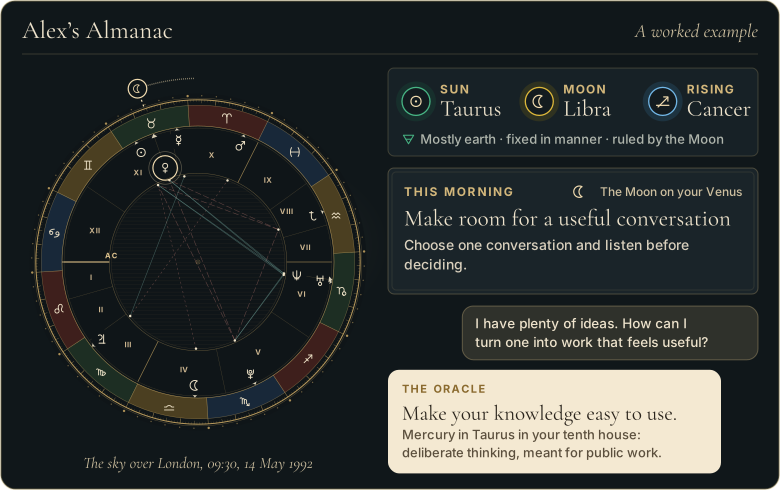
Walk through Alex’s whole example first
 The Road of AgesSee the turning points of your whole life, from your birth date
See your road's shape
The Road of AgesSee the turning points of your whole life, from your birth date
See your road's shape
Prefer to explore first?
 The Road of AgesThe turning points of your whole life, from your own chart
Walk my road
The Road of AgesThe turning points of your whole life, from your own chart
Walk my road
Free, by email
Your daily Almanac letter
One short letter at 7 each morning: the day’s theme read for your own chart, and one thing to do with it.
What the Ars Goetia says about Vapula
Vapula’s compact notice is centered on learned and practical competence. The winged-lion image supplies hybrid nobility and force, while the office list spans manual craft, occupations, philosophy, and sciences. “Science” in an early modern translation does not map exactly onto today’s institutional natural sciences, and “profession” can carry older senses of skilled vocation. The text does not single out engineering, computers, artificial intelligence, or one modern trade, even though contemporary interpreters sometimes extend the craft theme in those directions.
Lion and griffin imagery
Griffins traditionally combine leonine and avian features and can signify strength, vigilance, guardianship, or marvel in different artistic settings. The Goetic wording describes a lion with griffin wings rather than necessarily a full classical griffin with an eagle’s head. That distinction matters when reconstructing iconography. The catalog itself gives no interpretation of the hybrid form, so an asserted equation (wings equal intellect, lion equal mastery) is a possible modern reading, not a documented gloss from the manuscript.
Vapula, Naphula, and modern gender claims
Variant spellings such as Vapula and Naphula reflect copying and editorial transmission. English grammar in familiar editions often uses masculine pronouns generically for cataloged spirits, while modern art may portray Vapula as female, male, androgynous, or bestial. A depiction can make a creative choice without becoming historical evidence. To evaluate identity claims, compare the actual wording of dated witnesses. Do not turn a grammatical convention or recent illustration into certainty about an entity whose source description is only a few lines.
Study, fiction, and safety boundaries
Vapula is useful for studying how early modern magical catalogs imagined mastery of both liberal and mechanical arts and how modern culture updates old office lists. Compare manuscript records, editions, spelling, seals, and reception rather than following ritual instructions; none are provided here. Skill in a craft comes through training, feedback, safety practice, and sustained work, not guaranteed supernatural transmission. The office list can illuminate historical ideals of expertise without becoming a shortcut around apprenticeship or professional standards. If demonic material produces distress, commands, or fear of possession, pause the material and seek trustworthy personal or clinical support instead of treating online lore as a diagnosis. A terse catalog entry cannot determine the source of a frightening experience.
Sources and editorial method
Research and editorial references used for this page include:
- Project Gutenberg: The Lesser Key of Solomon - Searchable public-domain edition containing Vapula’s entry.
- Twilit Grotto: Lemegeton transcription - Comparative text and notes for examining spellings and catalog transmission.
These references support the factual, historical, textual, or interpretive claims on this page. Interpretive traditions are identified as such, and factual claims are kept separate from symbolic claims.
Related reading
Practice the craft honestly
A definition tells you what it is; your own birth chart tells you what it means for you. The Oracle casts your real chart and answers for your love, your work, and your year ahead, in conversation. It opens with the 7-day Seeker trial.
Speak with the OracleThe Cosmic Codex offers a reflective map of your year, written from your chart, never a prediction. Open the Cosmic Codex
More in Demons & Fallen Beings
From the reference page to your own chart
Every word here
is in your own chart.
- A personal reading about love, work or purpose, written from your chart
- A practical next step to consider
- It opens with 7 days free, with the AI Oracle and daily guidance
$0 today, then $12/month after 7 days. Cancel anytime.
Common questions
Is Vapula a griffin?
The common English description is a lion with griffin wings. Modern artists often simplify that to griffin, but the exact wording is worth preserving.
What does Vapula teach?
The catalog lists handicrafts, professions, philosophy, and sciences in broad early modern language. Specific modern specialties are later extrapolations.
Are Vapula and Naphula separate?
They are generally treated as spelling variants associated with the same catalog entry, not securely documented separate figures.
Free, by email
The Almanac, in your inbox at 7
One short letter at 7 each morning: the day’s theme read for your own chart, and one thing to do with it.
