

Constellations
Triangulum
Direct answer
Look between Andromeda and Aries on autumn evenings in the Northern Hemisphere. The constellation’s narrow triangle is modest, but under a very dark sky its diffuse galaxy M33 can be glimpsed with the unaided eye or, more reliably, with low-power binoculars.
Triangulum is a small northern constellation whose three main stars form a long, narrow triangle. Its outstanding deep-sky object is M33, the Triangulum Galaxy, a nearby spiral and major member of the Local Group.
$0 today, then $12/month after 7 days. Cancel anytime.
Quick facts
| Category | Details |
|---|---|
| Official name and abbreviation | Triangulum, Tri |
| Meaning | The triangle |
| Hemisphere | Northern celestial sky |
| Main outline | Beta, Alpha, and Gamma Trianguli form an elongated triangle |
| Principal deep-sky object | M33, the Triangulum Galaxy |
| Best general season | Northern autumn, especially October through December evenings |

What does your own chart say about you?
Choose love, work or purpose. Your reading is written from your chart. Your reading uses your own birth details.
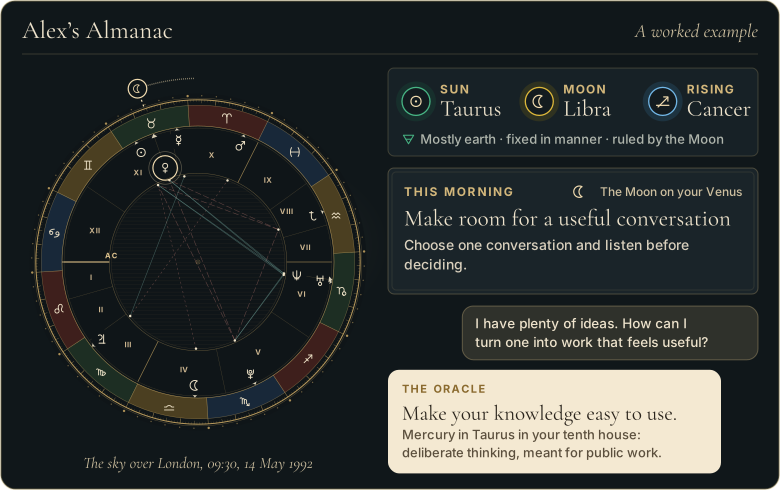
Walk through Alex’s whole example first
 The Road of AgesSee the turning points of your whole life, from your birth date
See your road's shape
The Road of AgesSee the turning points of your whole life, from your birth date
See your road's shape
Prefer to explore first?
 The Road of AgesThe turning points of your whole life, from your own chart
Walk my road
The Road of AgesThe turning points of your whole life, from your own chart
Walk my road
Free, by email
Your daily Almanac letter
One short letter at 7 each morning: the day’s theme read for your own chart, and one thing to do with it.
What Triangulum is
Triangulum is one of the 88 official constellations and one of the smaller northern sky regions. Its name is Latin for triangle. Unlike elaborate mythological figures whose intended outlines can be difficult to recognize, its basic shape is direct: three visible stars make a narrow triangle between the larger constellations Andromeda, Pisces, and Aries.
The constellation and the Triangulum Galaxy are not the same object. The constellation is a direction and bounded area as seen from Earth. The galaxy, catalogued as Messier 33, is one physical system located in that direction, nearly three million light-years away. The foreground stars drawing the triangle are within our own Milky Way and lie at unrelated distances.
A one-minute story
The Road of the Sun
Where the twelve signs came from, and why they carry the names they do.

How to find the triangle
- Choose an October, November, or December evening and face generally east or southeast after darkness; later in the night the constellation moves higher and westward.
- Find the Great Square of Pegasus and the chain of Andromeda stars extending away from it.
- Locate the compact stars of Aries below Andromeda. Triangulum occupies the space between those two constellations.
- Identify Beta Trianguli, the brightest apparent star in the constellation, then Alpha Trianguli and nearby Gamma Trianguli to trace the elongated wedge.
- Use averted vision if skyglow weakens the fainter points. A planetarium set to the exact time and location prevents confusion with similarly bright field stars.
The three-star figure
Beta Trianguli
The brightest apparent star of the constellation and a spectroscopic binary. It anchors the broader end of the narrow triangle.
Alpha Trianguli, Mothallah
Despite its Alpha designation, it appears slightly fainter than Beta. It marks the sharp end of the figure.
Gamma Trianguli
A white main-sequence star near Delta Trianguli; binoculars help separate the neighboring points and clarify the outline.
Bayer-letter order does not always match brightness. Alpha is therefore not guaranteed to be a constellation’s brightest star.
How to observe the Triangulum Galaxy, M33
M33 is a spiral galaxy and the third-largest major member of the Local Group after the Andromeda Galaxy and the Milky Way. NASA gives an apparent magnitude near 5.7, which sounds easy, but that light is spread over a broad area. Its low surface brightness makes it much harder than a compact star of the same total magnitude. Transparent air and a truly dark sky matter more than high magnification.
Begin with binoculars or a small telescope at the lowest useful power. Sweep slowly west of the main triangular outline and look for a broad, pale oval rather than a sharp nucleus. Averted vision (looking slightly beside the target) lets the more light-sensitive parts of the retina help. Increasing magnification too soon can spread the already diffuse glow until it disappears.
Exceptionally dark-sky observers may detect M33 without optical aid, making it one of the most distant objects potentially visible to the unaided eye. Treat that as a challenging observation, not a normal expectation. Moonlight, humidity, smoke, and suburban light pollution can hide it completely even when the constellation stars remain visible.
NGC 604: a giant star-forming region
Inside M33 lies NGC 604, a vast region where hot young stars energize surrounding hydrogen gas. It is one of the largest known star-forming regions in the Local Group and can appear as a distinct knot in sufficiently large amateur telescopes. Images from the Hubble Space Telescope resolve a complex cavity-and-filament structure created by radiation and winds from massive stars.
NGC 604 belongs to M33, not to the foreground Milky Way. Seeing it means detecting a nebula in another galaxy. That layered view (nearby constellation stars, a distant galaxy, and a luminous nursery within the galaxy) is the most useful way to understand what a constellation field contains.
History of the triangular figure
A triangular constellation appears in ancient Mediterranean star catalogues, including the tradition represented by Ptolemy’s Almagest. Later stories connected its shape with Sicily or the Nile delta, but historical interpretations vary by source and period. Those stories describe cultural readings of a convenient geometry; they do not explain the physical origin of the unrelated stars.
Modern astronomy retained the Latin name and, in the twentieth century, standardized the constellation boundaries. Today Triangulum is useful both as a historical sky figure and as an exact coordinate region for cataloguing astronomical objects.
Sources and editorial method
Research and editorial references used for this page include:
- NASA Hubble: Messier 33 - Distance, brightness, Local Group context, NGC 604, and practical observing guidance.
- International Astronomical Union: The Constellations - Official context for Triangulum as one of the 88 bounded constellations.
These references support the factual, historical, textual, or interpretive claims on this page. Interpretive traditions are identified as such, and factual claims are kept separate from symbolic claims.
Related reading
Open the triangle toward M33
A definition tells you what it is; your own birth chart tells you what it means for you. The Oracle casts your real chart and answers for your love, your work, and your year ahead, in conversation. It opens with the 7-day Seeker trial.
Speak with the OracleMore in Constellations & Star Lore
From the reference page to your own chart
Every word here
is in your own chart.
- A personal reading about love, work or purpose, written from your chart
- A practical next step to consider
- It opens with 7 days free, with the AI Oracle and daily guidance
$0 today, then $12/month after 7 days. Cancel anytime.
Common questions
Is M33 visible to the naked eye?
It can be under exceptionally dark, transparent skies with trained averted vision, but binoculars are more reliable. Its low surface brightness makes it harder than its total magnitude suggests.
Is Triangulum the same as the Summer Triangle?
No. Triangulum is an official constellation. The Summer Triangle is a large asterism formed by Vega, Deneb, and Altair across three different constellations.
When is Triangulum easiest to see?
For Northern Hemisphere observers, it is well placed on October through December evenings. Exact timing and altitude depend on latitude.
Free, by email
The Almanac, in your inbox at 7
One short letter at 7 each morning: the day’s theme read for your own chart, and one thing to do with it.
