
Asterisms and skywatching
Teapot Asterism
Direct answer
During July through September evenings, find Sagittarius near Scorpius. From mid-northern latitudes the Teapot stays low in the south; from many southern latitudes it climbs high and can pass north of the zenith. Under a dark sky, the Milky Way appears to rise like steam from the spout.
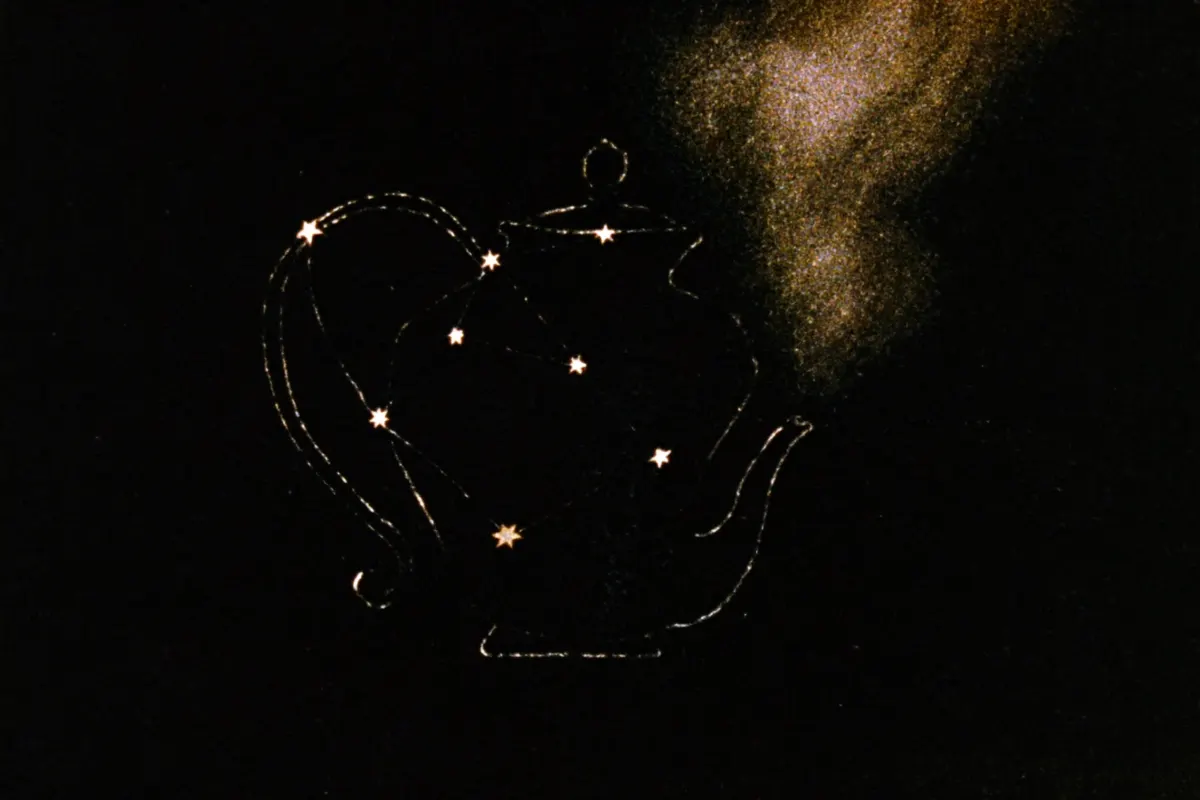
The Teapot is an eight-star pattern inside the constellation Sagittarius. Its handle, lid, body, and spout make Sagittarius easier to recognize, while the bright Milky Way above the spout resembles rising steam.
$0 today, then $12/month after 7 days. Cancel anytime.
Quick facts
| Feature | Details |
|---|---|
| Object type | Asterism: a recognizable star pattern, not an official IAU constellation |
| Official constellation | Sagittarius |
| Main outline | Eight stars forming a lid, handle, body, and spout |
| Best general season | July through September evenings, with exact visibility depending on latitude and time |
| Notable direction | The Milky Way’s galactic center lies in the same rich region of sky near the spout |
The Teapot is Sagittarius's familiar shape beneath the brightest central Milky Way star clouds.
A symbolic locator, not a substitute for an observational chart at a specific place and time.
What does your own chart say about you?
Choose love, work or purpose. Your reading is written from your chart. Your reading uses your own birth details.
Walk through Alex’s whole example first


 The Road of AgesSee the turning points of your whole life, from your birth date
See your road's shape
The Road of AgesSee the turning points of your whole life, from your birth date
See your road's shape
Prefer to explore first?
 The Road of AgesThe turning points of your whole life, from your own chart
Walk my road
The Road of AgesThe turning points of your whole life, from your own chart
Walk my road
Free, by email
Your daily Almanac letter
One short letter at 7 each morning: the day’s theme read for your own chart, and one thing to do with it.
What is the Teapot?
The Teapot is a modern, informal pattern made from prominent stars in Sagittarius. It is an asterism, meaning a useful visual figure that may occupy only part of a constellation or cross constellation boundaries. Sagittarius itself is one of the 88 official sky regions defined by the International Astronomical Union; the Teapot has no separate legal boundary or astronomical abbreviation.
Its popularity comes from practical recognition. The traditional centaur-archer figure can be difficult to trace, whereas a squat teapot with a handle on the east, a lid above, and a spout pointing west is comparatively easy to see. The pattern also sits against one of the brightest star-cloud regions of the Milky Way, so it becomes a gateway to rich binocular and telescope fields.
A one-minute story
The Road of the Sun
Where the twelve signs came from, and why they carry the names they do.

The eight stars in the outline
| Star | Bayer designation | Place in the Teapot |
|---|---|---|
| Alnasl | Gamma² Sagittarii | Tip of the spout |
| Kaus Media | Delta Sagittarii | Upper junction of body and spout |
| Kaus Australis | Epsilon Sagittarii | Lower junction of body and spout |
| Ascella | Zeta Sagittarii | Lower eastern body or base near the handle |
| Tau Sagittarii | Tau Sagittarii | Lower portion of the handle |
| Phi Sagittarii | Phi Sagittarii | Upper eastern corner of the body |
| Nunki | Sigma Sagittarii | Upper portion of the handle |
| Kaus Borealis | Lambda Sagittarii | Top of the lid |
Line drawings vary slightly. Use the star names and positions rather than assuming every chart connects the outline in exactly the same order.
How to find the Teapot
- Choose a dark site with an unobstructed southern horizon. From mid-northern latitudes, Sagittarius never rises very high, so buildings, trees, haze, and light pollution matter.
- Look during July, August, or early September evenings. In the Southern Hemisphere the same season places the pattern much higher in the sky.
- Find the hooked tail of Scorpius first. Move eastward into the bright Milky Way until a compact group suggests a teapot tipped slightly toward the scorpion.
- Identify Alnasl at the spout tip and the three Kaus stars around the spout, body, and lid. “Kaus” derives from Arabic wording associated with the bow.
- Allow at least 20 minutes for dark adaptation. Binoculars reveal the dense star fields even when the complete naked-eye outline is muted.
The Milky Way steam and galactic center
Under a genuinely dark sky, a luminous Milky Way star cloud rises above the Teapot’s spout like steam. This is not a physical cloud emerging from the eight stars. It is a long line of sight through the crowded inner disk of our galaxy, containing enormous numbers of unresolved stars plus bright and dark nebulae.
The direction toward the Milky Way’s center lies near the spout, in Sagittarius. Interstellar dust blocks a direct visible-light view of the central black hole, so the brightest naked-eye patch should not be mistaken for the center itself. Infrared, radio, X-ray, and other observations let astronomers study regions that visible light cannot penetrate.
What to observe around it
Lagoon Nebula, M8
A bright emission nebula above the Teapot’s spout. It is accessible to binoculars under a dark sky and becomes structured in a telescope.
Trifid Nebula, M20
A smaller nebula near M8 whose glowing and dark lanes reward a telescope and dark conditions.
Sagittarius Star Cloud, M24
A brilliant Milky Way window packed with stars; low-power binoculars are ideal.
Omega Nebula, M17
A bright star-forming region farther north along the Milky Way.
Globular clusters
M22 east of the lid and M54 within Sagittarius are compact ancient star systems visible with optical aid.
Latitude, season, and observing limits
The Teapot is best for observers at tropical and southern latitudes. It can still be seen from much of Europe and the continental United States, but appears low in the south and has a shorter clear observing window. Far enough north it remains below the horizon. Six months after the best evening season, Sagittarius lies near the Sun and is not available in a dark night sky.
Use a planisphere or planetarium set to the observing location and date. Atmospheric haze near the horizon and urban skyglow can erase the “steam” while leaving some outline stars visible. A photograph may show far more Milky Way structure than the unaided eye because a camera accumulates light over time.
Sources and editorial method
Research and editorial references used for this page include:
- NASA Science: What Are Asterisms? - NASA explanation of asterisms, including the Teapot within Sagittarius.
- NASA Science: August 2024 Skywatching Tips - Locator graphics and observing guidance for the Teapot and Lagoon Nebula.
- International Astronomical Union: The Constellations - Official context for Sagittarius as a bounded constellation region.
These references support the factual, historical, textual, or interpretive claims on this page. Interpretive traditions are identified as such, and factual claims are kept separate from symbolic claims.
Related reading
Let the Milky Way steam from Sagittarius
A definition tells you what it is; your own birth chart tells you what it means for you. The Oracle casts your real chart and answers for your love, your work, and your year ahead, in conversation. It opens with the 7-day Seeker trial.
Speak with the OracleMore in Constellations & Star Lore
From the reference page to your own chart
Every word here
is in your own chart.
- A personal reading about love, work or purpose, written from your chart
- A practical next step to consider
- It opens with 7 days free, with the AI Oracle and daily guidance
$0 today, then $12/month after 7 days. Cancel anytime.
Common questions
Is the Teapot a constellation?
No. It is an asterism within the official constellation Sagittarius. Asterisms are useful visual patterns but do not have IAU boundaries of their own.
Can I see the galactic center through the spout?
The spout points toward the central Milky Way region, but intervening dust hides the actual center in visible light. The bright “steam” is a foreground and inner-disk star field.
Why can’t I see it in winter?
Around Northern Hemisphere winter, Sagittarius is near the Sun in the sky. It becomes an early-morning target in spring before returning to summer evenings.
Free, by email
The Almanac, in your inbox at 7
One short letter at 7 each morning: the day’s theme read for your own chart, and one thing to do with it.
