Seasons and sky
Seasonal Lag
Direct answer
Seasonal Lag is the delay between an astronomical sunlight extreme and the usual maximum or minimum of temperature or another seasonal response.
Seasonal Lag is the delay between peak solar forcing and peak seasonal response.
$0 today, then $12/month after 7 days. Cancel anytime.
At a glance
- Found in
- Seasons & Earth Almanac
- Related
- Solar Insolation, Solar Terminator, Astronomical Season, Equinox
Seasonal Lag is the delay between peak solar forcing and peak seasonal response.
A Sun-Earth orientation for seasonal, atmospheric, tidal, and terrestrial terms.
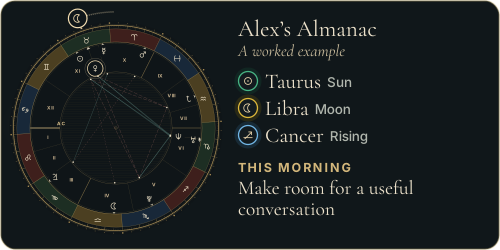
What does your own chart say about you?
Choose love, work or purpose. Your reading is written from your chart. Your reading uses your own birth details.
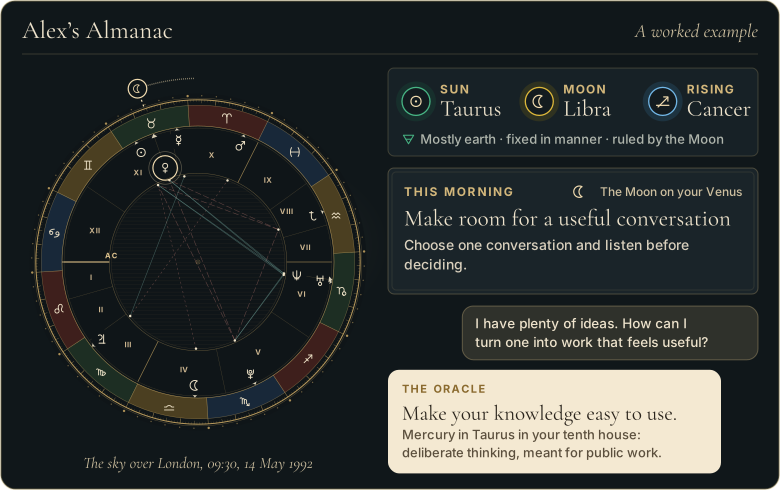
Walk through Alex’s whole example first
 The Road of AgesSee the turning points of your whole life, from your birth date
See your road's shape
The Road of AgesSee the turning points of your whole life, from your birth date
See your road's shape
Prefer to explore first?
 The Road of AgesThe turning points of your whole life, from your own chart
Walk my road
The Road of AgesThe turning points of your whole life, from your own chart
Walk my road
Free, by email
Your daily Almanac letter
One short letter at 7 each morning: the day’s theme read for your own chart, and one thing to do with it.
The story behind Seasonal Lag
Long weather records made the lag between solar geometry and local climate cycles quantitatively visible.
Why Seasonal Lag matters
Land, water, ice, and atmosphere need time to gain or lose heat, so solstices rarely coincide with temperature extremes.
How to read Seasonal Lag
Seasonal Lag comes up when comparing solstices with climate normals, ocean temperature, snow cover, or ecosystem timing.
Seasonal Lag in practice: an example
Many Northern Hemisphere coastal locations are warmest weeks after the June Solstice.
Where readings of Seasonal Lag go wrong
It is a mistake to assign one universal lag; it differs by latitude, surface, circulation, and the variable being measured.
Sources and editorial method
Research references used for this entry include:
- U.S. Naval Observatory: The Seasons and the Earth's Orbit - Official explanation of axial tilt, solstices, equinoxes, perihelion, aphelion, and seasonal sunlight.
- NOAA NCEI: U.S. Climate Normals - Official methodology and data for climate normals, degree days, growing seasons, and freeze dates.
- Source
- The Great Almanac Dictionary
- Category
- Seasons & Earth Almanac
- Last updated
- 2026-09-26
Compare light and temperature peaks
A definition tells you what it is; your own birth chart tells you what it means for you. The Oracle casts your real chart and answers for your love, your work, and your year ahead, in conversation. It opens with the 7-day Seeker trial.
Speak with the OracleRelated terms
More in Seasons & Earth Almanac
From the reference page to your own chart
Every word here
is in your own chart.
- A personal reading about love, work or purpose, written from your chart
- A practical next step to consider
- It opens with 7 days free, with the AI Oracle and daily guidance
$0 today, then $12/month after 7 days. Cancel anytime.
Common questions
What is seasonal lag?
Seasonal Lag is the delay between an astronomical sunlight extreme and the usual maximum or minimum of temperature or another seasonal response.
What do people get wrong about seasonal lag?
It is a mistake to assign one universal lag; it differs by latitude, surface, circulation, and the variable being measured.
Free, by email
The Almanac, in your inbox at 7
One short letter at 7 each morning: the day’s theme read for your own chart, and one thing to do with it.