
Calendars and historical dating
Regnal Year
Direct answer
To convert a regnal date, identify the ruler and jurisdiction, consult an authoritative table for that exact reign, establish the numbered year’s start and end, then place the document’s month and day within that interval.
A regnal year numbers time within a ruler’s reign rather than from January 1. A citation such as “9 John” means the ninth regnal year assigned to King John and can span parts of two modern calendar years.
$0 today, then $12/month after 7 days. Cancel anytime.
Quick facts
| Element | What it tells you |
|---|---|
| Ruler’s name | Which reign supplies the year count |
| Regnal number | The numbered year since the recognized accession |
| Day and month | Where the document falls inside the regnal-year interval |
| Jurisdiction | Which succession, legal, and calendar conventions apply |
| Calendar style | Whether dates use Julian, Gregorian, Old Style, New Style, or another local system |
A Regnal Year dates an event within a ruler reign.
A cycle or timeline schematic for comparing the named timekeeping concept.
What does your own chart say about you?
Choose love, work or purpose. Your reading is written from your chart. Your reading uses your own birth details.
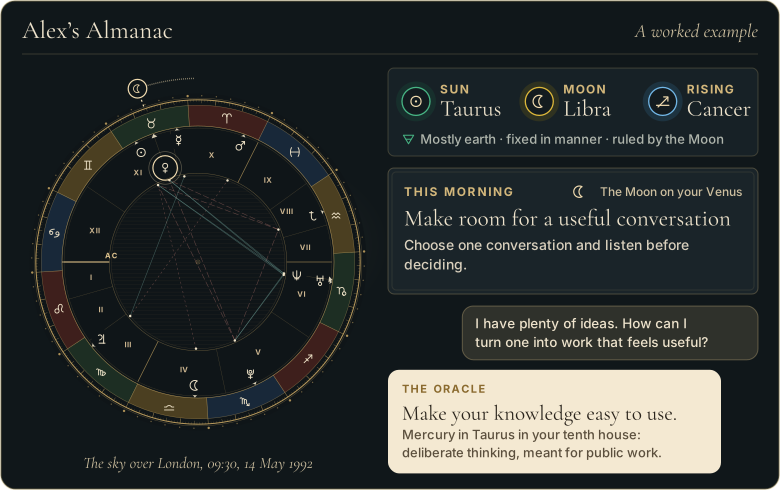
Walk through Alex’s whole example first
 The Road of AgesSee the turning points of your whole life, from your birth date
See your road's shape
The Road of AgesSee the turning points of your whole life, from your birth date
See your road's shape
Prefer to explore first?
 The Road of AgesThe turning points of your whole life, from your own chart
Walk my road
The Road of AgesThe turning points of your whole life, from your own chart
Walk my road
Free, by email
Your daily Almanac letter
One short letter at 7 each morning: the day’s theme read for your own chart, and one thing to do with it.
What a regnal year is
A regnal year is a year counted within the reign of a sovereign. In many later English records, year one began on the recognized accession date and ended before its anniversary, but earlier and exceptional reigns used other rules. Because the boundary was not January 1, one regnal year usually overlaps two calendar years.
Regnal dating appears in royal grants, letters patent, charters, statutes, court records, deeds, coins, and administrative indexes. A record may use Latin wording such as anno regni, “in the year of the reign,” followed by the monarch and a number. It is a dating system, not a ceremonial title.
How to convert a regnal date
- Transcribe the ruler’s name, title, regnal number, day, and month exactly. Do not begin by guessing a modern year.
- Identify the realm or jurisdiction. A ruler may have different titles, recognition, or year numbering in different territories.
- Use an authoritative table to find the exact calendar span of the requested regnal year. Do not derive every reign from one general anniversary rule.
- Place the stated day and month inside that span. This determines which of the two calendar years in the range applies.
- Check whether the source uses the Julian or Gregorian calendar and whether the legal year began on January 1, March 25, or another date.
- Record the conversion as a range until the complete day-and-month evidence resolves it, and preserve the original notation in the citation.
Worked example: 9 John
The UK National Archives gives the ninth regnal year of King John as 1207-1208. John is a crucial exception: his regnal years were reckoned from Ascension Day, the movable feast on which he was crowned, so their boundaries shifted. A specialist calendar gives 9 John as 31 May 1207 through 14 May 1208.
A document dated 10 June in 9 John therefore belongs to 1207, while one dated 10 February belongs to 1208. Writing only “9 John = 1207” loses half the answer, and simply adding eight to 1199 misses John’s movable boundary. The complete date and reign-specific table are essential.
Why conversions become difficult
Repeated names
Henry, Edward, Charles, and other royal names recur. The monarch’s ordinal and realm must be established before choosing a table.
Disputed succession
Depositions, rival claimants, conquest, abdication, and retroactive recognition can produce more than one politically meaningful starting point.
Joint and co-rulers
Documents may name two rulers or count from a joint reign. Never force a single-ruler table onto the evidence.
Calendar reform
A date can be valid in the Julian calendar but differ from its proleptic Gregorian equivalent. Conversion should name the calendar used.
Old Style legal year
In parts of British history, the civil or legal year began on 25 March even while regnal years followed accession anniversaries. Both issues may affect a citation.
Accession versus coronation
Many reigns follow legal accession, but exceptions exist. John’s years followed the movable feast of his coronation, so the exact reign-specific table controls.
How to cite a converted regnal date
A careful archival citation preserves what the document actually says and adds the interpreted calendar date in brackets or commentary. For example: “10 February, 9 John [1208].” This lets another researcher audit the conversion and protects against silent modernization.
When the day or month is missing, retain a range such as 1207-1208. If the monarch’s identity or calendar style is uncertain, state that uncertainty rather than manufacturing a single precise year. Genealogy and local-history errors often spread when a tentative conversion is copied without its assumptions.
Regnal years beyond medieval England
Ruler-based year counts have been used in many societies, but their mechanics are not interchangeable. Some systems restart at accession, some begin a first full year later, some use era names, and some count according to lunar or lunisolar calendars. The English archival method is therefore an example, not a global template.
Outside the British context, consult a chronology or archival guide specific to the polity, ruler, and period. The translated phrase “regnal year” does not guarantee English-style anniversary counting.
Sources and editorial method
Research and editorial references used for this page include:
- The National Archives: Royal Grants, Letters Patent and Charters from 1199 - Official UK archival guidance on records arranged and dated by regnal year.
- The National Archives: Enrolment of Deeds and Registration of Titles to Land - Provides the concrete conversion example “9 John” as 1207-1208.
- The National Archives: Dating Latin Documents - Reference guidance for Latin dating clauses, calendars, feast days, and regnal conventions.
- Medieval Genealogy: Regnal Calendar for King John - Detailed date table showing John’s movable Ascension Day regnal boundaries, including 9 John from 31 May 1207 to 14 May 1208.
These references support the factual, historical, textual, or interpretive claims on this page. Interpretive traditions are identified as such, and factual claims are kept separate from symbolic claims.
Related reading
Resolve the reign chronology
A definition tells you what it is; your own birth chart tells you what it means for you. The Oracle casts your real chart and answers for your love, your work, and your year ahead, in conversation. It opens with the 7-day Seeker trial.
Speak with the OracleMore in Calendars & Timekeeping
From the reference page to your own chart
Every word here
is in your own chart.
- A personal reading about love, work or purpose, written from your chart
- A practical next step to consider
- It opens with 7 days free, with the AI Oracle and daily guidance
$0 today, then $12/month after 7 days. Cancel anytime.
Common questions
Does a regnal year begin on January 1?
Usually not in the English records discussed here. It begins on the recognized accession anniversary, which is why one regnal year spans parts of two calendar years.
Is coronation day the start of year one?
Not normally, but exceptions matter. King John’s regnal years followed Ascension Day, the movable feast on which he was crowned. Consult a reign-specific table.
Why is a regnal year written as two years?
Its accession-to-accession interval crosses January 1. The day and month determine which calendar year applies to a specific document.
Can I convert every country with an English regnal table?
No. Regnal and era systems differ widely. Use a source specific to the ruler, state, language, calendar, and historical period.
Free, by email
The Almanac, in your inbox at 7
One short letter at 7 each morning: the day’s theme read for your own chart, and one thing to do with it.
