
Star lore
Lynx
Direct answer
Lynx is a long faint northern constellation between Ursa Major, Auriga, Gemini, and Cancer.
Lynx is a dim northern constellation whose name jokes that lynx-like eyesight is needed to see it.
$0 today, then $12/month after 7 days. Cancel anytime.
At a glance
- Found in
- Constellations & Star Lore
- Related
- Libra Constellation, Lupus, Lyra, Mensa

What does your own chart say about you?
Choose love, work or purpose. Your reading is written from your chart. Your reading uses your own birth details.
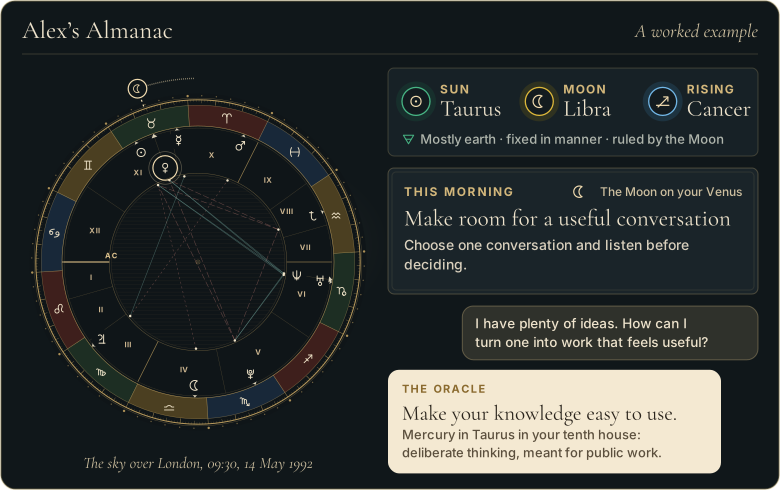
Walk through Alex’s whole example first
 The Road of AgesSee the turning points of your whole life, from your birth date
See your road's shape
The Road of AgesSee the turning points of your whole life, from your birth date
See your road's shape
Prefer to explore first?
 The Road of AgesThe turning points of your whole life, from your own chart
Walk my road
The Road of AgesThe turning points of your whole life, from your own chart
Walk my road
Free, by email
Your daily Almanac letter
One short letter at 7 each morning: the day’s theme read for your own chart, and one thing to do with it.
The story behind Lynx
Johannes Hevelius introduced Lynx in the seventeenth century and commented on the keen sight required to trace it.
A one-minute story
The Road of the Sun
Where the twelve signs came from, and why they carry the names they do.

Why Lynx matters
Lynx fills a large early-modern map gap and contains rewarding telescopic objects despite its weak naked-eye outline.
How to read Lynx
Bracket the region with the Big Dipper, Capella, and Castor, then use a chart to connect its sparse stars.
Lynx in practice: an example
NGC 2419, the Intergalactic Wanderer, is a distant Milky Way globular cluster projected within Lynx.
Where readings of Lynx go wrong
The nickname of NGC 2419 does not mean the cluster lies outside the Milky Way's gravitational system.
Sources and editorial method
Research references used for this entry include:
- International Astronomical Union: The Constellations - Official names, abbreviations, and boundaries for the 88 modern constellations.
- NASA Space Place: What Are Constellations? - NASA introduction to constellation regions, patterns, visibility, and seasonal sky changes.
- Source
- The Great Almanac Dictionary
- Category
- Constellations & Star Lore
- Last updated
- 2026-09-26
Test your night vision across Lynx
A definition tells you what it is; your own birth chart tells you what it means for you. The Oracle casts your real chart and answers for your love, your work, and your year ahead, in conversation. It opens with the 7-day Seeker trial.
Speak with the OracleRelated terms
More in Constellations & Star Lore
- Northern Cross
- Proxima Centauri
- Summer Triangle
- Zubenelgenubi
- Apus
- Canopus
- Crater
- Great Square of Pegasus
From the reference page to your own chart
Every word here
is in your own chart.
- A personal reading about love, work or purpose, written from your chart
- A practical next step to consider
- It opens with 7 days free, with the AI Oracle and daily guidance
$0 today, then $12/month after 7 days. Cancel anytime.
Common questions
What is lynx?
Lynx is a long faint northern constellation between Ursa Major, Auriga, Gemini, and Cancer.
What do people get wrong about lynx?
The nickname of NGC 2419 does not mean the cluster lies outside the Milky Way's gravitational system.
Free, by email
The Almanac, in your inbox at 7
One short letter at 7 each morning: the day’s theme read for your own chart, and one thing to do with it.