
Sky science
Lagrange Point
Direct answer
Lagrange Point: A Lagrange Point is one of five locations where a small body can maintain a repeating position in a rotating two-body system.
It is a special equilibrium region labeled L1 through L5.
$0 today, then $12/month after 7 days. Cancel anytime.
At a glance
- Found in
- Astronomy & Skywatching
- Related
- Orbital Resonance, Mean Motion Resonance, Hill Sphere, Roche Limit
It is a special equilibrium region labeled L1 through L5.
A scientific orientation to scale, light, or motion; the article supplies the precise definition.
What does your own chart say about you?
Choose love, work or purpose. Your reading is written from your chart. Your reading uses your own birth details.
Walk through Alex’s whole example first
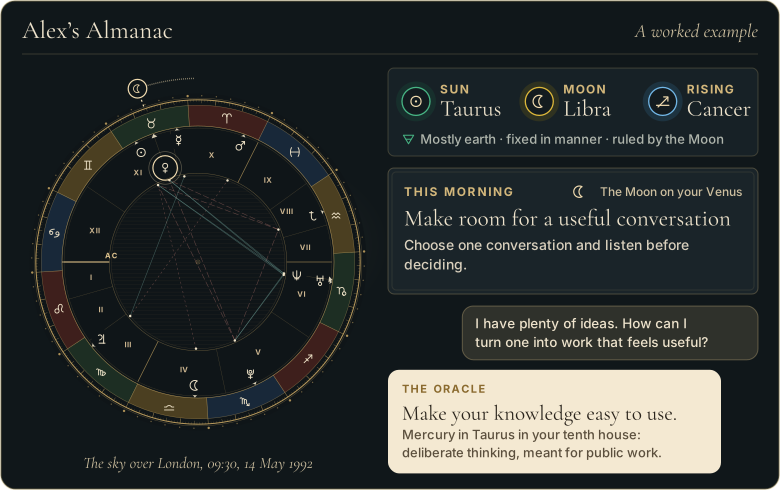
 The Road of AgesSee the turning points of your whole life, from your birth date
See your road's shape
The Road of AgesSee the turning points of your whole life, from your birth date
See your road's shape
Prefer to explore first?
 The Road of AgesThe turning points of your whole life, from your own chart
Walk my road
The Road of AgesThe turning points of your whole life, from your own chart
Walk my road
Free, by email
Your daily Almanac letter
One short letter at 7 each morning: the day’s theme read for your own chart, and one thing to do with it.
The story behind Lagrange Point
Lagrange analyzed the restricted three-body problem in the eighteenth century.
A one-minute story
The Wandering Stars
How the moving planets were watched, named and found, and what a transit is.

Why Lagrange Point matters
These regions support spacecraft operations and stable Trojan populations.
Lagrange Point in practice: an example
The James Webb Space Telescope follows a halo orbit associated with Sun-Earth L2.
Where readings of Lagrange Point go wrong
L1, L2, and L3 require station keeping; they are not effortless parking places.
Sources and editorial method
Research references used for this entry include:
- NASA Science: What Are Lagrange Points? - NASA reference for the five equilibrium regions in a rotating two-body system.
- NASA Science: Universe Glossary - NASA definitions for common stellar, galactic, orbital, and high-energy astronomy terms.
- Source
- The Great Almanac Dictionary
- Category
- Astronomy & Skywatching
- Last updated
- 2026-09-26
Visit the five gravitational waypoints
A definition tells you what it is; your own birth chart tells you what it means for you. The Oracle casts your real chart and answers for your love, your work, and your year ahead, in conversation. It opens with the 7-day Seeker trial.
Speak with the OracleRelated terms
More in Astronomy & Skywatching
- Orbital Eccentricity
- Prime Vertical
- Semimajor Axis
- Stellar Spectrum
- Airglow
- Astronomical Twilight
- Coronal Mass Ejection
- Galactic Coordinate System
From the reference page to your own chart
Every word here
is in your own chart.
- A personal reading about love, work or purpose, written from your chart
- A practical next step to consider
- It opens with 7 days free, with the AI Oracle and daily guidance
$0 today, then $12/month after 7 days. Cancel anytime.
Common questions
What is a Lagrange Point?
A Lagrange Point is one of five locations where a small body can maintain a repeating position in a rotating two-body system.
What do people get wrong about a Lagrange Point?
L1, L2, and L3 require station keeping; they are not effortless parking places.
Free, by email
The Almanac, in your inbox at 7
One short letter at 7 each morning: the day’s theme read for your own chart, and one thing to do with it.