Star lore
Diphda
Direct answer
Diphda is Beta Ceti, an orange giant and the brightest star in the large constellation Cetus.
Diphda is Cetus's brightest star, isolated near the creature's tail.
$0 today, then $12/month after 7 days. Cancel anytime.
At a glance
- Found in
- Constellations & Star Lore
- Related
- Hamal, Menkar, Alpheratz, Markab

What does your own chart say about you?
Choose love, work or purpose. Your reading is written from your chart. Your reading uses your own birth details.
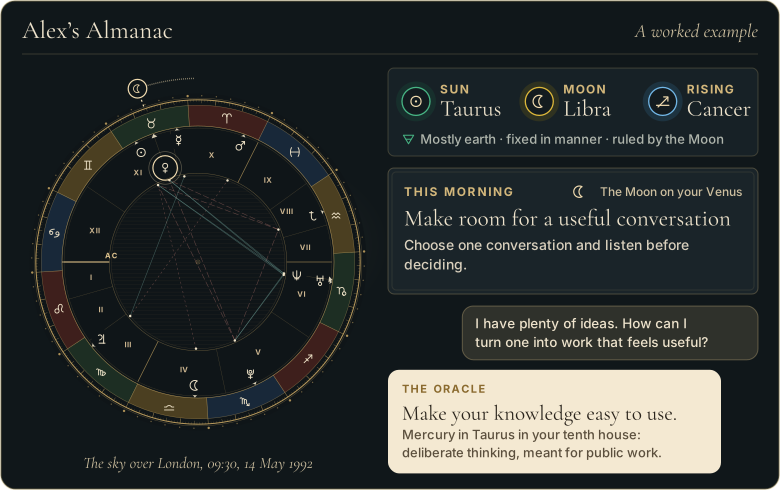
Walk through Alex’s whole example first
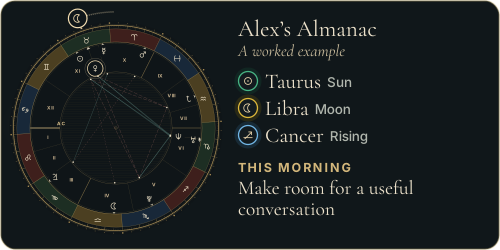
 The Road of AgesSee the turning points of your whole life, from your birth date
See your road's shape
The Road of AgesSee the turning points of your whole life, from your birth date
See your road's shape
Prefer to explore first?
 The Road of AgesThe turning points of your whole life, from your own chart
Walk my road
The Road of AgesThe turning points of your whole life, from your own chart
Walk my road
Free, by email
Your daily Almanac letter
One short letter at 7 each morning: the day’s theme read for your own chart, and one thing to do with it.
The story behind Diphda
The IAU-approved name coexists with the traditional name Deneb Kaitos, both tied to the sea creature's tail.
A one-minute story
The Road of the Sun
Where the twelve signs came from, and why they carry the names they do.

Why Diphda matters
Diphda’s solitary position makes it a valuable autumn orientation point between Fomalhaut, Pisces, and Eridanus.
How to read Diphda
Look east of Fomalhaut and south of the Pisces Circlet for Diphda's warm, relatively isolated light.
Diphda in practice: an example
Diphda can guide a sweep northward into Cetus or southward toward Sculptor and Phoenix.
Where readings of Diphda go wrong
The usual misreading is to confuse Deneb Kaitos with Deneb in Cygnus; deneb appears in several Arabic-derived tail-star names.
Sources and editorial method
Research references used for this entry include:
- IAU Division C Working Group on Star Names - Official IAU working group responsible for standardizing star names used in international astronomy.
- CDS SIMBAD Astronomical Database - Professional astronomical database for stellar identifiers, positions, classifications, and bibliography.
- Source
- The Great Almanac Dictionary
- Category
- Constellations & Star Lore
- Last updated
- 2026-09-26
Anchor the autumn sea at Diphda
A definition tells you what it is; your own birth chart tells you what it means for you. The Oracle casts your real chart and answers for your love, your work, and your year ahead, in conversation. It opens with the 7-day Seeker trial.
Speak with the OracleRelated terms
More in Constellations & Star Lore
From the reference page to your own chart
Every word here
is in your own chart.
- A personal reading about love, work or purpose, written from your chart
- A practical next step to consider
- It opens with 7 days free, with the AI Oracle and daily guidance
$0 today, then $12/month after 7 days. Cancel anytime.
Common questions
What is Diphda?
Diphda is Beta Ceti, an orange giant and the brightest star in the large constellation Cetus.
What do people get wrong about Diphda?
The usual misreading is to confuse Deneb Kaitos with Deneb in Cygnus; deneb appears in several Arabic-derived tail-star names.
Free, by email
The Almanac, in your inbox at 7
One short letter at 7 each morning: the day’s theme read for your own chart, and one thing to do with it.