
Symbolic questions and discernment
AI Oracle
Direct answer
For a useful answer, ask one clear question, provide only the relevant verified context, and request themes, alternatives, and a grounded next step. The response cannot know hidden facts, read another person’s mind, guarantee an outcome, or replace medical, legal, financial, or crisis support.
An AI oracle is a conversational feature that uses a language model to synthesize a question with supplied symbolic context, such as chart placements or selected cards. Its response is generated probabilistically and should be treated as reflection, not revelation.
$0 today, then $12/month after 7 days. Cancel anytime.
Quick facts
| Capability | Realistic boundary |
|---|---|
| Synthesis | Can connect a question with supplied symbolic data and explain possible themes. |
| Personal context | Can use accurate birth or reading inputs but cannot independently verify a life story. |
| Prediction | Can describe scenarios; it cannot reliably foresee a unique future event. |
| Authority | Produces language from patterns in data, not communication from a deity, spirit, or deceased person. |
| Privacy | Users should avoid unnecessary secrets, identifying third-party data, and sensitive records. |
AI Oracle is the app's personalized, safety-bounded question-answer feature.
A process map showing how the named concept fits into the website rather than the private app.
What does your own chart say about you?
Choose love, work or purpose. Your reading is written from your chart. Your reading uses your own birth details.
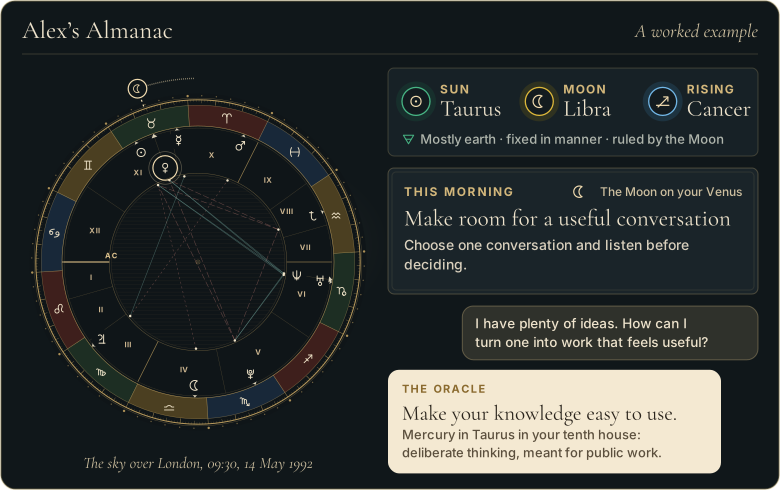
Walk through Alex’s whole example first
 The Road of AgesSee the turning points of your whole life, from your birth date
See your road's shape
The Road of AgesSee the turning points of your whole life, from your birth date
See your road's shape
Prefer to explore first?
 The Road of AgesThe turning points of your whole life, from your own chart
Walk my road
The Road of AgesThe turning points of your whole life, from your own chart
Walk my road
Free, by email
Your daily Almanac letter
One short letter at 7 each morning: the day’s theme read for your own chart, and one thing to do with it.
What generates an AI oracle response
A language model predicts and assembles text from learned statistical patterns plus the question, instructions, and context it receives. If a chart is included, calculation software should first derive positions from date, time, and location; the model then interprets the resulting placements rather than calculating them by intuition. This separation matters. Accurate astronomical inputs can coexist with a mistaken interpretation, and fluent prose can conceal a wrong premise. A strong response names the symbolic evidence it used so the reader can inspect the chain.
A one-minute story
The Book of the Sky
How people learned to read the sky, from Babylon to the day you were born.

How to ask questions that preserve agency
Questions about choices work better than demands for certainty. Replace “Will this person return?” with “What relationship pattern deserves attention, and what respectful information can I seek directly?” Replace “Which investment will make me rich?” with a request to reflect on risk tolerance while consulting regulated financial evidence. Give a time frame and distinguish known facts from fears. Ask for more than one plausible reading, disconfirming signs, and a small reversible action. This reduces the tendency to turn evocative language into an order.
Hallucination, bias, and the appearance of certainty
A model may invent a source, misstate a placement, echo a leading question, or produce a generic sentence that feels uncannily personal. Training data can carry cultural, gender, racial, religious, and disability bias. Repetition does not make an answer true: asking until one version confirms a desired belief is selection, not validation. Check calculations, dates, quotations, and factual claims independently. Treat emotionally precise claims about another person’s motives, infidelity, curses, pregnancy, illness, or criminal behavior as unsupported unless ordinary evidence exists.
Privacy and high-stakes boundaries
Share the minimum data needed and do not submit someone else’s private messages, medical records, passwords, or precise location without permission. An oracle response should never encourage self-harm, violence, stalking, discrimination, medication changes, evasion of professional care, or escalating payments to remove danger. In an emergency, contact local services or a crisis resource and a trusted person. The best use is bounded reflection: a clearly labeled symbolic interpretation that supports curiosity, critical thinking, consent, and real-world conversation while leaving decisions with the person who must live them.
Sources and editorial method
Research and editorial references used for this page include:
- NIST: Artificial Intelligence Risk Management Framework - Framework for trustworthy, transparent, and risk-aware use of artificial intelligence.
- UNESCO: Recommendation on the Ethics of Artificial Intelligence - International guidance on human agency, privacy, fairness, and oversight.
These references support the factual, historical, textual, or interpretive claims on this page. Interpretive traditions are identified as such, and factual claims are kept separate from symbolic claims.
Related reading
See it in your own chart
A definition tells you what it is; your own birth chart tells you what it means for you. The Oracle casts your real chart and answers for your love, your work, and your year ahead, in conversation. It opens with the 7-day Seeker trial.
Speak with the OracleYour year, written once from your chart alone: the Cosmic Codex reads the whole of it, month by month. Open the Cosmic Codex
More in The Great Almanac System
- Chart Memory
- Cosmic Signature
- Free Personalized Reading
- Membership Change Credit
- Oracle Degree
- Plan Gate
- Reading Snapshot
- Spiritual Calendar
From the reference page to your own chart
Every word here
is in your own chart.
- A personal reading about love, work or purpose, written from your chart
- A practical next step to consider
- It opens with 7 days free, with the AI Oracle and daily guidance
$0 today, then $12/month after 7 days. Cancel anytime.
Common questions
Is an AI oracle communicating with spirits?
No evidence follows from the generated text itself. A language model produces responses from statistical patterns and supplied context, not verified supernatural contact.
Why can an answer feel extremely personal?
It may use details you provided, familiar human patterns, emotionally resonant language, and broad statements that many people recognize. Feeling seen does not prove every claim.
Can it calculate an exact birth chart?
A dedicated astronomical calculation can supply exact placements from valid inputs. The language model should interpret that data and should not pretend to know missing time or location.
Free, by email
The Almanac, in your inbox at 7
One short letter at 7 each morning: the day’s theme read for your own chart, and one thing to do with it.
