Observational astronomy
Zenith
Direct answer
If you extend the local upward vertical until it meets the celestial sphere, that direction is the zenith. An object at altitude 70 degrees has zenith distance 20 degrees because zenith distance equals 90 degrees minus altitude.
The zenith is the point in the sky directly above a particular observer. It is local, changes as the observer moves, and lies 90 degrees above every point on the astronomical horizon.
$0 today, then $12/month after 7 days. Cancel anytime.
Quick facts
| Term | Definition |
|---|---|
| Zenith | The direction directly overhead for the observer |
| Nadir | The opposite direction, directly beneath the observer |
| Altitude | Angle measured upward from the astronomical horizon |
| Zenith distance | Angular distance from the zenith; z = 90° − altitude |
| Culmination | An object crossing the local meridian at a daily high or low point, not necessarily the zenith |
It is the sky point at altitude 90 degrees.
A scientific orientation to scale, light, or motion; the article supplies the precise definition.
What does your own chart say about you?
Choose love, work or purpose. Your reading is written from your chart. Your reading uses your own birth details.
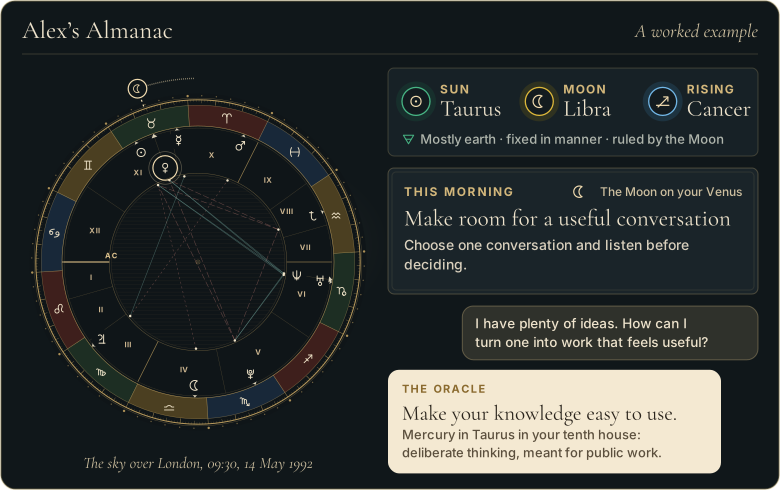
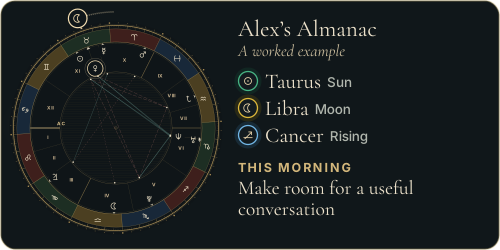
Walk through Alex’s whole example first
 The Road of AgesSee the turning points of your whole life, from your birth date
See your road's shape
The Road of AgesSee the turning points of your whole life, from your birth date
See your road's shape
Prefer to explore first?
 The Road of AgesThe turning points of your whole life, from your own chart
Walk my road
The Road of AgesThe turning points of your whole life, from your own chart
Walk my road
Free, by email
Your daily Almanac letter
One short letter at 7 each morning: the day’s theme read for your own chart, and one thing to do with it.
The zenith is a local direction
In everyday language, zenith can mean a peak or highest stage. In positional astronomy it has a precise geometric meaning: the point directly overhead. It is defined by the observer’s local vertical, not by a permanent star or fixed celestial coordinate. Two people at different places have different zeniths at the same instant.
As Earth rotates, different celestial coordinates pass across an observer’s meridian and near the zenith. If the observer moves, even without waiting, the vertical changes relative to the stars. This is why a sky chart must know location and time to place the zenith correctly.
A one-minute story
The Wandering Stars
How the moving planets were watched, named and found, and what a transit is.

Altitude and zenith distance
The astronomical horizon is the great circle 90 degrees from the zenith. Altitude is measured from that horizon: 0 degrees at the horizon and 90 degrees at the zenith. Zenith distance measures the same vertical circle from the opposite end, beginning at 0 degrees overhead. Their sum is therefore 90 degrees.
| Object altitude | Zenith distance | Interpretation |
|---|---|---|
| 90° | 0° | At the zenith |
| 68° | 22° | High in the sky, 22 degrees from overhead |
| 45° | 45° | Halfway in angular altitude from horizon to zenith |
| 10° | 80° | Low above the horizon |
| 0° | 90° | On the astronomical horizon |
Astronomical, geodetic, and geocentric zenith
For ordinary observing, the astronomical zenith follows the local plumb-line direction opposite gravity. Precision geodesy distinguishes this from the geodetic zenith, which is normal to a chosen reference ellipsoid approximating Earth’s shape, and the geocentric zenith, which extends radially from Earth’s center through the observer.
Earth is not a perfect sphere, mass is unevenly distributed, and the physical plumb line can deviate slightly from an ellipsoid normal. The difference is tiny for naked-eye skywatching but important in surveying, reference systems, and high-precision astrometry. A rigorous source should therefore state which vertical is intended.
Zenith is not the same as culmination
A star culminates when it crosses the observer’s meridian. At upper culmination it normally reaches its greatest altitude for that daily path, but it passes through the zenith only under a special condition: its declination must match the observer’s latitude closely enough for the paths to coincide. Most objects culminate north or south of the zenith.
The Sun can pass through the zenith only within the tropics, between approximately 23.4 degrees north and 23.4 degrees south latitude. Outside that zone, even the highest midday Sun remains displaced toward the equator. “The Sun is overhead” is therefore often an informal expression rather than an exact astronomical statement.
Why astronomers prefer targets near the zenith

Light from a high-altitude object travels through less of Earth’s atmosphere than light arriving near the horizon. Near the horizon, a longer path increases extinction, color distortion, turbulence, haze, and the effects of light pollution. Observing a target near culmination often gives sharper, brighter, and steadier views because that is when it is highest, even when it never reaches the exact zenith.
The exact zenith can be awkward for some telescope mounts, and alt-azimuth instruments may encounter rapid tracking motion or a “zenith blind spot.” Practical planning therefore seeks a comfortably high altitude, not necessarily zero zenith distance.
Worked uses
- A planet at 73 degrees altitude has a zenith distance of 17 degrees.
- A star crossing the meridian at 52 degrees altitude is culminating, but it remains 38 degrees from the zenith.
- If a sky map shows an object directly overhead, look upward rather than toward north or south; azimuth becomes indeterminate at the exact zenith.
- The nadir is 180 degrees from the zenith and lies beneath the observer, hidden by Earth.
Sources and editorial method
Research and editorial references used for this page include:
- U.S. Naval Observatory: Astronomical Almanac Glossary - Authoritative definitions of zenith, astronomical zenith, geocentric and geodetic zenith, altitude, and zenith distance.
- NASA Science: Skywatching FAQ - Practical NASA context for observing the local sky, seasonal visibility, and object position.
These references support the factual, historical, textual, or interpretive claims on this page. Interpretive traditions are identified as such, and factual claims are kept separate from symbolic claims.
Related reading
Identify the point overhead
A definition tells you what it is; your own birth chart tells you what it means for you. The Oracle casts your real chart and answers for your love, your work, and your year ahead, in conversation. It opens with the 7-day Seeker trial.
Speak with the OracleMore in Astronomy & Skywatching
- Astronomical Opposition
- Celestial Pole
- Exit Pupil
- Irregular Galaxy
- Objective Lens
- Position Angle
- Right Ascension Hour
- Star Hopping
From the reference page to your own chart
Every word here
is in your own chart.
- A personal reading about love, work or purpose, written from your chart
- A practical next step to consider
- It opens with 7 days free, with the AI Oracle and daily guidance
$0 today, then $12/month after 7 days. Cancel anytime.
Common questions
Is the North Star at the zenith?
Only for an observer extremely near the North Pole. Elsewhere Polaris’s altitude is approximately the observer’s north latitude, not 90 degrees.
Can a star stay at the zenith?
No ordinary star remains there. Earth’s rotation carries celestial objects across the local sky, and only an instantaneous crossing is possible.
What is the zenith distance formula?
Zenith distance z equals 90 degrees minus altitude h: z = 90° − h. The relationship uses the astronomical horizon and local vertical.
Does the Sun reach the zenith everywhere?
No. Exact overhead Sun passages occur only within the tropics. Locations outside the tropics never have the Sun at 90 degrees altitude.
Free, by email
The Almanac, in your inbox at 7
One short letter at 7 each morning: the day’s theme read for your own chart, and one thing to do with it.
