
Demonology and grimoire history
Valac
Direct answer
In the surviving Goetic tradition, Valac is a named spirit described in a short catalog entry rather than a figure with a developed biography. Claims about his motives, personality, relationships, or modern cinematic appearance usually come from later invention, not the early source.
Valac is the sixty-second spirit in the usual printed ordering of the Ars Goetia. The text calls him a president and associates him with hidden treasure, serpents, and an unusual childlike image riding a two-headed dragon.
$0 today, then $12/month after 7 days. Cancel anytime.
Quick facts
| Question | Historical answer |
|---|---|
| Where does Valac appear? | In the Ars Goetia, the first book of the compilation commonly called the Lemegeton or Lesser Key of Solomon. |
| What rank is given? | President, commanding thirty-eight legions in the common English edition. |
| What is the traditional image? | A small or childlike figure with angelic wings, riding a two-headed dragon. |
| What offices are attributed? | Giving answers about hidden treasure and revealing or controlling serpents. |
What does your own chart say about you?
Choose love, work or purpose. Your reading is written from your chart. Your reading uses your own birth details.
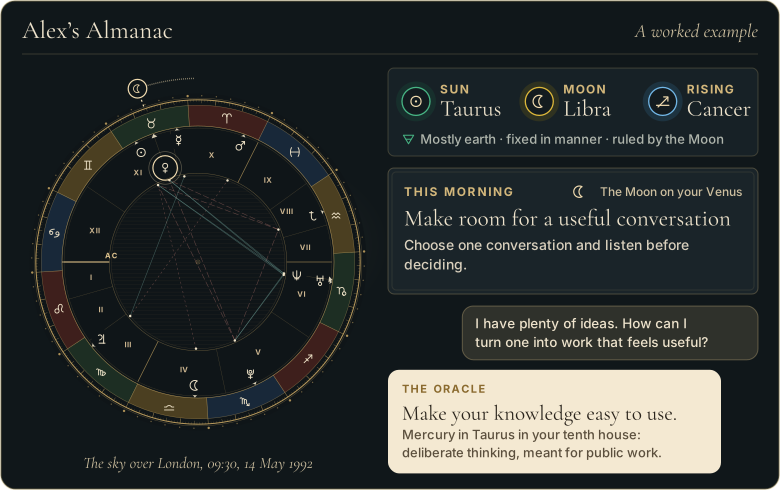
Walk through Alex’s whole example first
 The Road of AgesSee the turning points of your whole life, from your birth date
See your road's shape
The Road of AgesSee the turning points of your whole life, from your birth date
See your road's shape
Prefer to explore first?
 The Road of AgesThe turning points of your whole life, from your own chart
Walk my road
The Road of AgesThe turning points of your whole life, from your own chart
Walk my road
Free, by email
Your daily Almanac letter
One short letter at 7 each morning: the day’s theme read for your own chart, and one thing to do with it.
What the Ars Goetia actually says
Valac receives only a compact notice in the Ars Goetia. Depending on the transcription, the name appears as Valac, Volac, Valak, Ualac, or Valu. Such variation is normal in handwritten occult catalogs: a copyist may mistake one letter for another, a printer may normalize a spelling, and translators may choose different ways to represent the same form. The variants do not establish separate spirits unless a particular source explicitly treats them that way.
The entry identifies Valac as a mighty president and describes a child with angel wings mounted on a two-headed dragon. It credits the spirit with truthful answers about concealed treasure and with revealing serpents to the practitioner without force or injury. The familiar edition assigns thirty-eight legions. That is nearly the whole early textual dossier; elaborate psychological profiles found online should therefore be labeled as contemporary interpretation rather than manuscript fact.
How to read the image and attributed offices
The child, wings, dragon, treasure, and serpents belong to the symbolic vocabulary of a grimoire catalog. They need not combine into one fixed allegory. A historian can compare the imagery with Christian demonology, treasure-seeking magic, medieval bestiaries, and authority over dangerous animals without claiming that any single comparison proves the author intended it. The two-headed mount, in particular, invites interpretation but is not explained by the entry itself.
Hidden treasure was a practical concern in European magical literature, where buried wealth could be imagined as guarded, enchanted, or known to spirits. Serpents carried many meanings, from danger and cunning to healing and secret knowledge. Valac’s listed offices connect those themes, yet the source does not say that he is a universal patron of money, reptiles, childhood, or dragons. Turning a terse office list into a broad portfolio creates a modern mythology rather than recovering an old one.
Manuscripts, editions, and name variants
The Lemegeton survives through early modern manuscripts rather than one authorial master copy. Modern readers often encounter the 1904 edition prepared by S. L. MacGregor Mathers and Aleister Crowley, but that edition is only one point in a longer transmission history. British Library manuscripts such as Sloane MS 3825 and related copies allow scholars to compare wording, sequence, seals, and spelling. Catalog metadata is often more reliable than unsourced claims about a supposed ancient origin.
The work is traditionally attributed to Solomon, but historians do not treat that attribution as evidence that the biblical king wrote it. Its compilation belongs to a much later European ritual-magic environment. Likewise, the title “president” reflects the ranked political vocabulary used throughout the spirit list. It does not document an independent ancient cult or prove a continuous tradition centered on Valac before the grimoire record.
Separating the historical figure from modern horror
Recent horror films and online fiction have made the spelling Valak widely recognizable, often presenting a demonic nun or an antagonist with a detailed personal agenda. That characterization is not the child-on-a-dragon image in the Ars Goetia. A work of fiction may borrow a name while replacing nearly every historical attribute. It is useful to ask four questions: which text is being cited, how early is it, what does it literally say, and which details first appear in entertainment or social media?
Studying Valac need not involve attempting contact, testing a seal, or following ritual instructions. Historical inquiry can stay with editions, manuscript descriptions, iconography, translation choices, and reception. Anyone distressed by fears of supernatural attack should step away from alarming material and seek grounded help from a trusted person or qualified health professional; a catalog entry cannot diagnose the cause of frightening experiences.
Sources and editorial method
Research and editorial references used for this page include:
- Project Gutenberg: The Lesser Key of Solomon - Searchable public-domain edition containing the Ars Goetia catalog and the Valac entry.
- British Library: Sloane MS 3825 catalog record - Institutional manuscript record for an important Lemegeton witness.
These references support the factual, historical, textual, or interpretive claims on this page. Interpretive traditions are identified as such, and factual claims are kept separate from symbolic claims.
Related reading
Return to the source text
A definition tells you what it is; your own birth chart tells you what it means for you. The Oracle casts your real chart and answers for your love, your work, and your year ahead, in conversation. It opens with the 7-day Seeker trial.
Speak with the OracleThe Cosmic Codex offers a reflective map of your year, written from your chart, never a prediction. Open the Cosmic Codex
More in Demons & Fallen Beings
From the reference page to your own chart
Every word here
is in your own chart.
- A personal reading about love, work or purpose, written from your chart
- A practical next step to consider
- It opens with 7 days free, with the AI Oracle and daily guidance
$0 today, then $12/month after 7 days. Cancel anytime.
Common questions
Is Valac the demon nun from modern films?
No. The films use a similar name, but their nun imagery and narrative are modern fiction. The Goetic description is a winged child riding a two-headed dragon.
Are Valac, Volac, and Ualac different beings?
They are generally treated as spelling or transcription variants of the same catalog entry. A claim that they are separate needs evidence from a source that distinguishes them.
Does the historical text give a ritual for summoning Valac?
The wider grimoire contains ritual material, but a responsible reference entry does not reproduce operational instructions. Valac’s individual notice is chiefly a rank, image, and list of attributed offices.
Free, by email
The Almanac, in your inbox at 7
One short letter at 7 each morning: the day’s theme read for your own chart, and one thing to do with it.
