Runes and modern design
Runic Circle
Direct answer
Identify the rune row, language, date, object, reading direction, and inscription before assigning meaning. A ring of Elder Futhark characters sold as an ancient protective seal may be a recent composition even though the individual rune forms are historically derived.
“Runic circle” is not one standard historical artifact. It can mean runes arranged around a modern design, a circular inscription on an object, a rune-based calendar diagram, or a contemporary symbolic layout inspired by Germanic alphabets.
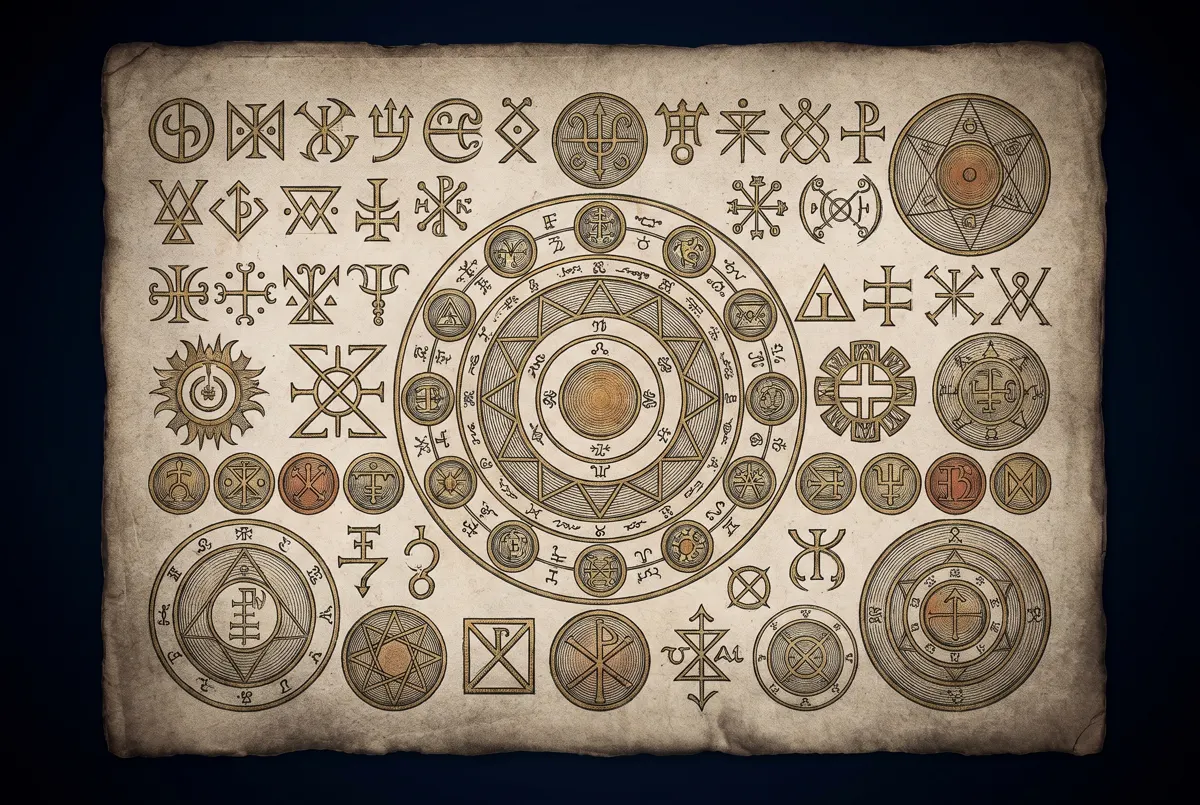
Runic Circle means a circular arrangement of runes used in modern symbolic, decorative, or esoteric contexts.
A conceptual orientation, not an exact historical reproduction of every mark or seal.Quick facts
| Question | What to check |
|---|---|
| Which rune row? | Elder Futhark, Younger Futhark, Anglo-Saxon futhorc, medieval runes, or invented characters. |
| Is the circle historical? | Look for provenance, excavation or collection record, material dating, and scholarly reading. |
| Does order matter? | Yes. Direction, separators, repeated signs, bind-runes, and damaged areas affect transcription. |
| Is it a calendar? | Some rune calendars use circular or staff layouts, but they require their own calendrical conventions. |
The Instruments
Ten readings, worked out from your own birth chart
An instrument is a reading this house works out for you. Give your birth date, time and place once, and each one reads today’s real sky against the chart you were born under. Eight are personal; two are calendars anyone can open. A free account opens one instrument a day. The plans open every instrument, every day.
- Natal Chart Every planet, house and aspect in your chart
- Active Transits Where the planets are now, read against your chart
- Daily Counsel What to pursue today, and what to leave alone
- Personal Timing Your best days to decide, weeks ahead
- Fellowship Your chart and another, read side by side
- Theme of the Day The one thing today is asking of you
- Sacred Numbers Your life path, your cycles, your name in numbers
- Aeolian Harmonics Classical music chosen to match your chart
- Mercury Retrograde Every Mercury retrograde this year, with its dates Open to all
- Void-of-Course Moon When the Moon is between signs, hour by hour Open to all
Runes were writing systems before they were symbols
Runic alphabets recorded names, ownership, memorial texts, messages, makers, prayers, and occasional magical formulas across different Germanic languages and periods. Elder Futhark is not interchangeable with Viking Age Younger Futhark, and medieval runes continued evolving after Christianization. A circular arrangement does not change that first task: transcribe the signs as writing. Modern charts that assign one English keyword to each rune may obscure phonetic value, variant forms, linguistic context, and the centuries separating one rune row from another.
What historical circular rune arrangements may be
Runes can follow the rim of a brooch, amulet, stone, bowl, or other curved surface because the object invites circular placement. A rune calendar may encode recurring weeks, feast days, lunar cycles, or golden numbers on a staff, booklet, or round diagram. These uses are not a single “runic circle tradition.” Archaeological context, museum provenance, reading direction, and comparison with parallel inscriptions determine interpretation. Damage or decorative pseudo-runes can make a confident translation impossible, and honest cataloging should preserve that uncertainty.
Modern rune wheels, bind-runes, and protective claims
Contemporary artists and practitioners arrange complete futharks around wheels, combine signs into radial bind-runes, or add circles to compass-like Icelandic magical staves. These can be legitimate modern creative or religious expressions, but they should not be advertised automatically as Viking artifacts. Icelandic galdrastafir belong largely to a much later manuscript environment and are not simply “runes.” A product claim such as “ancient Norse protection circle” needs a dated source showing the same composition, not merely historically shaped letters placed in a new layout.
A reliable way to analyze a runic circle
Photograph the full object and scale, then copy each sign without silently correcting it. Mark breaks, uncertain strokes, separators, and possible rotations. Test several reading starts only when the artifact gives no clear beginning. Compare forms with a period-appropriate corpus and consult a runologist for valuable or contested material. Symbolic reflection can follow, but it should be labeled contemporary. This page does not provide spell-casting instructions, and no design can guarantee protection; use physical security, medical care, and legal help for real-world risks.
Sources and editorial method
Research and editorial references used for this page include:
- National Museum of Denmark: Runes - Museum introduction to runes as historical writing in Viking Age Denmark.
- British Museum: Rune collection search - Provenanced artifacts and catalog descriptions for comparing real inscriptions and object types.
These references support the factual, historical, textual, or interpretive claims on this page. Interpretive traditions are identified as such, and factual claims are kept separate from symbolic claims.
Related reading
Read the symbol with context
Runic Circle in a book is one thing; Runic Circle in your own birth chart is your life. The Oracle casts your real chart and tells you what it means for your love, your work, and your year ahead, in conversation, free.
Speak with the OracleYour year, written once from your chart alone: the Cosmic Codex reads the whole of it, month by month. Open the Cosmic Codex
More in Sigils, Seals & Symbols
Common questions
Did Vikings use a standard runic circle?
No single universal Viking runic circle is documented. Circular inscriptions existed, while many familiar rune wheels are modern arrangements.
Is Vegvísir a runic circle?
Vegvísir is an Icelandic magical stave documented in a much later manuscript context. Calling it Viking or simply runic is historically misleading.
Can every circular rune inscription be translated?
No. Pseudo-runes, damage, unknown language, stylization, missing separators, and modern invention can prevent a secure reading.