
Ancient Mesopotamian religion
Pazuzu
Direct answer
Ancient Pazuzu objects combine danger and protection: inscriptions identify him as a powerful wind demon, while heads, pendants, and plaques could be used apotropaically to repel another feared being. He was not simply the Christian Devil.
Pazuzu is a first-millennium BCE Mesopotamian demonic figure associated with destructive winds whose frightening image was also used protectively, especially against Lamashtu.
$0 today, then $12/month after 7 days. Cancel anytime.
Quick facts
| Question | Direct answer |
|---|---|
| Main period | Especially Neo-Assyrian and Neo-Babylonian contexts in the first millennium BCE. |
| Typical features | Canine or leonine face, bulging eyes, horns, wings, talons, scaled body, and scorpion-like elements. |
| Associated threat | Harmful winds and their destructive effects. |
| Protective role | His image could be deployed against Lamashtu, feared in relation to pregnancy and infants. |
What does your own chart say about you?
Choose love, work or purpose. Your reading is written from your chart. Your reading uses your own birth details.
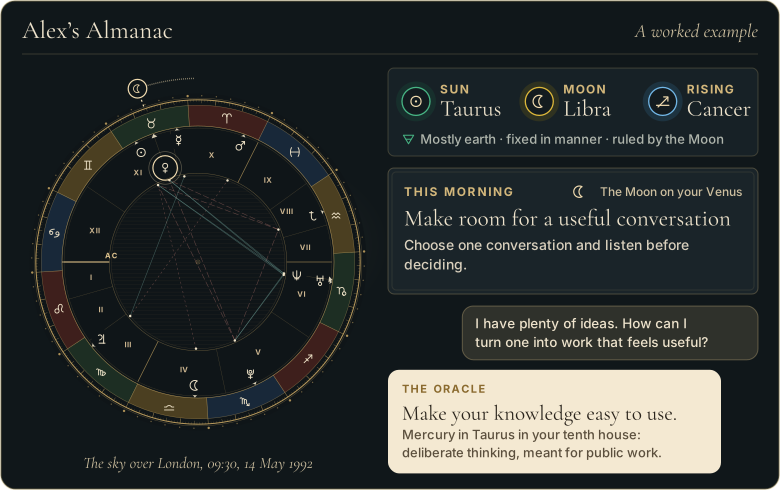
Walk through Alex’s whole example first
 The Road of AgesSee the turning points of your whole life, from your birth date
See your road's shape
The Road of AgesSee the turning points of your whole life, from your birth date
See your road's shape
Prefer to explore first?
 The Road of AgesThe turning points of your whole life, from your own chart
Walk my road
The Road of AgesThe turning points of your whole life, from your own chart
Walk my road
Free, by email
Your daily Almanac letter
One short letter at 7 each morning: the day’s theme read for your own chart, and one thing to do with it.
A demon of destructive winds
Pazuzu appears in Mesopotamian texts and objects during the first millennium BCE, particularly the Assyrian period. Inscriptions identify him as a son of Hanpa and king of harmful wind demons. His association with winds from mountainous or western directions connects him with illness, crop damage, and hostile environmental forces in ancient explanatory systems. Calling him a “god” or “demon” can each oversimplify Mesopotamian categories, but “wind demon” captures the common scholarly description. He is not derived from medieval European grimoires and should not be inserted into the Ars Goetia’s seventy-two-spirit catalogue.
How ancient artists represented Pazuzu
Surviving heads and complete figures assemble threatening animal and human features: a snarling canine or leonine face, prominent eyes, horns, wings, bird talons, a scaled body, and often a scorpion tail. The British Museum’s yellow limestone head, dated roughly 800 to 600 BCE, bears cuneiform identifying Pazuzu. Small heads were pierced or fitted for suspension, showing that the image could be worn or attached. The mixed body is not random fantasy; it makes danger visible through a concentrated vocabulary of predators, venom, flight, and abnormality recognizable within Mesopotamian material culture.
Why a dangerous figure could protect
Ancient apotropaic practice often confronted one threat with another powerful image. Pazuzu was especially invoked against Lamashtu, a female demonic figure blamed for dangers surrounding pregnancy, childbirth, and infants. Plaques can show Lamashtu being driven away while Pazuzu’s head appears above the scene. This does not make Pazuzu benevolent in a simple modern sense. His value lay in the capacity of a feared power to repel a competing danger. The dual role helps explain why isolated labels such as “evil god” fail to describe how the objects functioned in households and ritual medicine.
From ancient amulet to The Exorcist
William Peter Blatty’s novel The Exorcist and its film adaptation transformed Pazuzu into a globally recognized name for a possessing demon. That fictional role differs substantially from ancient Mesopotamian evidence and has encouraged false claims that any Pazuzu object was designed for possession. Museums instead document amulets, plaques, inscriptions, and protective contexts. Modern horror is a legitimate chapter in the figure’s reception, but it should be labeled as twentieth-century reinvention. Claims that a replica automatically invites harm are not supported by archaeology, just as fiction cannot establish the supernatural efficacy of an ancient object.
How to evaluate claims about Pazuzu
Claims about Pazuzu should be tied to a dated text, object, author, or community rather than presented as timeless fact. Names and images often accumulate new meanings as they move between languages, religions, literature, art, and popular culture. Etymology does not by itself determine later symbolism, and a resemblance between traditions is not proof that one secretly derived from the other. A useful interpretation identifies the historical layer being discussed, distinguishes evidence from speculation, and acknowledges competing readings. Personal reflection may begin with a cultural symbol, but it should not erase the people, texts, or circumstances that gave that symbol its documented forms.
Sources and editorial method
Research and editorial references used for this page include:
- British Museum: Limestone head of Pazuzu - Museum catalogue record with dating, inscription, imagery, and curatorial context.
- Metropolitan Museum of Art: Pendant with the head of Pazuzu - Museum object record explaining Pazuzu imagery and protective use against Lamashtu.
These references support the factual, historical, textual, or interpretive claims on this page. Interpretive traditions are identified as such, and factual claims are kept separate from symbolic claims.
Related reading
Read Pazuzu historically
A definition tells you what it is; your own birth chart tells you what it means for you. The Oracle casts your real chart and answers for your love, your work, and your year ahead, in conversation. It opens with the 7-day Seeker trial.
Speak with the OracleThe Cosmic Codex offers a reflective map of your year, written from your chart, never a prediction. Open the Cosmic Codex
More in Demons & Fallen Beings
From the reference page to your own chart
Every word here
is in your own chart.
- A personal reading about love, work or purpose, written from your chart
- A practical next step to consider
- It opens with 7 days free, with the AI Oracle and daily guidance
$0 today, then $12/month after 7 days. Cancel anytime.
Common questions
Was Pazuzu considered purely evil?
No. He embodied dangerous winds but his image was also used apotropaically against other threats, especially Lamashtu.
Is Pazuzu in the Ars Goetia?
No. Pazuzu belongs to ancient Mesopotamian traditions, not the early modern Goetic catalogue.
Did The Exorcist accurately portray him?
It created an influential modern horror interpretation rather than reproducing his ancient role.
Free, by email
The Almanac, in your inbox at 7
One short letter at 7 each morning: the day’s theme read for your own chart, and one thing to do with it.
