
Demonology and grimoire history
Murmur
Direct answer
The early record is a brief and difficult grimoire notice. It does not supply a full biography or establish that communication with deceased people occurred. Modern claims about necromancy, personality, offerings, relationships, or a fixed gender must be identified as later interpretation.
Murmur is the fifty-fourth spirit in the common Ars Goetia ordering. The catalog assigns both duke and earl ranks, describes a warrior riding a griffin and preceded by trumpets, and attributes philosophy and constraint of the souls of the dead.
$0 today, then $12/month after 7 days. Cancel anytime.
Quick facts
| Feature | Common textual description |
|---|---|
| Catalog number | Fifty-four in the widely read ordering. |
| Ranks | Great duke and earl, commonly assigned thirty legions. |
| Image | A warrior riding a griffin or vulture-like creature, wearing a ducal crown, with ministers sounding trumpets. |
| Offices | Teaches philosophy and compels souls of the deceased to appear and answer questions. |

What does your own chart say about you?
Choose love, work or purpose. Your reading is written from your chart. Your reading uses your own birth details.
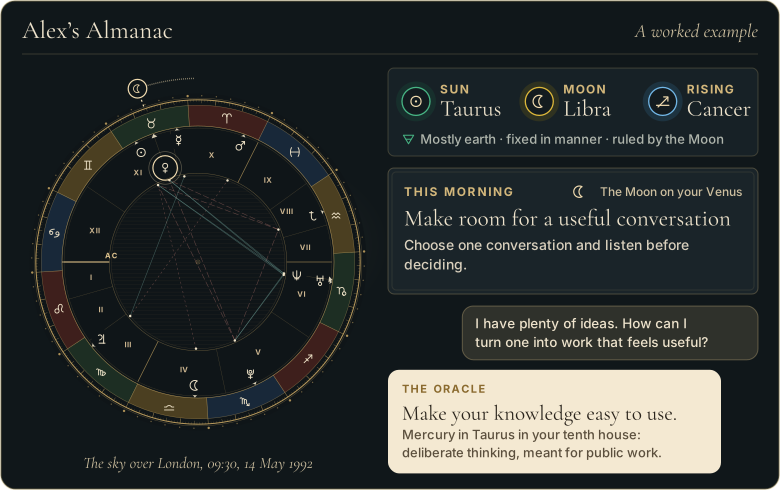
Walk through Alex’s whole example first
 The Road of AgesSee the turning points of your whole life, from your birth date
See your road's shape
The Road of AgesSee the turning points of your whole life, from your birth date
See your road's shape
Prefer to explore first?
 The Road of AgesThe turning points of your whole life, from your own chart
Walk my road
The Road of AgesThe turning points of your whole life, from your own chart
Walk my road
Free, by email
Your daily Almanac letter
One short letter at 7 each morning: the day’s theme read for your own chart, and one thing to do with it.
The catalog entry and its unstable details
Murmur’s entry combines martial procession, noble rank, learned teaching, and power over the dead. Editions differ over whether the mount is a griffin, vulture, or related composite, illustrating how handwriting and translation reshape iconography. Trumpets announce the arrival, and a crown marks rank. The assigned office concerning deceased souls is written from within the grimoire’s ritual worldview. A historian can report the claim and compare vocabulary without assuming that the described appearances happened or that the text accurately represents the dead.
Murmur, Murmus, and the sound of a name
Variants such as Murmur and Murmus circulate. The familiar English word “murmur” encourages associations with whispering voices, and Latin murmur can refer to a murmur, mutter, or low sound. That possible wordplay is relevant but does not prove a complete origin story. The catalog’s loud trumpets actually complicate a purely whisper-based interpretation. Etymology should follow dated forms and language history, while claims that every unexplained murmur signals this figure should be rejected as fearful pattern-making rather than textual analysis.
Philosophy and the souls of the dead
The juxtaposition can be read within older conceptions of philosophy as knowledge of divine, natural, and metaphysical matters, including questions of soul and death. It should not be converted into evidence that Murmur authored teachings or that a séance message is philosophically authoritative. Purported statements from the dead can exploit grief and may be shaped by prior information, cueing, memory, or invention. No attributed message should determine inheritance, treatment, guilt, or consent for a living person without ordinary documentation.
Textual study without necromantic instruction
Compare manuscript witnesses, the 1904 English edition, seal variants, and later artistic reception. Record exactly where a claim first appears; fiction and contemporary spirituality can be studied as new layers without being mislabeled ancient. This reference provides no conjurations, methods for coercing the dead, or ritual directions. If grief makes alleged messages especially compelling, consult supportive people who will not demand money or secrecy. Hearing voices or feeling commanded can also merit prompt clinical care, particularly when sleep, safety, or daily function is affected.
Sources and editorial method
Research and editorial references used for this page include:
- Project Gutenberg: The Lesser Key of Solomon - Searchable public-domain edition containing the Murmur entry.
- British Library: Sloane MS 3825 catalog record - Institutional manuscript context for the Lemegeton tradition.
These references support the factual, historical, textual, or interpretive claims on this page. Interpretive traditions are identified as such, and factual claims are kept separate from symbolic claims.
Related reading
Honor the dead without control
A definition tells you what it is; your own birth chart tells you what it means for you. The Oracle casts your real chart and answers for your love, your work, and your year ahead, in conversation. It opens with the 7-day Seeker trial.
Speak with the OracleThe Cosmic Codex offers a reflective map of your year, written from your chart, never a prediction. Open the Cosmic Codex
More in Demons & Fallen Beings
From the reference page to your own chart
Every word here
is in your own chart.
- A personal reading about love, work or purpose, written from your chart
- A practical next step to consider
- It opens with 7 days free, with the AI Oracle and daily guidance
$0 today, then $12/month after 7 days. Cancel anytime.
Common questions
Is Murmur named after whispering?
The name resembles Latin and English words for low sound, but the exact etymological history should not be overstated. The entry also features loud ceremonial trumpets.
Is Murmur a duke or an earl?
The familiar text assigns both ranks. Multiple titles occur elsewhere in spirit catalogs and should be preserved rather than forced into one.
Does the Goetia prove that Murmur speaks for dead people?
No. It records an attributed magical office within a grimoire. That is evidence of a historical claim, not verification of spirit communication.
Free, by email
The Almanac, in your inbox at 7
One short letter at 7 each morning: the day’s theme read for your own chart, and one thing to do with it.
