

Contemporary spiritual-warfare language
Monitoring Spirit
Direct answer
The exact phrase does not occur in the Bible. Contemporary speakers combine biblical language about watchfulness, accusation, divination, or spiritual conflict into a later interpretive concept, so it should not be presented as a direct scriptural diagnosis.
“Monitoring spirit” is a modern spiritual-warfare phrase for an alleged hostile spirit believed to watch a person and report or exploit their activity; it is not a named biblical category.
$0 today, then $12/month after 7 days. Cancel anytime.
Quick facts
| Question | Direct answer |
|---|---|
| Is the phrase in Scripture? | No. English Bible translations do not name a class called monitoring spirits. |
| Where is it common? | In some contemporary Pentecostal, charismatic, deliverance, and online spiritual-warfare settings. |
| Does a repeated coincidence prove one? | No. Coincidence, ordinary observation, data tracking, anxiety, and real surveillance need separate evaluation. |
| What if someone is actually watching me? | Document observable conduct, secure devices and accounts, and seek trusted or legal help as appropriate. |

What does your own chart say about you?
Choose love, work or purpose. Your reading is written from your chart. Your reading uses your own birth details.
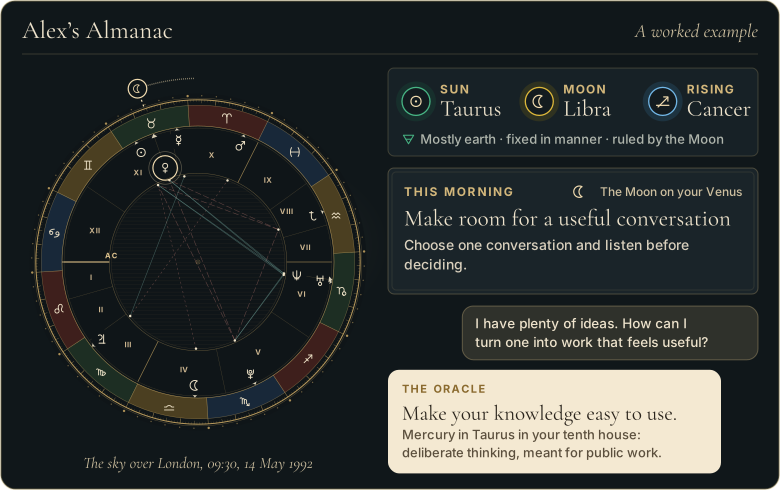
Walk through Alex’s whole example first
 The Road of AgesSee the turning points of your whole life, from your birth date
See your road's shape
The Road of AgesSee the turning points of your whole life, from your birth date
See your road's shape
Prefer to explore first?
 The Road of AgesThe turning points of your whole life, from your own chart
Walk my road
The Road of AgesThe turning points of your whole life, from your own chart
Walk my road
Free, by email
Your daily Almanac letter
One short letter at 7 each morning: the day’s theme read for your own chart, and one thing to do with it.
How the term is used today
A “monitoring spirit” is commonly described in sermons and social-media testimony as an unseen agent that observes a person’s plans, relationships, prayer life, or progress. Accounts may link the idea to dreams of eyes or animals, recurring setbacks, gossip, or the feeling of being watched. These associations are not standardized doctrine. Different speakers place the alleged spirit under witchcraft, familiar spirits, accusation, or demonic surveillance. Because the category expands easily to explain almost any unwanted event, it can become unfalsifiable: absence of evidence is recast as evidence that the watcher is hidden.
What relevant biblical passages actually say
The New Testament uses imagery of vigilance and spiritual struggle, notably the adversary prowling in 1 Peter 5 and the armor of God in Ephesians 6. Other passages condemn divination or describe accusers and unclean spirits. None supplies the modern label, a detection checklist, or a teaching that ordinary animals and acquaintances are covert cameras for demons. Exegesis should begin with each passage’s audience, literary purpose, and surrounding argument. Combining isolated verses into a detailed invisible surveillance system is a theological construction, not a quotation from the text.
Separate spiritual language from observable surveillance
Modern life includes real forms of monitoring: compromised passwords, location sharing, advertising trackers, workplace systems, stalking, abusive partners, and gossip networks. Check device sessions, privacy permissions, financial alerts, locks, and documented communications before interpreting a pattern spiritually. Repeated content online may result from recommendation algorithms, not secret knowledge. If a person is threatening, following, impersonating, or accessing accounts, preserve evidence and contact relevant safeguarding, platform, workplace, or legal resources. Practical action is compatible with prayer; it should not be delayed while searching for an invisible agent.
Responding when the fear itself becomes overwhelming
Feeling constantly watched can be terrifying. Sleep deprivation, trauma, anxiety, medication effects, substance use, and several health conditions can intensify pattern detection and threat perception. A compassionate response neither mocks the person nor confirms an unverified supernatural explanation. Ask what has been directly observed, reduce immediate risk, involve a trusted person, and seek qualified medical or mental-health care when fear disrupts sleep, work, eating, or relationships. Urgent danger or thoughts of harming oneself or someone else require immediate local emergency support. No deliverance seller should exploit fear through secrecy, escalating fees, or instructions to isolate.
Reading Monitoring Spirit with textual care
A sound account of Monitoring Spirit distinguishes the wording of the relevant ancient text from later interpretation, popular preaching, fiction, and internet folklore. Translation choices, genre, historical setting, and differences among Jewish and Christian canons can materially change what a passage appears to say. The text should be read in context rather than converted into a code for identifying strangers, predicting a date, or diagnosing an unseen attack. Churches and scholars may disagree in good faith, so major interpretations should be named rather than presented as the only possible reading. Spiritual concern does not cancel ordinary evidence: immediate danger, abuse, illness, or severe distress calls for qualified help and concrete safeguarding.
Sources and editorial method
Research and editorial references used for this page include:
- Bible Gateway: Ephesians 6:10-20 - Primary text for the armor-of-God passage often cited in spiritual-warfare teaching.
- Bible Gateway: 1 Peter 5:6-11 - Primary text for vigilance imagery, read in its literary context.
These references support the factual, historical, textual, or interpretive claims on this page. Interpretive traditions are identified as such, and factual claims are kept separate from symbolic claims.
Related reading
Ground surveillance fear
A definition tells you what it is; your own birth chart tells you what it means for you. The Oracle casts your real chart and answers for your love, your work, and your year ahead, in conversation. It opens with the 7-day Seeker trial.
Speak with the OracleThe Cosmic Codex offers a reflective map of your year, written from your chart, never a prediction. Open the Cosmic Codex
More in Curses & Spiritual Warfare
- Rejecting Occult Fear
- Spirit of Antichrist
- Spirit of Witchcraft
- Witchcraft Attack
- Bloodline Curse
- Cursed Object
- Evil Prayer
- House Oppression
From the reference page to your own chart
Every word here
is in your own chart.
- A personal reading about love, work or purpose, written from your chart
- A practical next step to consider
- It opens with 7 days free, with the AI Oracle and daily guidance
$0 today, then $12/month after 7 days. Cancel anytime.
Common questions
Are monitoring spirits mentioned by name in the Bible?
No. The phrase is a modern interpretive label assembled from broader spiritual-warfare themes.
Does dreaming of an animal prove spiritual surveillance?
No. Dream imagery has many ordinary sources and cannot establish that a person or animal is a supernatural monitor.
Can I take both pastoral and practical steps?
Yes. Trusted pastoral care can accompany account security, documentation, medical care, counseling, and safeguarding.
Free, by email
The Almanac, in your inbox at 7
One short letter at 7 each morning: the day’s theme read for your own chart, and one thing to do with it.
