

Folklore, envy, and protection beliefs
Jealousy Curse
Direct answer
A run of setbacks cannot establish that a jealous person cursed you. Separate the cultural belief from the evidence for a specific event, investigate ordinary causes first, and avoid confronting or naming a supposed culprit without verifiable facts. Urgent health, safety, legal, or financial problems need appropriate professional help.
“Jealousy curse” is a modern umbrella phrase for beliefs that another person’s envy, hostile attention, or deliberate cursing causes misfortune. It often overlaps with the evil eye, but traditions differ on whether harm is intentional, spoken, ritualized, or transmitted by a look.
$0 today, then $12/month after 7 days. Cancel anytime.
Quick facts
| Question | Careful answer |
|---|---|
| Is jealousy itself a curse? | In some traditions envy is believed to transmit harm; in others a curse requires words or deliberate action. |
| Is this identical to the evil eye? | They overlap, but evil-eye beliefs have distinct regional histories, symbols, and theories of intentionality. |
| Do repeated setbacks prove a curse? | No. Clustering, stress, confirmation bias, conflict, illness, and material causes must be considered. |
| What is the safest first response? | Address concrete risks, document facts, obtain medical or practical help, and do not accuse someone on symbolic grounds. |

What does your own chart say about you?
Choose love, work or purpose. Your reading is written from your chart. Your reading uses your own birth details.
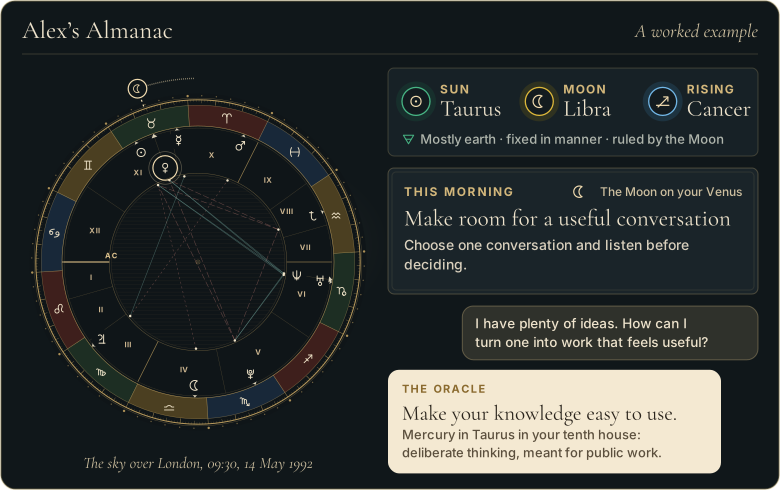
Walk through Alex’s whole example first
 The Road of AgesSee the turning points of your whole life, from your birth date
See your road's shape
The Road of AgesSee the turning points of your whole life, from your birth date
See your road's shape
Prefer to explore first?
 The Road of AgesThe turning points of your whole life, from your own chart
Walk my road
The Road of AgesThe turning points of your whole life, from your own chart
Walk my road
Free, by email
Your daily Almanac letter
One short letter at 7 each morning: the day’s theme read for your own chart, and one thing to do with it.
What people mean by a jealousy curse
The phrase can describe several different ideas: an envious glance that unintentionally harms, malicious speech that “sends” misfortune, a deliberate magical act motivated by rivalry, or a general feeling that success has attracted hostile attention. These should not be treated as one universal doctrine. Mediterranean, Middle Eastern, South Asian, African, Latin American, and European communities have their own terms, protective customs, and explanations. The English label may flatten those differences, so a cultural account should use the community’s own vocabulary when possible.
Why envy becomes a language for misfortune
Beliefs about dangerous envy often arise where praise, display, scarcity, and unequal fortune create social tension. A healthy child, profitable harvest, new possession, romance, or public success can be imagined as especially exposed. Protective etiquette (modest speech, blessing after praise, concealed wealth, or an amulet) may regulate boasting and acknowledge vulnerability. Historians and anthropologists can study those social functions without deciding that envy literally emits a harmful force. The belief itself is real and consequential even when supernatural causation is not established.
How to evaluate a feared curse without escalating it
Write down the specific event, date, known cause, and actual evidence of another person’s conduct. Look for ordinary connections: equipment failure, infection, debt terms, workplace decisions, sleep loss, or ongoing interpersonal abuse. Count uneventful days as well as memorable setbacks. Avoid interpreting vague posts, facial expressions, or coincidental messages as proof. If someone has threatened or harassed you, preserve those concrete communications and seek appropriate support; the actionable issue is the documented behavior, not an untestable supernatural theory.
Grounded care and cultural respect
Non-harmful cultural practices such as prayer, speaking with a trusted elder, or wearing a familiar symbol may offer comfort when they complement rather than replace practical care. Avoid anyone who diagnoses a curse from a photograph, demands secrecy or escalating payments, identifies a loved one as the attacker, or instructs retaliation. Do not ingest unknown substances or delay medical treatment. Persistent fear, sleeplessness, or certainty that strangers are transmitting messages deserves compassionate mental-health support. Respect for folklore and religion is compatible with refusing blame, coercion, dangerous remedies, and false certainty.
Sources and editorial method
Research and editorial references used for this page include:
- The Metropolitan Museum of Art: Amulets and the evil eye - Museum records showing the material and cultural variety of protective objects.
- World Health Organization: Disinformation and public health - Health guidance relevant when supernatural claims risk replacing evidence-based care.
These references support the factual, historical, textual, or interpretive claims on this page. Interpretive traditions are identified as such, and factual claims are kept separate from symbolic claims.
Related reading
Refuse envy-based fear
A definition tells you what it is; your own birth chart tells you what it means for you. The Oracle casts your real chart and answers for your love, your work, and your year ahead, in conversation. It opens with the 7-day Seeker trial.
Speak with the OracleThe Cosmic Codex offers a reflective map of your year, written from your chart, never a prediction. Open the Cosmic Codex
More in Curses & Spiritual Warfare
From the reference page to your own chart
Every word here
is in your own chart.
- A personal reading about love, work or purpose, written from your chart
- A practical next step to consider
- It opens with 7 days free, with the AI Oracle and daily guidance
$0 today, then $12/month after 7 days. Cancel anytime.
Common questions
Can someone curse me just by feeling jealous?
Some traditions say envy can harm without deliberate ritual, while others do not. There is no reliable test proving that another person’s feeling caused a setback.
How is a jealousy curse different from the evil eye?
The evil eye is a family of culturally specific beliefs about harmful gaze or envy. “Jealousy curse” is a looser modern phrase that may also imply speech or deliberate magic.
Should I confront the person I suspect?
Not on the basis of symbolic signs or coincidence. Respond only to observable conduct, prioritize safety, and use mediation, workplace, legal, or health support when the facts warrant it.
Free, by email
The Almanac, in your inbox at 7
One short letter at 7 each morning: the day’s theme read for your own chart, and one thing to do with it.
