
Demonology and grimoire history
Furcas
Direct answer
Furcas’s source entry is a compact grimoire description, not a complete biography. It lists philosophy, astrology, rhetoric, logic, palmistry, and pyromancy among his attributed subjects; claims about his personality, loyalties, offerings, or modern relationships need a later source.
Furcas is the fiftieth spirit in the common Ars Goetia ordering. The catalog calls him a knight, depicts an elderly bearded man riding a pale horse with a sharp weapon, and credits him with teaching several learned and divinatory arts.
$0 today, then $12/month after 7 days. Cancel anytime.
Quick facts
| Question | Historical answer |
|---|---|
| Where does Furcas appear? | In the Ars Goetia, first section of the Lemegeton or Lesser Key of Solomon. |
| What rank is given? | Knight, an uncommon rank within the catalog. |
| What appearance is described? | A cruel-looking old man with long beard and white hair, riding a pale horse and carrying a sharp weapon. |
| What offices are attributed? | Teaching philosophy, astrology, rhetoric, logic, chiromancy or palmistry, and pyromancy. |
What does your own chart say about you?
Choose love, work or purpose. Your reading is written from your chart. Your reading uses your own birth details.
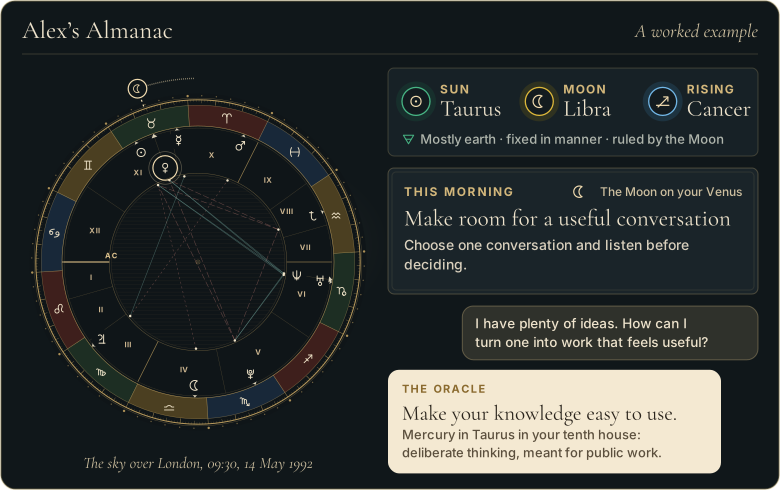
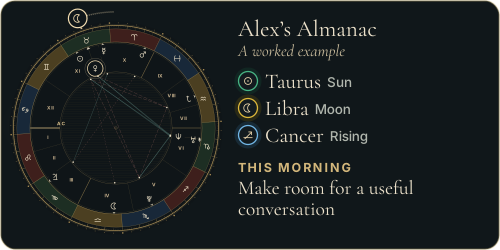
Walk through Alex’s whole example first
 The Road of AgesSee the turning points of your whole life, from your birth date
See your road's shape
The Road of AgesSee the turning points of your whole life, from your birth date
See your road's shape
Prefer to explore first?
 The Road of AgesThe turning points of your whole life, from your own chart
Walk my road
The Road of AgesThe turning points of your whole life, from your own chart
Walk my road
Free, by email
Your daily Almanac letter
One short letter at 7 each morning: the day’s theme read for your own chart, and one thing to do with it.
The Furcas entry in the Ars Goetia
The catalog places Furcas at number fifty and assigns twenty legions in the best-known English edition. Unlike the many dukes, presidents, earls, and kings, he is labeled a knight. His image combines advanced age, mounted status, and a weapon, while his offices are strikingly academic: philosophy, astrology, rhetoric, and logic appear beside two forms of divination. The text does not explain why those subjects belong together or how the image relates to them, leaving later readers substantial interpretive space.
What the attributed “arts” meant historically
Philosophy in an early modern setting could include natural philosophy and metaphysics, not only modern academic philosophy. Astrology was a mathematical and judicial art integrated with medicine and calendars. Rhetoric and logic belonged to formal education. Chiromancy interpreted the hand, while pyromancy sought signs through fire. Listing these subjects presents Furcas as a teacher of hidden and learned disciplines, but it does not validate their predictive claims. Translators should preserve historical terms rather than silently converting them into modern psychology or “energy reading.”
Furcas, Forcas, and similarly named figures
Spelling varies across manuscript copies and later dictionaries, and Furcas can be confused with Foras or Forcas, another Goetic president with partially overlapping teaching offices. A variant spelling is not enough to merge two numbered entries, but neither should every letter change create a new being. Check rank, sequence, image, and office list together. Online genealogies that derive the name confidently from a Latin word or link it to an older deity need linguistic evidence, not resemblance alone.
Historical study and limits of the record
The Lemegeton survives in early modern manuscripts and is pseudonymously connected with Solomon. The 1904 Mathers-Crowley edition made one English form widely available but does not erase variant witnesses. Research can compare transcriptions, seals, spelling, rank systems, and the reception of learned magic without performing a rite. This reference omits conjurations and operational instructions. Fictional portrayals and contemporary devotional accounts should be dated and labeled. If frightening material produces a sense of threat or command, disengage and seek grounded support rather than using a demon catalog to explain distress.
Sources and editorial method
Research and editorial references used for this page include:
- Project Gutenberg: The Lesser Key of Solomon - Searchable public-domain edition containing the Furcas entry.
- British Library: Sloane MS 3825 catalog record - Institutional context for an important Lemegeton manuscript witness.
These references support the factual, historical, textual, or interpretive claims on this page. Interpretive traditions are identified as such, and factual claims are kept separate from symbolic claims.
Related reading
Discipline the search for knowledge
A definition tells you what it is; your own birth chart tells you what it means for you. The Oracle casts your real chart and answers for your love, your work, and your year ahead, in conversation. It opens with the 7-day Seeker trial.
Speak with the OracleThe Cosmic Codex offers a reflective map of your year, written from your chart, never a prediction. Open the Cosmic Codex
More in Demons & Fallen Beings
From the reference page to your own chart
Every word here
is in your own chart.
- A personal reading about love, work or purpose, written from your chart
- A practical next step to consider
- It opens with 7 days free, with the AI Oracle and daily guidance
$0 today, then $12/month after 7 days. Cancel anytime.
Common questions
Is Furcas the same as Foras?
They are usually separate entries in the Ars Goetia, with different ranks and catalog positions, even though spelling and attributed teaching can overlap.
Why is Furcas called a knight?
That is the rank assigned by the catalog. It is unusual among the Goetic political titles, but the text does not provide a theory explaining it.
Does the source call Furcas a philosopher?
It says he teaches philosophy and related arts. That is an attributed office in a grimoire, not evidence of authored philosophical works.
Free, by email
The Almanac, in your inbox at 7
One short letter at 7 each morning: the day’s theme read for your own chart, and one thing to do with it.
